Some films entertain. A rare few transcend entertainment to become something deeper—a cultural touchstone, a philosophical treatise, and a mirror held up to the darkest corners of the human condition. Sidney Lumet’s 12 Angry Men (1957) is one of those rare treasures. It didn’t rely on explosions, special effects, or sweeping landscapes. It relied on something far more powerful: twelve men in a single room, debating the fate of a teenage boy accused of murder.
More than sixty-five years after its release, 12 Angry Men remains one of the most gripping and essential films ever made. It is a masterclass in tension, a searing examination of prejudice and justice, and a stirring reminder of the power of one person’s conscience in the face of overwhelming opposition. It is, quite simply, a perfect film.
The Anatomy of a Trial: One Room, Twelve Lives
The film opens in the suffocating heat of a New York City courtroom. The judge delivers his instructions to the jury, and we are immediately thrust into the deliberation room. The case seems open-and-shut: a 19-year-old boy from the slums is accused of stabbing his abusive father to death. The evidence appears damning. An eyewitness claims to have seen the murder through a passing elevated train. A second witness heard the boy yell, “I’m going to kill you,” followed by the sound of a body hitting the floor. The murder weapon, a switchblade, is supposedly unique, and the boy claimed he lost it. The prosecution has built a seemingly airtight case.
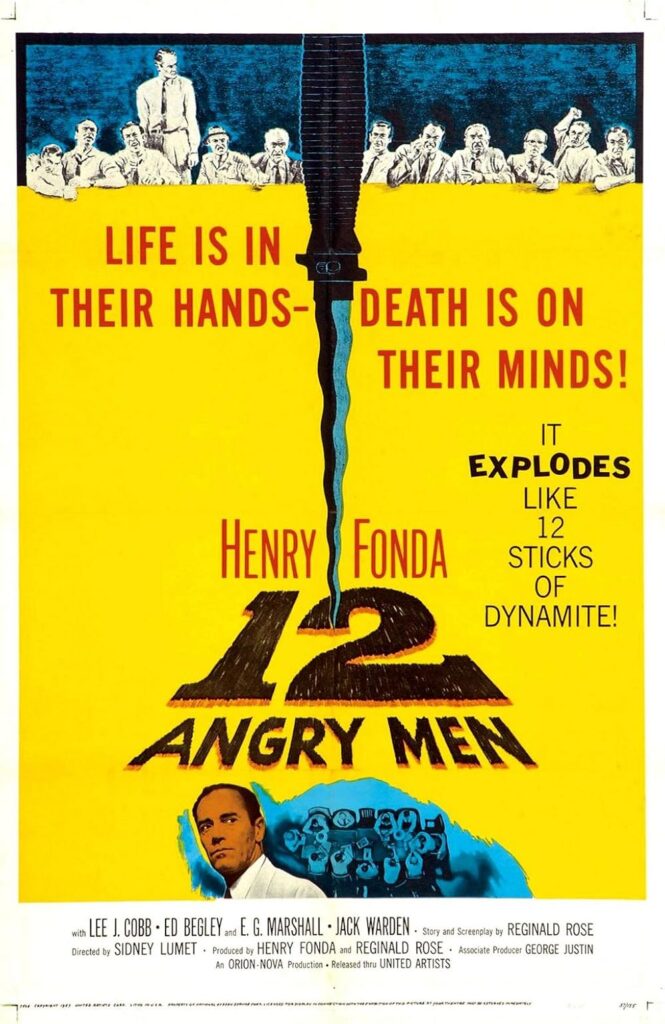
The first vote is taken. Eleven men vote guilty. Only one man, Juror 8 (Henry Fonda), votes not guilty. He doesn’t claim the boy is innocent. He merely says, “I don’t know. It’s not easy for me to raise my hand and send a boy off to die without talking about it first.” This simple act of doubt is the spark that ignites the film’s entire narrative.
What follows is a tense, riveting, and emotionally charged debate that unfolds in real time. As the men argue, we learn not only about the case but also about each juror’s prejudices, fears, and life experiences. The room becomes a microcosm of society, and the deliberation becomes a crucible in which truth, justice, and human decency are tested to their breaking point.
A Masterclass in Ensemble Acting
The cast of 12 Angry Men is a who’s who of character actors, and each performance is a gem. Henry Fonda, as Juror 8, is the moral center of the film. He is calm, rational, and quietly relentless. He doesn’t shout or bully; he simply asks questions and refuses to be rushed. Fonda’s performance is a study in quiet conviction, and his unwavering commitment to due process is the film’s beating heart.
But the true revelation is Lee J. Cobb as Juror 3, the film’s primary antagonist. Cobb delivers a volcanic performance as a man consumed by rage and personal trauma. His hatred of the defendant is rooted in his own painful relationship with his estranged son. His journey from belligerent certainty to shattered admission—”I’m all alone, you bastards!”—is one of the most powerful moments in cinema history.
The supporting cast is equally brilliant. Ed Begley as Juror 10 is a bigot who spews venomous prejudice against the boy’s ethnicity. Jack Warden as Juror 7 is a bored, cynical salesman who just wants to get to a baseball game. Martin Balsam as Juror 1, the foreman, tries desperately to maintain order. John Fiedler as Juror 2 is a timid, easily swayed man. Jack Klugman as Juror 5 grew up in the slums and has firsthand knowledge of switchblades. George Voskovec as Juror 11 is a European immigrant who understands the preciousness of the American justice system. Edward Binns as Juror 6 is a working-class man who respects the process but struggles with the finer points of the case. Robert Webber as Juror 12 is a slick advertising executive. And Joseph Sweeney as Juror 9 is an elderly, perceptive man who is the first to side with Juror 8.
Each actor brings a distinct personality, background, and prejudice to the table, creating a rich tapestry of human frailty and decency. The chemistry among them is electric, and the film’s power comes from watching these very different men clash, compromise, and ultimately come to a decision that will determine a young man’s life.
The Burden of Proof: Themes of Justice, Prejudice, and Reason
12 Angry Men is far more than a courtroom drama; it is a profound exploration of fundamental democratic ideals. The film’s central theme is the concept of reasonable doubt. Juror 8 repeatedly emphasizes that the prosecution must prove its case beyond a reasonable doubt, and he forces the others to confront the uncertainties in the evidence.
One by one, the pieces of the prosecution’s case are dismantled. The “unique” switchblade is revealed to be common. The eyewitness who claimed to see the murder through the train windows is shown to have been physically incapable of seeing it. The woman who heard the murder and saw it from her bed couldn’t have done so without her glasses. These are not grand revelations; they are small, reasonable doubts that snowball into a crisis of faith in the prosecution’s case.
But the film’s true brilliance lies in its refusal to provide easy answers. We never learn if the boy is actually innocent. The film ends with the jurors filing out, leaving the fate of the defendant unknown. This ambiguity is the film’s greatest strength. It is not about what happened in the apartment; it is about the process of deliberation itself. It is a reminder that justice is not about certainty; it is about the fair and impartial weighing of evidence.
The film is also a damning indictment of prejudice. Juror 10’s racist tirade against the boy’s “kind” is chilling. His speech about how “you can’t believe a word they say” and how “they’re born liars” is a stark reminder of how bigotry can poison the search for truth. The other jurors’ silent, angry rejection of his rant is a powerful moment of moral clarity.
Direction and Cinematography: The Art of Tension
Sidney Lumet’s direction is a masterclass in visual storytelling. The film’s budget was modest, and nearly the entire film takes place in one room. But Lumet uses this limitation to brilliant effect.
The film’s running time is 96 minutes, and Lumet paces the action to mirror the growing tension in the room. In his book Making Movies, Lumet describes how he and cinematographer Boris Kaufman used the camera to heighten the claustrophobia and intensity. As the film progresses and the arguments become more heated, the lenses become longer and the walls seem to close in. The camera moves from wide shots to tight close-ups, trapping the characters in the frame. The lighting, which starts bright and diffused, becomes harder and more oppressive, reflecting the sweltering heat and the mounting pressure.
The sound design is equally effective. The single electric fan in the room becomes a character in its own right, its constant hum a reminder of the oppressive heat and the characters’ growing frustration. The rain that falls as the film reaches its climax provides a cathartic release, washing away the tension and signaling a new beginning.
The True Legacy
The impact of 12 Angry Men cannot be overstated. It was nominated for three Academy Awards, including Best Picture, Best Director, and Best Adapted Screenplay. It has been preserved in the National Film Registry as a “culturally, historically, or aesthetically significant” work. It has been adapted for television, stage, and even remade in other countries.
But its true legacy lies in its enduring relevance. In an age of polarized politics, echo chambers, and “alternative facts,” the message of 12 Angry Men is more important than ever. It reminds us that the truth is not always easy to find; that our prejudices and biases can blind us; and that we have a civic duty to listen, reason, and engage with those who see the world differently.
It is a film that celebrates the power of doubt. Juror 8’s doubt, his refusal to accept the easy answer, is the engine that drives the film forward. He is a reminder that the most important question we can ask is not “What do I believe?” but “What if I’m wrong?”
Conclusion: A Verdict That Matters
12 Angry Men is a film that teaches us a fundamental lesson: justice is not automatic. It requires patience, deliberation, and courage. It asks us to confront our biases and to remember that behind every case lies a human being whose life hangs in the balance.
Henry Fonda’s Juror 8 puts it perfectly: “It’s always difficult to keep personal prejudice out of a thing like this. And wherever you run into it, prejudice always obscures the truth.” In a world where truth is increasingly subjective and reason is often drowned out by noise, this film stands as a beacon of hope and a call to action.
More than six decades after its release, 12 Angry Men remains a film of startling power and relevance. It is a masterclass in tension, a work of great moral clarity, and a testament to the enduring power of faith in the democratic process. It is a verdict that still matters, and one that we should all consider.