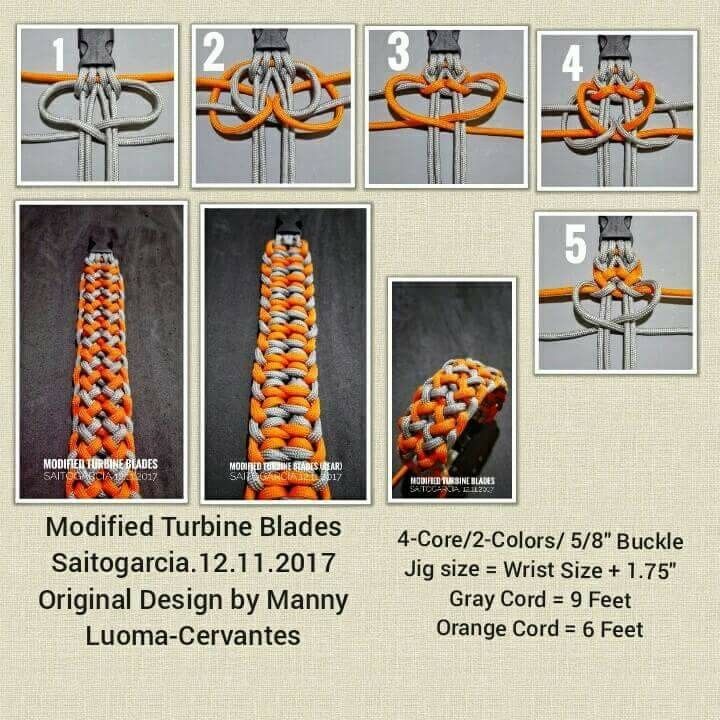
How to Tie a Modified Turbine Blade Knot: Thank you for sharing this image. It appears to be a project note or pattern reference for a macrame or paracord creation — possibly a bracelet, keychain, or small accessory. The text includes:
- “Modified Turbine Blades” (likely a knot pattern name)
- “Gray Cord = 9 Feet” and “Orange Cord = 6 Feet”
- Names: Saitogarcia and Luoma-Cervantes (possibly designers or project credits)
- A date: 12.11.2017
Below is a complete how-to guide, full meaning, and full understanding of what a Turbine Blade knot is, how to modify it, and how to apply this to your artisanal purple macrame bracelet.
How to Tie a Modified Turbine Blade Knot: Complete Guide & Understanding
Full Meaning of “Turbine Blades” in Macrame
| Term | Meaning |
|---|---|
| Turbine Blade | A decorative macrame knot pattern that resembles the curved, twisted shape of a jet engine turbine or fan blade |
| Appearance | A series of spiral or twisted diagonal bands, often using two colors |
| Structure | Typically a variation of the half-hitch spiral or a modified square knot sequence where working cords cross at angles |
| Common use | Bracelets, lanyards, watch bands, and paracord survival gear |
The “turbine” name comes from the way the knots angle and overlap — they look like blades rotating around a central core.
Modified vs. Standard Turbine Blade
| Type | Description |
|---|---|
| Standard turbine | Uniform diagonal wraps, same direction throughout |
| Modified turbine | Direction changes at specific points, creating a mirrored or “V” pattern; often alternates colors in a specific sequence |
Your image shows a modified version — likely because the cord lengths differ (9ft gray, 6ft orange), suggesting one color is used for the core or for fewer passes.
Full Understanding: Cord Lengths & Color Roles
| Cord | Length | Probable Role |
|---|---|---|
| Gray cord | 9 feet (274 cm) | Main working cord or outer weave (requires more length) |
| Orange cord | 6 feet (183 cm) | Core strands or secondary accent color |
Why the Length Difference?
In a two-color turbine blade:
- One color (gray) wraps around the other
- The wrapping cord needs significantly more length
- The inner/core cord stays straight and uses less
A 9:6 ratio is common for a bracelet that is approximately 7–8 inches finished length.
How-To Guide: Modified Turbine Blade Bracelet
Materials
- 9ft gray cord (or purple for your artisanal bracelet)
- 6ft orange cord (or a contrasting purple shade, e.g., lavender or deep violet)
- Clipboard or tape
- Scissors and lighter (for paracord) or glue (for soft cord)
Step 1 — Prepare the Cords
Find the midpoint of the orange cord (6ft). This will be your core (two parallel strands).
Find the midpoint of the gray cord (9ft). This will be your working cord.
Step 2 — Attach to a Buckle or Loop
Option A: Fold both cords in half. Attach all four ends to a buckle using cow hitches (as in your earlier paracord guide).
Option B: Create a simple loop at the start using an overhand knot.
Step 3 — Set Up the Turbine Position
Arrange the cords so:
- Two orange strands are in the center (parallel)
- Two gray strands are on the left and right (working cords)
Step 4 — First Turbine “Blade” (Diagonal Half-Hitch)
Instead of a straight square knot, you will make diagonal half-hitches:
- Take the left gray cord. Cross it diagonally over the orange cores to the right.
- Wrap it under and up through the loop, pulling tight.
- Repeat with the right gray cord, crossing diagonally to the left.
This creates a twisted, angled band — the first blade.
Step 5 — Continue the Sequence
Standard turbine: Repeat step 4 always in the same direction, creating a spiral.
Modified turbine: After 5–7 diagonal passes, reverse direction. This creates a zigzag or “V” pattern.
Step 6 — Switch Colors (If Modified)
In some modified versions, you alternate which color is the working cord:
- First 5 blades: gray working, orange core
- Next 5 blades: orange working, gray core
But your image shows fixed roles (gray = 9ft, orange = 6ft), so the modification is likely in the direction changes only.
Step 7 — Finish the Bracelet
Continue the alternating diagonal pattern until you reach the desired length (typically 1–2cm shorter than wrist circumference, as the knot will stretch slightly).
Tie an overhand knot with all four strands. Trim and melt or glue.
Step 8 — Final Dress
Gently pull and adjust each diagonal wrap so the turbine blades are evenly spaced and angled. The finished pattern should look like interlocking fan blades.
Modified Turbine vs. Other Knots You Know
| Knot | Shape | Cord Use | Difficulty |
|---|---|---|---|
| Square knot (French) | Flat, horizontal | Equal lengths | Easy |
| Cobra weave | Flat, vertical | Equal lengths | Easy |
| King cobra | Thick, stacked | Equal lengths | Medium |
| Monkey’s fist | Spherical | One long cord | Medium |
| Pan Chang | Geometric, looped | One cord | Hard |
| Tatting chain | Textured, lace-like | Two cords | Medium |
| Turbine blade | Diagonal, twisted | Unequal lengths (9:6) | Medium–Hard |
| Modified turbine | Zigzag diagonal | Unequal lengths | Hard |
Applying This to Your Artisanal Purple Macrame Bracelet
Color Suggestions
| Role | Cord Color | Length |
|---|---|---|
| Core (inner) | Deep violet | 6 feet |
| Working (outer) | Light lavender or magenta | 9 feet |
Or, for a monochromatic look:
- Core: Dark purple
- Working: Medium purple with silver metallic thread
Design Variation: “Purple Turbine”
Follow the modified turbine steps but:
- Every 4th blade, reverse direction
- At the center of the bracelet, add a small silver bead
- Finish with a Pan Chang knot at the clasp end
This creates a bracelet that is:
- Technically complex (turbine + Pan Chang)
- Visually striking (zigzag diagonal purples)
- Artisanal (hand-tied, uneven lengths, intentional modification)
Common Mistakes & Fixes
| Mistake | Cause | Fix |
|---|---|---|
| Turbine spirals instead of staying flat | Always wrapping in same direction | Modified version requires direction changes every 5–7 knots |
| Gray cord runs out too soon | 9ft not enough for your wrist size | Start with 10–11ft for a 7–8in bracelet |
| Orange cord visible on edges | Core cords slipping outward | Keep tension centered; use a clipboard |
| Blades uneven | Diagonal angles inconsistent | Measure angle visually; all blades should tilt the same degree |
Final Pro Tip: The “Saitogarcia / Luoma-Cervantes” Credit
Your image credits two names. In the paracord and macrame community, it is common to:
- Saitogarcia – likely the original designer of the turbine blade pattern
- Luoma-Cervantes – the person who modified it (changed direction sequence or color ratio)
When you make your purple version, you can credit:
“Turbine blade pattern inspired by Saitogarcia, modified by Luoma-Cervantes, adapted for purple artisanal bracelet by [Your Name]”
This honors the craft tradition.
Summary: Modified Turbine Blade at a Glance
| Element | Specification |
|---|---|
| Knot type | Diagonal half-hitch sequence |
| Cord ratio | Working cord 1.5× longer than core (e.g., 9ft vs 6ft) |
| Pattern | Zigzag diagonal “blades” |
| Difficulty | Medium to hard |
| Best for | Statement bracelets, men’s jewelry, two-tone designs |


