Traditional Korean Maedeup: Complete Guide to 18 Decorative Knots

Maedeup (매듭) is the traditional Korean art of decorative knotting. For centuries, these knots have adorned clothing, accessories, wedding ceremonies, and Buddhist rituals. Unlike purely practical knots, Maedeup is a refined craft where the knot itself is the decoration — beautiful, symmetrical, and rich with meaning.

Traditional Korean Maedeup: Complete Guide to 18 Decorative Knots

In this guide, you will learn:

  • The full meaning of 18 traditional Maedeup knot names
  • Korean pronunciation (Hangul and romanization)
  • Cultural symbolism and traditional uses
  • English equivalents and descriptions

This guide is based on information from the Korean Cultural Centre Australia (KCC Australia) , located in Sydney.


Why Learn Korean Maedeup?

BenefitExplanation
Rich cultural heritageMaedeup is an important part of Korean traditional arts (along with hanbok, hanji, and jangseung)
Unique knot stylesKorean knots have distinctive shapes and symmetrical beauty
Symbolic meaningsEach knot carries wishes for luck, love, longevity, or protection
Used in modern craftsIncorporate Maedeup into jewelry, keychains, bookmarks, and accessories
Meditative practiceTying Maedeup requires focus and patience, similar to meditation

Part 1: Basic & Connection Knots

1. 도래 매듭 (Dorae Maedeup) — Double Connection Knot

AttributeDetail
Hangul도래 매듭
RomanizationDorae Maedeup
EnglishDouble Connection Knot
Similar toChinese 双联结 (Double Connection), Japanese 双連結び
SymbolismUnity, connection, harmony
DifficultyEasy
UseJoining two cords, starting and ending many Maedeup projects

How to identify: Two interlocking loops that lie flat against each other. The most fundamental Korean knot.

2. 귀도래 매듭 (Gwidorae Maedeup) — Eared Double Connection Knot

AttributeDetail
Hangul귀도래 매듭
RomanizationGwidorae Maedeup
EnglishEared Double Connection Knot
Meaning“귀” (gwi) = ear — the knot has small ear-like loops on the sides
DifficultyEasy–Medium
UseDecorative versions of the double connection knot; often used at the ends of tassels

Difference from Dorae: Dorae is flat and minimal. Gwidorae has additional ear-shaped loops that extend outward.


Part 2: Nature-Inspired Knots (Flowers & Plants)

3. 연봉 매듭 (Yeonbong Maedeup) — Lotus Bud Knot

AttributeDetail
Hangul연봉 매듭
RomanizationYeonbong Maedeup
EnglishLotus Bud Knot
SymbolismThe lotus (연 / yeon) represents purity, enlightenment, and rebirth — it grows from mud but blooms clean
DifficultyMedium
UseBuddhist accessories, wedding decorations, spring-themed norigae (traditional Korean pendant)

How to identify: A teardrop or bud shape, narrower at the top and rounded at the bottom.

4. 매화 매듭 (Maehwa Maedeup) — Apricot Flower Knot

AttributeDetail
Hangul매화 매듭
RomanizationMaehwa Maedeup
EnglishApricot Flower Knot (Plum Blossom Knot)
SymbolismThe apricot blossom (매화) represents resilience, purity, and early spring — it blooms while snow is still on the ground
DifficultyMedium–Hard
UseSpring-themed norigae, hair ornaments, feminine accessories

Note: In Korean, 매화 refers to the apricot blossom (Prunus mume), which is the same flower known as “plum blossom” in Chinese and Japanese contexts.

5. 국화 매듭 (Gukwa Maedeup) — Chrysanthemum Knot

AttributeDetail
Hangul국화 매듭
RomanizationGukwa Maedeup
EnglishChrysanthemum Knot
SymbolismThe chrysanthemum (국화) represents longevity, autumn, and nobility
DifficultyHard
UseAutumn-themed accessories, formal norigae, older women’s hanbok decorations

How to identify: A multi-petaled flower shape, similar to a daisy or mum, with many radiating loops.


Part 3: Animal-Inspired Knots

6. 병아리 매듭 (Byeongari Maedeup) — Chick Knot

AttributeDetail
Hangul병아리 매듭
RomanizationByeongari Maedeup
EnglishChick Knot
SymbolismA baby chick (병아리) represents new life, cuteness, and spring
DifficultyMedium
UseChildren’s accessories, cute keychains, spring crafts

7. 잠자리 매듭 (Jamjari Maedeup) — Dragonfly Knot

AttributeDetail
Hangul잠자리 매듭
RomanizationJamjari Maedeup
EnglishDragonfly Knot
SymbolismThe dragonfly (잠자리) represents courage, happiness, and the autumn season
DifficultyMedium–Hard
UseSummer/autumn accessories, norigae, masculine designs

How to identify: An elongated knot with four wing-like loops.

8. 매미 매듭 (Maemi Maedeup) — Cicada Knot

AttributeDetail
Hangul매미 매듭
RomanizationMaemi Maedeup
EnglishCicada Knot
SymbolismThe cicada (매미) represents rebirth, immortality, and summer. In Korean tradition, the cicada sheds its skin and emerges renewed.
DifficultyHard
UseSummer accessories, symbolic gifts for new beginnings

9. 암나비 매듭 (Amnabi Maedeup) — Female Butterfly Knot

AttributeDetail
Hangul암나비 매듭
RomanizationAmnabi Maedeup
EnglishFemale Butterfly Knot
Meaning“암” (am) = female; “나비” (nabi) = butterfly
SymbolismThe butterfly represents joy and marital happiness. A female butterfly has rounder, softer wings.
DifficultyHard
UseWedding decorations, feminine accessories, paired with Sunabi

10. 수나비 매듭 (Sunabi Maedeup) — Male Butterfly Knot

AttributeDetail
Hangul수나비 매듭
RomanizationSunabi Maedeup
EnglishMale Butterfly Knot
Meaning“수” (su) = male
SymbolismA male butterfly has sharper, more angular wings
DifficultyHard
UseWedding decorations, masculine accessories, paired with Amnabi

Pairing: Together, 암나비 and 수나비 represent a happy married couple. They are often used together in wedding norigae.


Part 4: Geometric & Symbolic Knots

11. 가락지 매듭 (Garakji Maedeup) — Ring Knot

AttributeDetail
Hangul가락지 매듭
RomanizationGarakji Maedeup
EnglishRing Knot
Meaning가락지 (garakji) = ring or bracelet
SymbolismEternity, completeness, cycles
DifficultyMedium
UseSimple decorative loops, connecting elements

12. 생쭉 매듭 (Saengjjak Maedeup) — Ginger Knot

AttributeDetail
Hangul생쭉 매듭
RomanizationSaengjjak Maedeup
EnglishGinger Knot
MeaningNamed because it resembles a ginger root (생쭉) — knobby and organic
DifficultyMedium
UseTextured accents, rustic designs

13. 삼정자 매듭 (Samjeongja Maedeup) — Three “#”-Shaped Knot

AttributeDetail
Hangul삼정자 매듭
RomanizationSamjeongja Maedeup
EnglishThree “#”-Shaped Knot
Meaning“삼” (sam) = three; “정자” (jeongja) = the character 井 (well / # shape)
SymbolismThe three well-like shapes represent abundance, order, and structure
DifficultyHard
UseFormal norigae, geometric designs

14. 장구 매듭 (Janggu Maedeup) — Double Carrick Bend / Hourglass Knot

AttributeDetail
Hangul장구 매듭
RomanizationJanggu Maedeup
EnglishDouble Carrick Bend / Hourglass Knot
Meaning장구 (janggu) is a traditional Korean hourglass-shaped drum
SymbolismMusic, rhythm, celebration
DifficultyMedium–Hard
UseMusical-themed accessories, decorative centers

How to identify: An hourglass or drum shape, narrow in the middle and wider at both ends.


Part 5: Love, Eternity & Specialty Knots

15. 동심결 매듭 (Dongsimgyeol Maedeup) — Eternal Unity / Same Heart Knot

AttributeDetail
Hangul동심결 매듭
RomanizationDongsimgyeol Maedeup
EnglishEternal Unity Knot (Same Heart Knot)
Meaning“동심” (dongsim) = same heart / unity of mind; “결” (gyeol) = knot
SymbolismRepresenting eternity and everlasting love. Two hearts becoming one.
DifficultyHard
UseWedding favors, couple’s bracelets, anniversary gifts

16. 안경 매듭 (Angyeong Maedeup) — Glasses Knot

AttributeDetail
Hangul안경 매듭
RomanizationAngyeong Maedeup
EnglishGlasses Knot
MeaningNamed because it resembles a pair of eyeglasses (안경)
DifficultyMedium
UseWhimsical accessories, novelty keychains

How to identify: Two round loops connected by a bridge, like a pair of spectacles.

17. 가지방석 매듭 (Gajibangseok Maedeup) — Branch Cushion Knot

AttributeDetail
Hangul가지방석 매듭
RomanizationGajibangseok Maedeup
EnglishBranch Cushion Knot
Meaning“가지” (gaji) = branch; “방석” (bangseok) = cushion / mat
DifficultyHard
UseComplex decorative pieces, traditional norigae

18. 석씨 매듭 (Seokssi Maedeup) — Seok Family Knot

AttributeDetail
Hangul석씨 매듭
RomanizationSeokssi Maedeup
EnglishSeok Family Knot
Meaning“석씨” (Seokssi) = the Seok family name — this knot may be named after a specific knotting master or family tradition
DifficultyExpert
UseHeirloom pieces, master-level work

Part 6: Complete Quick Reference Table

#HangulRomanizationEnglishDifficultySymbolism
1도래 매듭DoraeDouble ConnectionEasyUnity
2귀도래 매듭GwidoraeEared Double ConnectionEasy–MedConnection + ears
3연봉 매듭YeonbongLotus BudMediumPurity, enlightenment
4매화 매듭MaehwaApricot FlowerMed–HardResilience, spring
5국화 매듭GukwaChrysanthemumHardLongevity, autumn
6병아리 매듭ByeongariChickMediumNew life, cuteness
7잠자리 매듭JamjariDragonflyMed–HardCourage, happiness
8매미 매듭MaemiCicadaHardRebirth, immortality
9암나비 매듭AmnabiFemale ButterflyHardMarital joy (female)
10수나비 매듭SunabiMale ButterflyHardMarital joy (male)
11가락지 매듭GarakjiRingMediumEternity
12생쭉 매듭SaengjjakGingerMediumOrganic texture
13삼정자 매듭SamjeongjaThree “#” shapeHardAbundance, order
14장구 매듭JangguDouble Carrick / HourglassMed–HardMusic, rhythm
15동심결 매듭DongsimgyeolEternal Unity / Same HeartHardEverlasting love
16안경 매듭AngyeongGlassesMediumWhimsy
17가지방석 매듭GajibangseokBranch CushionHardTraditional decoration
18석씨 매듭SeokssiSeok FamilyExpertMaster-level work

Part 7: Traditional Use — Norigae (노리개)

Maedeup knots are most commonly seen on norigae (노리개) — traditional Korean pendant ornaments worn by women on their hanbok (traditional clothing). A typical norigae consists of:

ComponentDescription
Maedeup (knot)The decorative centerpiece
Sulp (술)Tassel hanging below
PendantJade, silver, or gold ornament attached below the tassel

Different knots are used for different occasions:

  • Weddings: Butterfly knots (Amnabi/Sunabi), Eternal Unity (Dongsimgyeol)
  • First birthday (dol): Lotus, Chick
  • Spring: Apricot flower (Maehwa)
  • Autumn: Chrysanthemum (Gukwa), Dragonfly (Jamjari)
  • Buddhist ceremonies: Lotus (Yeonbong)

Part 8: Maedeup vs. Chinese & Japanese Knots

FeatureKorean MaedeupChinese 中国结Japanese 結び
Cord materialSilk (often thicker)Silk, satin, nylonSilk, kumihimo
Typical colorsBright (red, blue, yellow, pink)Red, gold, greenMuted, natural, indigo
Shape styleRounded, full, symmetricalGeometric, loop-heavyDelicate, fine, layered
Typical useNorigae (pendants)Wall hangings, giftsObijime (kimono cords)

Part 9: Korean Knotting Vocabulary

HangulRomanizationEnglish
매듭maedeupKnot
노리개norigaeTraditional pendant ornament
한복hanbokTraditional Korean clothing
sulTassel
도래doraeDouble connection
gwiEar
연봉yeonbongLotus bud
매화maehwaApricot blossom
국화gukwaChrysanthemum
나비nabiButterfly
잠자리jamjariDragonfly
매미maemiCicada
동심결dongsimgyeolSame heart / eternal unity

Common Mistakes & Fixes

MistakeCauseFix
Confusing Maehwa (apricot) with Gukwa (chrysanthemum)Both are flower knotsMaehwa has 5 petals; Gukwa has many more
Butterfly knots look the sameNeed to see male vs. femaleFemale (Amnabi) = rounder wings; Male (Sunabi) = sharper wings
Dorae and Gwidorae mixed upBoth are double connectionsGwidorae has extra ear loops
Janggu (drum) knot collapsesHourglass shape not pinnedUse pins to hold the narrow center while tightening
Norigae tassel unevenCut without measuringWrap tape around the tassel before final trim

SEO Blog Post Optimization

Meta TagSuggested Content
TitleTraditional Korean Maedeup: Complete Guide to 18 Decorative Knots
Meta DescriptionLearn 18 traditional Korean Maedeup knots, including Dorae, Yeonbong, Maehwa, Butterfly, Dragonfly, Cicada, and Dongsimgyeol. Meanings, uses, and cultural context.
URL slug/korean-maedeup-knots-guide
KeywordsKorean maedeup, 매듭, traditional Korean knots, dorae maedeup, yeonbong maedeup, norigae, Korean Cultural Centre Australia
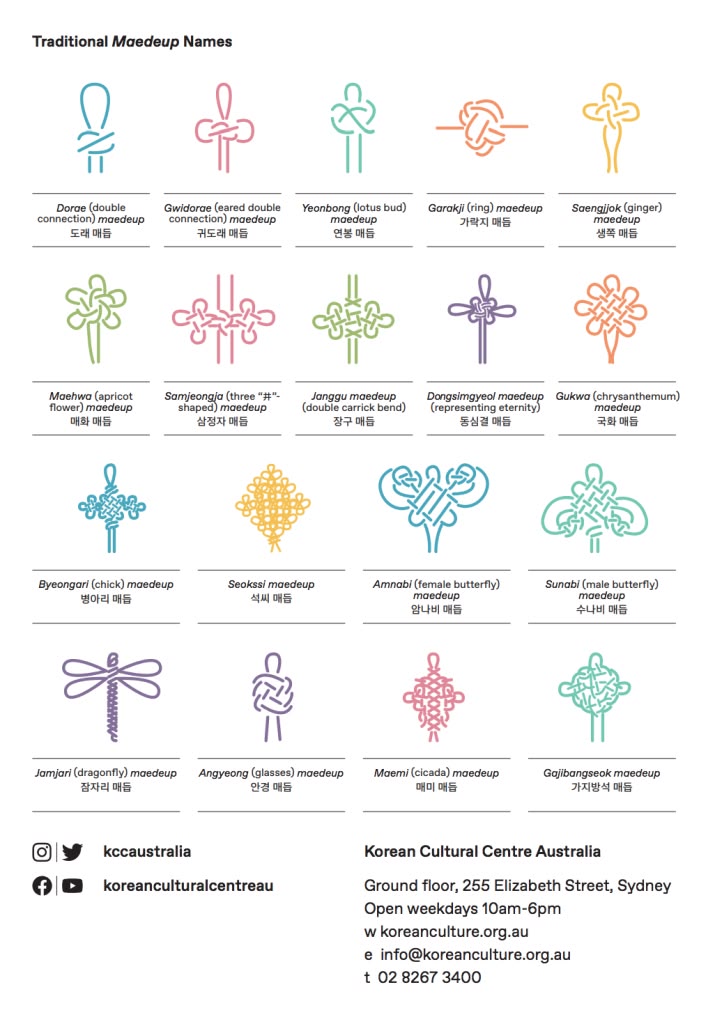
Alt text for imageTraditional Korean Maedeup knot chart from the Korean Cultural Centre Australia showing 18 knot names in Hangul and English including Dorae, Gwidorae, Yeonbong, Garakji, Saengjjak, Maehwa, Samjeongja, Janggu, Dongsimgyeol, Gukwa, Byeongari, Seokssi, Amnabi, Sunabi, Jamjari, Angyeong, Maemi, and Gajibangseok

Final Pro Tip: Visit the Korean Cultural Centre

Your image includes the address of the Korean Cultural Centre Australia:

DetailInformation
LocationGround floor, 255 Elizabeth Street, Sydney
HoursWeekdays 10am–6pm
Websitekoreanculture.org.au
Emailinfo@koreanculture.org.au
Phone02 8267 3400

If you are in Sydney, visit the centre to see traditional Maedeup demonstrations, attend workshops, or view historical norigae in person.


Summary: You Can Now Identify 18 Korean Maedeup Knots
CategoryKnots
Basic connections도래 (Dorae), 귀도래 (Gwidorae)
Flowers연봉 (Lotus), 매화 (Apricot), 국화 (Chrysanthemum)
Insects병아리 (Chick), 잠자리 (Dragonfly), 매미 (Cicada), 암나비/수나비 (Butterflies)
Geometric가락지 (Ring), 생쭉 (Ginger), 삼정자 (Three #), 장구 (Hourglass)
Love & eternity동심결 (Eternal Unity)
Specialty안경 (Glasses), 가지방석 (Branch Cushion), 석씨 (Seok Family)

Bookmark this guide and refer back whenever you encounter Korean Maedeup in traditional crafts, museum collections, or modern jewelry designs.