Some films entertain. A rare few transcend entertainment to become something deeper—a moral imperative, a historical document, and a searing examination of the human soul. Steven Spielberg’s Schindler’s List (1993) is one of those rare treasures. It is not merely a film; it is an act of bearing witness, a cinematic monument to the six million Jews who perished in the Holocaust, and an unflinching exploration of how one man’s unlikely transformation from profiteer to savior can offer a glimmer of hope in humanity’s darkest hour.
More than three decades after its release, Schindler’s List remains an essential, devastating, and profoundly important work of art. Shot in stark black and white, it strips away any sense of glamour or escapism, forcing the audience to confront the brutal reality of the Holocaust with an immediacy that is almost unbearable. It is a film that demands to be seen, and once seen, can never be forgotten.
The Man Behind the List: Oskar Schindler’s Extraordinary Transformation
At the heart of the film is one of the most complex and fascinating characters ever committed to cinema: Oskar Schindler (Liam Neeson). He is introduced as a flawed, opportunistic, and deeply pragmatic man. A Nazi party member, a womanizer, and a war profiteer, Schindler arrives in Kraków, Poland, at the outbreak of World War II with one goal: to make a fortune. He ingratiates himself with the SS, takes over a confiscated Jewish-owned enamelware factory, and staffs it with cheap Jewish labor from the nearby ghetto.
Schindler is not a hero at the start. He is a man of contradictions, a “bad man” who does good deeds. He is motivated by profit, not principle. But as the horrors of the Holocaust unfold around him, a profound change begins to take root. The turning point comes when he witnesses the liquidation of the Kraków ghetto, a brutal, chaotic scene of murder and cruelty that transforms the abstract concept of genocide into a tangible, visceral reality. He sees a little girl in a red coat—one of the few splashes of color in the film—wandering through the carnage, and it is this image that pierces through his cynical exterior and awakens his conscience.
Schindler’s journey from profiteer to savior is gradual, nuanced, and utterly believable. He begins by protecting individual workers, bribing officials, and using his charm to shield them from deportation. But as the war progresses and the Nazi regime’s “Final Solution” becomes clearer, Schindler’s ambitions shift. He uses his entire fortune to bribe officials and purchase his workers, ultimately saving over 1,100 Jews from certain death in Auschwitz. By the end of the film, he is bankrupt, broken, and weeping as he laments that he could have saved more. “I could have got more,” he sobs. “I didn’t do enough.”
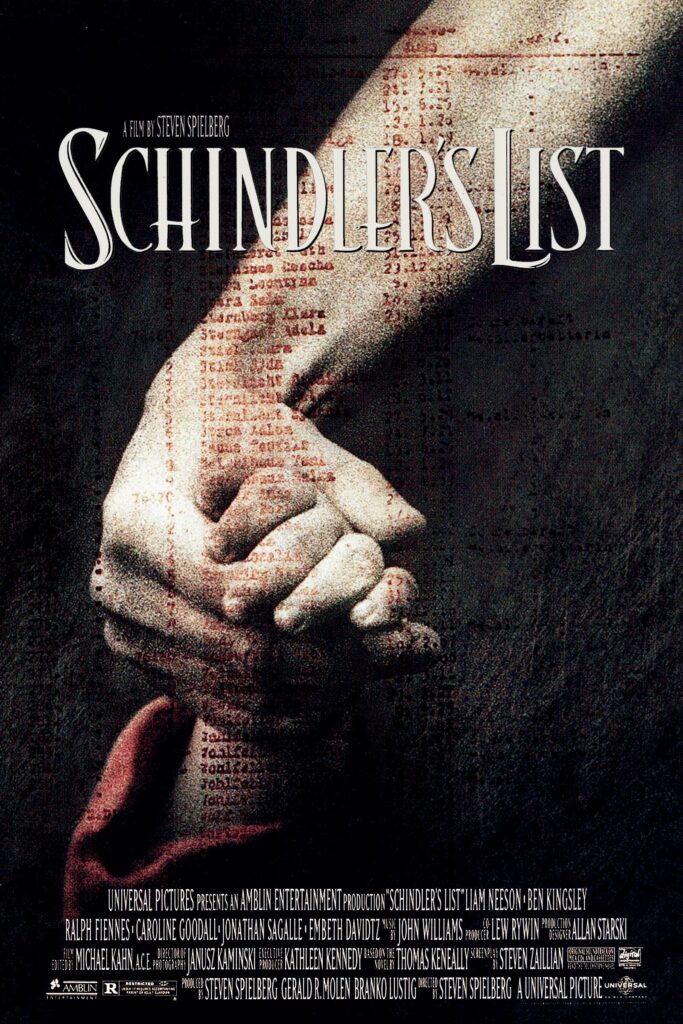
Liam Neeson delivers a career-defining performance, capturing Schindler’s charm, his moral ambiguity, and his eventual, heartbreaking redemption. It is a performance of immense depth and subtlety, a man who is never quite sure of his own motivations but is ultimately driven by a profound, desperate humanity.
The Face of Evil: Amon Göth and the Banality of Cruelty
Opposite Schindler is one of the most chillingly evil characters in cinematic history: Amon Göth (Ralph Fiennes), the sadistic commandant of the Plaszów concentration camp. Fiennes delivers a performance of breathtaking, terrifying power. His Göth is not a caricature of evil; he is a real, complex, and utterly despicable human being. He is a man who casually murders prisoners from his balcony with a sniper rifle, who beats his maid without a second thought, and who treats human life with the same indifference as swatting a fly.
Yet Fiennes and Spielberg do something remarkable with Göth. They humanize him, not to excuse his actions, but to demonstrate the terrifying banality of evil. Schindler’s attempts to appeal to Göth’s capacity for “power”—the ability to pardon rather than to kill—serve as a chilling demonstration of the moral void at the heart of the Nazi ideology. Göth, we come to realize, is not a monster from a horror film; he is a man who has chosen to become a monster, a man whose cruelty is a deliberate act of will. His descent into madness and sadism is a stark warning about the corrupting influence of absolute power.
The dynamic between Schindler and Göth is central to the film. They are mirror images, two men presented with the same opportunities and circumstances. One chooses profit and ultimately redemption; the other chooses cruelty and damnation. Their interactions are a masterclass in tension and moral complexity.
A Harrowing Document of the Holocaust
Schindler’s List is, above all, a harrowing document of the Holocaust. Spielberg refuses to shy away from the brutality of the genocide. The film depicts the horrors in unflinching detail: the forced relocation to the ghetto, the random shootings, the cattle cars packed with desperate families, the gas chambers, and the crematoria. The images are burned into the viewer’s memory: the woman weeping in the gas chamber, the snow falling over Auschwitz, and the little girl in the red coat, whose fate is revealed in one of the film’s most devastating moments.
The decision to shoot the film in black and white was a brilliant artistic choice. It evokes the stark, documentary footage of the era and gives the film a timeless, almost archival quality. It strips the story of any sentimental gloss. The only splashes of color are a Shabbat candle flame at the beginning, which fades to black and white as the title appears, and the iconic red coat of the little girl. This use of color is not a gimmick; it is a devastating symbol of innocence lost, a poignant reminder of the individual lives destroyed.
The film’s historical accuracy is also a key component of its power. Spielberg and his team consulted with Holocaust survivors, including many of Schindler’s Jews, to ensure the film was as authentic as possible. The result is a film that feels less like a dramatization and more like a document, a record of events that must never be forgotten.
Thematic Depth: Hope, Redemption, and the Cost of Salvation
Beyond its historical importance, Schindler’s List is a film of profound thematic depth. It explores the nature of good and evil, the possibility of redemption, and the extraordinary power of individual action in the face of overwhelming injustice. Schindler is not a perfect saint; he is a deeply flawed man who made a series of choices that ultimately saved lives. His transformation is a testament to the human capacity for change, even in the most dire circumstances.
The film also explores the theme of Jewish resistance. It is not just a story of passive suffering; it is a story of Jewish ingenuity, solidarity, and survival. The workers in Schindler’s factory are not just victims; they are active agents in their own survival. They find ways to subvert the system, to protect one another, and to maintain their humanity in the face of unimaginable cruelty. The famous scene of the women at the train station, offering water to the prisoners in the cattle cars, is a powerful testament to the resilience of the human spirit.
The film’s final scene, in which the surviving “Schindler Jews” visit his grave in Jerusalem and place stones upon it, is one of the most moving moments in cinema history. It is a tribute to the man who saved them, but it is also a profound statement about the enduring power of life in the face of death. The film ends not with despair, but with a quiet, resilient hope.
Technical Mastery: Spielberg’s Greatest Work
Steven Spielberg’s direction is nothing short of masterful. He had previously been known for blockbuster entertainments like Jaws, E.T., and Raiders of the Lost Ark. But with Schindler’s List, he proved himself one of the great dramatic filmmakers of his generation. His direction is restrained, powerful, and utterly focused. He never sensationalizes the violence; he presents it with a cold, clear-eyed objectivity that makes it all the more devastating.
The cinematography, by Janusz Kamiński, is breathtaking. The black-and-white imagery is rich and textured, capturing the bleakness of the ghetto and the looming, industrial horror of Auschwitz. The camera work is often handheld, lending the film a documentary-like immediacy. The score, by John Williams, is haunting and unforgettable, though Spielberg actually used little of it. The most powerful moments are often scored by silence.
Conclusion: A Call to Remember
Schindler’s List is more than a film; it is an imperative, a call to remember. It is a testament to the power of one individual to make a difference in the face of evil, and a stark reminder of the consequences of indifference. As the film closes, the surviving “Schindler Jews” and the actors who portrayed them file past the grave, placing stones in a solemn, silent ritual.
In the end, Schindler’s List is not just about the past. It is a film for the present and the future. It is a reminder that the human capacity for both good and evil is immense, and that we all have a choice about which side we will take. The film teaches us that saving one life is saving a world entire. That is the profound and lasting legacy of this harrowing, brilliant, and essential cinematic monument.