Chinese macrame project — likely a coin purse, pendant, or decorative ornament incorporating 72号玉线 (size 72 jade thread), 雀头结 (lark’s head knots), 斜卷结 (diagonal clove hitches), 反斜卷结 (reverse diagonal clove hitches), 大钱 (large Chinese coins), and a 流苏 (tassel). The steps range from step 1 to step 99, making this an advanced, multi-session project.

Below is a complete guide that explains the full meaning of the Chinese terms, the structure of the project, a condensed how-to organized by phase, and a glossary for future reference.
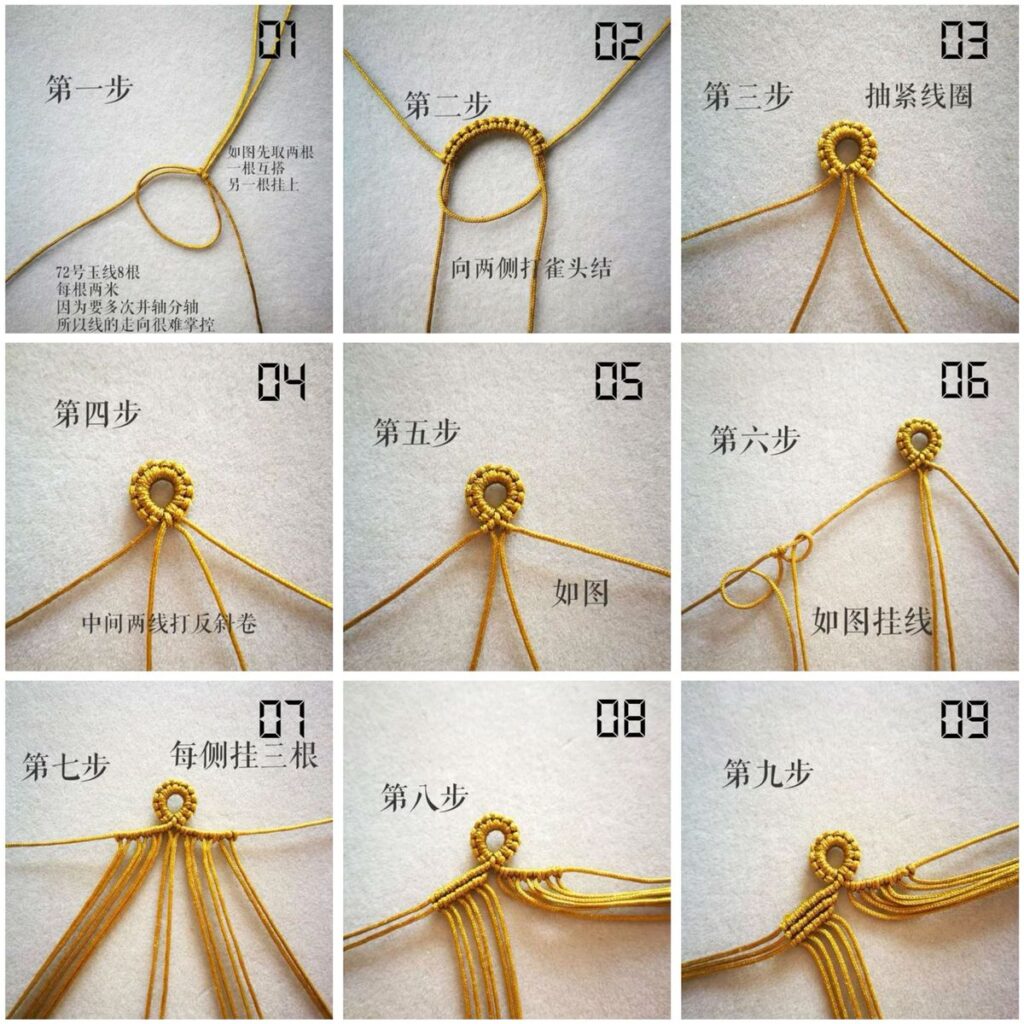


Complete Guide to a 99-Step Chinese Macrame Project: Coins, Tassels & Jade Thread
Overview of the Project
| Feature | Detail |
|---|---|
| Material | 72号玉线 (size 72 jade thread) — 8 strands, each 2 meters long |
| Main knots | 雀头结 (lark’s head / sparrow head knot), 斜卷结 (diagonal clove hitch), 反斜卷结 (reverse diagonal clove hitch) |
| Special elements | 大钱 (large Chinese coins), 挂绳 (hanging cord), 流苏 (tassel) |
| Difficulty | Advanced (complex axis changes, multiple splits, front/back layers) |
| Finished item | Likely a decorative coin purse, a wall hanging, or a structured ornament with front and back panels |
Note: Because there are 99 photographed steps, this guide provides a condensed, phase-based explanation. To recreate the exact project, you would need the original photo tutorial. This guide focuses on understanding the techniques and the sequence logic.
Part 1: Materials & Setup (Steps 01–06)
Step 01–03: Initial Setup
| Step | Chinese | English Meaning |
|---|---|---|
| 01 | 如图先取两根 根互搭 | As shown, first take two strands and cross them over each other |
| 02 | 另一根挂上 | Attach another strand (using a lark’s head knot) |
| 03 | 72号玉线8根 每根两米 | 8 strands of size 72 jade thread, each 2 meters long |
What is 72号玉线 (size 72 jade thread)?
| Property | Detail |
|---|---|
| Thickness | Approximately 0.8mm |
| Material | Nylon or polyester, waxed or unwaxed |
| Use | Chinese macrame, jewelry, knotting |
| Compared to paracord | Much thinner, smoother, more drapable |
Setup Summary:
- You have 8 strands, each 2m long.
- You start by crossing two strands as a base.
- Additional strands are added using lark’s head knots.
Step 04: 向两侧打雀头结 (Make lark’s head knots to both sides)
| Term | Meaning |
|---|---|
| 雀头结 (què tóu jié) | Lark’s head knot / sparrow head knot (same as cow hitch) |
This step creates a symmetric V-shape of lark’s head knots spreading left and right.
Step 05–06: Intermediate setup
| Step | Meaning |
|---|---|
| 05 | 因为要多次并轴分轴 — Because you will combine and separate axes many times, the cord paths become complex |
| 06 | 如图挂线 — Attach cords as shown in the diagram |
Key insight: This project involves constantly changing which strands are working cords and which are core axes (轴). This is why it is advanced.
Part 2: Building the Structure (Steps 07–27)
Step 07: 每侧挂三根 (Attach three strands on each side)
By now, you have:
- Center cords (axes)
- 3 working cords on the left, 3 on the right
Steps 19–27 (from file b75bdd8a...)
| Step | Chinese | English |
|---|---|---|
| 19–21 | (no text visible) | Positioning and knotting |
| 22–24 | 两侧都做好 打左右半斜卷9次 | Complete both sides. Tie left and right half diagonal clove hitches 9 times. |
| 25–27 | 放出一根轴线 | Release / free one axis strand. |
斜卷结 (diagonal clove hitch) — a fundamental Chinese macrame knot:
- It creates a diagonal line of knots.
- One strand is the working cord, the other is the core (轴) .
- Tying many in a row (here: 9 times) creates a textured diagonal ridge.
Part 3: Mid-Project Complexity (Steps 28–60)
Steps 28–36 (from file 1c679046...)
| Step | Meaning |
|---|---|
| 28–30 | Continuing the diagonal clove hitches |
| 31–33 | 钩出一个线套 — Hook out a loop of thread |
| 34–36 | Shaping and tightening |
Steps 46–54 (from file 043435d6...)
| Step | Chinese | English |
|---|---|---|
| 46–48 | (no text) | Position and knot |
| 49–51 | 打8个雀头结 | Tie 8 lark’s head knots |
| 52–54 | 放轴 | Release the axis |
Steps 55–63 (from file 26c7c123...)
| Step | Chinese | English |
|---|---|---|
| 55–57 | 以这两线为轴 打斜卷结 | Use these two strands as axes. Tie diagonal clove hitches. |
| 58–60 | 开始会主轴线 | Begin to merge / organize the main axes. |
| 61–63 | 打一个右斜卷结 留两根不合并 两侧都做好 | Tie a right diagonal clove hitch. Leave two strands unmerged. Complete on both sides. |
Right斜卷结 vs Left斜卷结: The direction changes which side the working cord comes from.
Part 4: Front & Back Panels + Coins (Steps 82–95)
Steps 82–90 (from file 6985c87a...)
| Step | Chinese | English |
|---|---|---|
| 82–84 | 正面背面都做四线小菱形 | Make a small diamond shape (4 threads) on both front and back. |
| 85 | 夹上大钱 | Insert a large Chinese coin. |
| 86–87 | 互换绕线 继续打小菱形 | Swap the working cords. Continue making small diamonds. |
| 88–90 | 绕线互换 加入第二个大钱 | Swap working cords again. Add the second large coin. |
大钱 (dà qián) — large Chinese coins:
- Typically have a square hole in the center.
- Represent wealth, prosperity, and good fortune.
- The macrame wraps around or through the coin.
四线小菱形 (4-thread small diamond):
- A diamond-shaped motif made with 4 strands.
- Created by tying diagonal clove hitches that slope inward to a point, then outward.
Steps 91–95 (from file 8d4b94bc...)
| Step | Chinese | English |
|---|---|---|
| 91–93 | 往前面的绕线 后面的绕线 上加 | Add to the front and back working cords. |
| 94–95 | 加上挂绳 对接流苏 | Add the hanging cord. Attach/join the tassel. |
流苏 (liú sū) — tassel:
- A decorative fringe attached to the bottom.
- Often made from the same jade thread or a contrasting color.
Part 5: Completion (Steps 96–99)
| Step | Chinese | English |
|---|---|---|
| 96 | 实在是没有线了 | Truly, there is no thread left (humorous note from the maker) |
| 97 | 对接流苏 | Join / attach the tassel |
| 98 | 完工 | Finished / complete |
| 99 | 手工客 shougongke.com | Handmade guest (watermark / source credit) |
Core Techniques Explained (Full Meaning)
1. 雀头结 (Lark’s Head / Sparrow Head Knot)
| Also known as | Cow hitch, lark’s head |
| Use | Attaching cords to a ring, another cord, or a coin |
How to tie:
- Fold a cord in half.
- Pass the loop over/through the ring or axis cord.
- Pass the two ends through the loop.
- Pull tight.
2. 斜卷结 (Diagonal Clove Hitch)
| Also known as | Diagonal half hitch, diagonal lark’s head |
| Use | Creating diagonal ridges, filling shapes (diamonds, triangles) |
How to tie (right version):
- Take working cord (right side). Hold axis cord diagonally across the work.
- Wrap working cord over and around the axis cord, then up through the loop.
- Repeat for as many hitches as needed.
3. 反斜卷结 (Reverse Diagonal Clove Hitch)
| Also known as | Reverse diagonal half hitch |
| Use | Creating the opposite diagonal direction, or working on the back side |
Difference: The working cord comes from the opposite side and wraps in the reverse direction.
4. 轴 (Axis / Core Cord)
| Meaning | The stationary cord that other cords tie onto. |
| In this project | Axes change constantly (并轴 = combine axes; 分轴 = separate axes). |
5. 大钱 (Large Coin)
| Meaning | Chinese coin (often replica with square hole) |
| Symbolism | Wealth, prosperity, protection |
| How attached | Wrapped with lark’s head knots or diagonal clove hitches through the center hole |
How to Approach a 99-Step Photo Tutorial
| Step | Action |
|---|---|
| 1 | Read all the way through once without doing anything. |
| 2 | Gather all materials (8 strands of 2m 72号玉线, 2+ coins, tassel cord). |
| 3 | Work in phases (setup → body → coins → finishing). |
| 4 | Use a cork board and pins to hold axes in place. |
| 5 | Mark each photo with a sticky note when completed. |
| 6 | If lost, look for axes (轴) — the stationary strands — to reorient yourself. |
Common Mistakes & Fixes (for advanced Chinese macrame)
| Mistake | Cause | Fix |
|---|---|---|
| Losing track of which strand is axis | Axes change frequently | Pin the axis strand to the board; mark it with a colored pin |
| Diamond shapes uneven | Diagonal clove hitch tension inconsistent | Practice on a scrap piece first; keep the same pull force each time |
| Coins wobble | Not enough knots around the coin hole | Add 2–3 extra lark’s head knots through the center |
| Front and back panels misaligned | Did not mirror the knots on the back | Always complete each step on both sides before moving on |
| Running out of thread | 2m per strand is minimum | Add extra 50cm per strand for practice |
| Confusing left vs. right斜卷结 | Working direction reversed | Left斜卷结 = working cord comes from left; right斜卷结 = from right |
Vocabulary Cheat Sheet (for this project)
| Chinese | Pinyin | English |
|---|---|---|
| 72号玉线 | 72 hào yù xiàn | Size 72 jade thread (0.8mm nylon cord) |
| 雀头结 | què tóu jié | Lark’s head / sparrow head knot |
| 斜卷结 | xié juǎn jié | Diagonal clove hitch |
| 反斜卷结 | fǎn xié juǎn jié | Reverse diagonal clove hitch |
| 轴 | zhóu | Axis / core cord |
| 并轴 | bìng zhóu | Combine axes |
| 分轴 | fēn zhóu | Separate axes |
| 大钱 | dà qián | Large Chinese coin |
| 流苏 | liú sū | Tassel |
| 挂绳 | guà shéng | Hanging cord |
| 小菱形 | xiǎo líng xíng | Small diamond shape |
| 绕线 | rào xiàn | Working cord (the one that wraps) |
| 正面 | zhèng miàn | Front side |
| 背面 | bèi miàn | Back side |
| 完工 | wán gōng | Finished |
What to Make with This Technique
| Project | Adaptations |
|---|---|
| Coin purse | Follow the steps as shown, adding a zipper or button closure |
| Wall hanging | Use larger coins, longer tassel, hang from a dowel |
| Necklace pendant | Reduce scale, use thinner thread (72号 is already thin) |
| Bookmark | Omit the coins, extend the diamond pattern |
| Keychain | Use one coin, shorter tassel, add a key ring at the top |
SEO Blog Post Optimization
| Meta Tag | Suggested Content |
|---|---|
| Title | 99-Step Chinese Macrame Project: Coins, Tassels & Jade Thread (72号玉线) |
| Meta Description | Complete guide to an advanced Chinese macrame project with 8 strands of 72号玉线, lark’s head knots, diagonal clove hitches, coins, and tassel. |
| URL slug | /chinese-macrame-coins-tassels-guide |
| Keywords | 72号玉线, 雀头结, 斜卷结, Chinese macrame, Chinese coin knot, 大钱, 流苏, shougongke |
| Alt text for images | Step-by-step Chinese macrame tutorial showing lark’s head knots, diagonal clove hitches, small diamond shapes, large Chinese coins, front and back panels, and tassel attachment |
Final Pro Tip: Working with 72号玉线
| Property | Tip |
|---|---|
| Slipperiness | 72号玉线 can be slippery. Use a drop of fray check or clear nail polish on cut ends. |
| Tension | Unlike paracord, jade thread has no stretch. Keep consistent, medium tension. |
| Frogging (undoing knots) | Difficult because the wax coating locks knots. Be deliberate before tightening. |
| Color | The number 72 refers to thickness, not color. Choose any color you like. For an artisanal purple theme, use purple 72号玉线. |
Summary: You Can Now Understand This 99-Step Project
| Phase | Steps | Main Techniques |
|---|---|---|
| Setup | 01–06 | 8 strands, 2m each, lark’s head attachments |
| Body & diamonds | 07–60 | Diagonal clove hitches, axis changes, small diamonds |
| Coins & front/back | 82–95 | Insert coins, swap working cords, mirror front and back |
| Finishing | 91–99 | Add hanging cord, attach tassel, complete |
This is an advanced project that assumes you already know how to tie lark’s head knots, diagonal clove hitches, and how to manage multiple axes. If you are a beginner, practice those individual knots first.


