Some films entertain. A rare few transcend entertainment to become something deeper—a cultural earthquake, a philosophical Rorschach test, and a mirror held up to the darkest corners of the modern male psyche. David Fincher’s Fight Club (1999) is one of those rare treasures. It didn’t just tell a story; it ignited a firestorm of controversy, inspired obsessive devotion, and posed uncomfortable questions about identity, consumerism, and masculinity that still resonate more than two decades later.
Based on Chuck Palahniuk’s influential novel, Fight Club arrived in theaters amid a swirl of studio anxiety and critical confusion. It was a box office disappointment, earning only $37 million domestically against a $60 million budget. Yet, like its protagonist, the film refused to die. On DVD, it found its true audience, selling millions of copies and cementing its status as one of the defining cult classics of its era. It is a film that demands to be discussed, debated, and dissected—a movie that, as one critic noted, “refuses to be ignored or dismissed”.
A Journey into the Abyss: The Narrator and Tyler Durden
The film introduces us to its unnamed Narrator (Edward Norton), a man suffocated by the monotony of his white-collar existence. He is an insomniac, a slave to his IKEA-furnished apartment, and a man who defines himself through the consumer goods he purchases. His life is a cycle of “single-serving” airplane meals, anonymous hotel rooms, and a job that leaves him feeling “crushed by the lack of light, adventure and emotion in his life”.
His only relief comes from attending support groups for terminal illnesses, where he can cry and feel something—anything—authentic. This fragile solace is shattered by the arrival of Marla Singer (Helena Bonham Carter), another “faker” who attends for the voyeuristic thrill. She is a “femme fatale” whose presence destabilizes the Narrator’s carefully constructed world.
Enter Tyler Durden (Brad Pitt), a charismatic, anarchic soap salesman who embodies everything the Narrator is not. Tyler is free, fearless, and fiercely anti-consumerist. He spouts aphorisms that sound like revelations: “The things you own end up owning you,” and “It’s only after we’ve lost everything that we’re free to do anything”. After the Narrator’s apartment mysteriously explodes, he moves into Tyler’s dilapidated house, and the two form an unlikely bond.
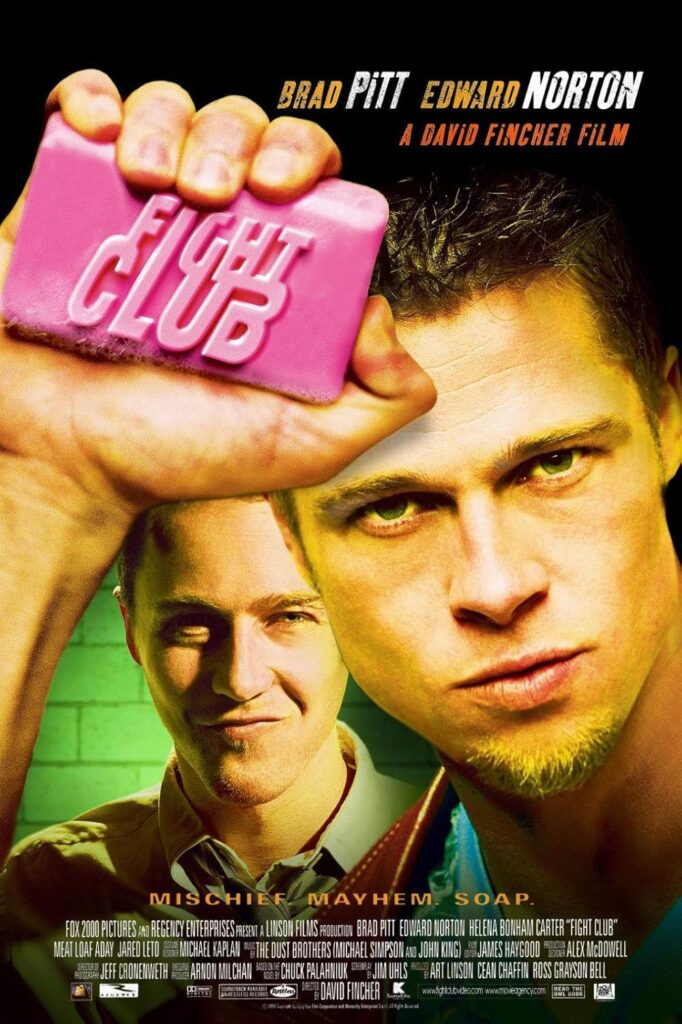
This bond is forged in violence. In a moment of primal release, Tyler asks the Narrator to hit him. “I wanted to destroy something beautiful,” the Narrator muses. This first fight becomes the genesis of Fight Club, an underground organization where disaffected men gather to beat each other senseless. The rules are simple: the first rule of Fight Club is you do not talk about Fight Club. The second rule of Fight Club is you do not talk about Fight Club.
Themes of Masculinity, Consumerism, and Chaos
Fight Club is a film of profound thematic depth, a work that has inspired “a host of interpretations—Nietzschean, Buddhist, Marxist”. At its core, however, it is a critique of modern masculinity in crisis.
The Crisis of Masculinity
Tyler’s central thesis is that modern men have been emasculated. He declares, “We’re a generation of men raised by women”. In a world of safe, domesticated lives, men have lost their primal, aggressive nature. They have become “cogs in a wheel,” numbed by day-to-day drudgery and stripped of any sense of purpose or identity. Fight Club offers a brutal antidote: a return to primal, physical confrontation. The fights are not about winning or losing but about “building strength and confidence and fulfilling a primal urge”. As one analysis puts it, the film suggests that “the only way they can regain a sense of individuality is by getting in touch with the primal, barbaric instincts of pain and violence”.
The Narrator’s transformation is the film’s central arc. He goes from a meek, emasculated office worker to a man who, under Tyler’s influence, is capable of anything. He stands up to his boss, flaunts his injuries, and embraces a life of chaos and destruction. Yet, the film’s twist—that Tyler is actually a figment of the Narrator’s imagination, a dissociated personality he has created to escape his own insecurities—complicates this celebration of masculine power. The Narrator is so unused to expressing himself that “he has to sell himself his own anger”. This revelation makes the film less a straightforward celebration of violence and more a tragic exploration of a fractured psyche.
The Attack on Consumerism
The film’s anti-consumerist message is equally potent. Tyler rails against a culture that defines people by their possessions, their jobs, and their bank accounts. “You are not your job. You’re not how much money you have in the bank. You’re not the car you drive. You’re not your fucking khakis,” he proclaims. The Narrator’s obsession with his IKEA catalog is a symbol of a life defined by materialism. Tyler’s solution is destructive and anarchic: Project Mayhem, a series of terrorist attacks designed to destroy corporate landmarks and “erase the debt record” by blowing up credit card headquarters.
However, this critique is not without its contradictions. As one reviewer notes, Fight Club is “the most fashionable commercial imaginable for anti-materialism”. It is a product of the very system it condemns, and its vision of liberation is regressive, relying on “gendered and sexist hierarchies that flow directly from the consumer culture it claims to be criticizing”. As cultural critics Henry Giroux and Imre Szeman argue, the film “has nothing substantive to say about the structural violence of unemployment, job insecurity, cuts in public spending, and the destruction of institutions capable of defending social provisions and the public good”.
The Twist and Its Legacy
The film’s famous twist—that Tyler Durden is a hallucination—is not merely a gimmick but an integral part of its thematic architecture. It recontextualizes everything that has come before, forcing the audience to question the reliability of the Narrator and the nature of his reality. This twist, which one critic compared to The Sixth Sense, is integrated so effectively that it doesn’t dictate the film’s success; it enhances it. Even if you know the ending, the film remains a powerful and provocative experience.
The legacy of Fight Club is immense. It has seeped into the cultural lexicon, giving us catchphrases like “The first rule of Fight Club…” and “You are not a beautiful or unique snowflake”. Its swaggering, rebellious ethos has been adopted by everyone from pickup artists to political movements. And its critiques, while not without their flaws, remain startlingly prescient. As The Atlantic noted on the film’s 25th anniversary, “We’re Still Living in a ‘Fight Club’ World”.
Conclusion: An Offer You Shouldn’t Refuse
Fight Club is a film of contradictions. It is a dazzling entertainment that asks us to luxuriate in violence as we condemn it. It is a critique of consumerism that has itself become a consumer product. It is a meditation on male identity that is both insightful and deeply problematic.
Yet, for all its contradictions, Fight Club remains an essential piece of cinema. It is a film that refuses to be ignored, a work that challenges us to think about the world we live in and the people we have become. It is a film that, as one critic put it, “offers a clear, uncompromising portrait that disturbs because it is perceptive and defies the facile answers proffered by elected officials”. It is a masterpiece, plain and simple—a film that will continue to be debated, dissected, and discovered by new generations of viewers who, like the Narrator, are searching for something real in a world of illusions.
And that, perhaps, is the true power of Fight Club. It is a film about the search for authenticity in a world of artifice. It is a film about the primal need for connection in an age of isolation. It is a film about the dark, uncomfortable truths that lie beneath the surface of our comfortable, consumer-driven lives. It is a film that, as one review concluded, is “not just a movie; it’s an experience”.