Some films entertain. A rare few transcend entertainment to become something deeper—a cultural earthquake, a paradigm shift, and a defining moment for an entire generation of filmmakers. Quentin Tarantino’s Pulp Fiction (1994) is one of those rare treasures. It didn’t just tell a story; it shattered conventions, redefined cool, and proved that independent cinema could achieve massive mainstream success while remaining fiercely unconventional.
More than three decades after its release, Pulp Fiction remains one of the most influential and essential films ever made. It is a dizzying, hilarious, violent, and unexpectedly tender tapestry of interwoven stories that pulse with energy, wit, and a profound love for the cinematic medium itself. It is a film that demands to be seen, discussed, and debated—a movie that refuses to be forgotten.
A New Kind of Storytelling: The Non-Linear Narrative
The film’s most famous innovation is its non-linear structure. Tarantino and his co-writer Roger Avary famously scrambled the chronology of their scripts, presenting the story in a series of interlocking chapters that unfold out of sequence. The film opens with a couple, “Pumpkin” (Tim Roth) and “Honey Bunny” (Amanda Plummer), discussing a robbery in a diner, only to cut to the film’s actual beginning: two hitmen, Jules Winnfield (Samuel L. Jackson) and Vincent Vega (John Travolta), driving and discussing the nuances of fast food in Europe.
From there, the narrative spirals outward and backward, telling three interconnected stories: Vincent’s misadventures while taking his boss’s wife, Mia (Uma Thurman), out for a date; the story of boxer Butch Coolidge (Bruce Willis), who double-crosses the same boss; and the redemption of Jules, who experiences a spiritual awakening after a miraculous escape from death. The film ends where it began, in the diner, completing a circular narrative that feels both perfectly structured and wildly unpredictable.
This non-linear approach was not a gimmick; it was a statement. Tarantino was telling audiences that they didn’t need to be coddled by traditional storytelling. He trusted them to piece together the chronology, to find the connections between the stories, and to appreciate the thematic resonances that emerged from the fractured structure. The result is a film that feels alive, unpredictable, and endlessly rewatchable. You can watch it a dozen times and still discover new details and connections.
The Cast: A Symphony of Iconic Performances
Pulp Fiction features one of the most remarkable ensembles ever assembled, with each actor delivering a performance that has become legendary in its own right.
Samuel L. Jackson, as Jules Winnfield, is the film’s moral and spiritual center. His character’s journey from a cold-blooded killer who recites biblical verses before executions to a man seeking redemption is one of cinema’s great character arcs. Jackson’s delivery of Ezekiel 25:17—the “path of the righteous man” speech—has become one of the most quoted and parodied monologues in film history. Yet beneath the cool exterior and the explosive violence, Jackson brings a surprising vulnerability and intelligence to the role. His transformation is the film’s emotional heart.
John Travolta, in a career-reviving performance, is perfectly cast as Vincent Vega. He is the jaded, heroin-addicted hitman who is simultaneously cool and deeply pathetic. Travolta’s Vincent is a man out of his depth, whether he’s nervously trying to impress his boss’s wife or accidentally shooting a man in the back seat of a car. His performance is a masterclass in understated comedy and tragicomic pathos.
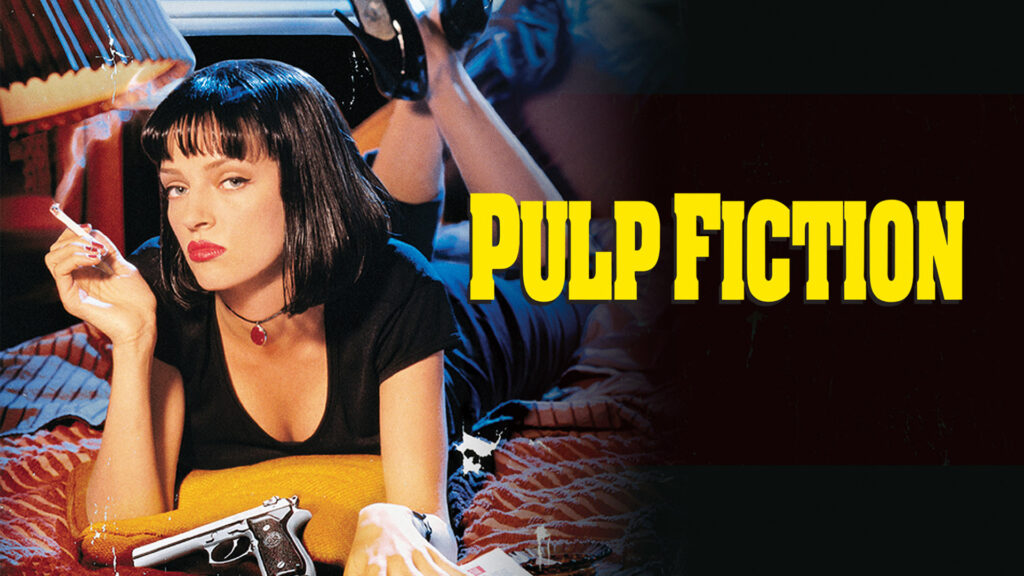
Uma Thurman’s Mia Wallace is an icon. With her sharp bob, white shirt, and black pants, she embodies a kind of dangerous, untouchable cool. Her performance is magnetic, balancing vulnerability with an almost supernatural confidence. The dance scene between Vincent and Mia at Jack Rabbit Slim’s—a 1950s-themed restaurant where the waitresses dress as Marilyn Monroe and Buddy Holly—is one of the most memorable moments in cinema history. It is a scene of pure, unadulterated cinematic joy, a celebration of movement, music, and chemistry.
Bruce Willis, as Butch Coolidge, brings a quiet, stoic intensity to the role of the boxer who decides to throw a fight and flee with his girlfriend. Willis is brilliant at conveying Butch’s internal conflict, his loyalty to his family’s legacy, and his ultimate, defiant decision to rescue his enemy, Marsellus Wallace (Ving Rhames), from a horrifying fate. The scene in the pawn shop is one of the most shocking and darkly humorous sequences in the film, a brutal exploration of power dynamics and the unexpected bonds that can form between enemies.
The supporting cast is equally brilliant. Harvey Keitel is perfectly cast as “The Wolf,” the fixer who arrives with a calm, professional demeanor to clean up a bloody mess. Tim Roth and Amanda Plummer bring a chaotic energy to the opening and closing diner scene. And Christopher Walken delivers a scene-stealing monologue as a traumatized Vietnam veteran, recounting a tale of a watch hidden in a most unlikely place. Each performance adds a layer of depth and texture to the film’s rich tapestry.
The Dialogue: A New American Vernacular
Perhaps Tarantino’s greatest contribution to cinema is his distinctive dialogue. He has a gift for creating conversations that are simultaneously mundane and profound, profane and poetic. The characters in Pulp Fiction don’t talk like people in most movies; they talk like real people, or rather, like a hyper-stylized, heightened version of real people. They discuss the difference between a Quarter Pounder with Cheese in America and a “Royale with Cheese” in France. They debate the morality of foot massages. They argue about the philosophical implications of a miraculous bullet.
This dialogue serves multiple purposes. It establishes character, builds tension, and creates a sense of lived-in authenticity. But it also serves as a kind of musical score, a rhythmic, melodic flow of words that is as captivating as any action sequence. Tarantino understands that the most dramatic moments often come not from explosions, but from conversations. The film’s most shocking moment—the accidental shooting of Marvin—is treated with dark, absurdist comedy, the characters debating the logistics of the disaster while Vincent desperately tries to clean the blood from his car.
The dialogue also reflects Tarantino’s deep love for pop culture. The characters reference everything from comic books and 1950s rock and roll to 1970s television shows and martial arts films. This self-referential quality makes the film feel like a celebration of the entire history of cinema and American culture.
Themes of Redemption, Chance, and Choice
Beneath its surface of violence and profanity, Pulp Fiction is a film of profound thematic depth. The central theme is redemption. Jules’s journey is one of spiritual awakening. He realizes that the miraculous survival of his bullet-ridden body was a sign from God, a signal that he should leave his life of violence behind. His decision to “try to be a shepherd” is a powerful statement about the possibility of change, even for the most hardened souls.
Butch also experiences a form of redemption. Despite his initial plan to betray Marsellus, he ultimately chooses to rescue him from a horrific situation. This act of courage, even at the cost of his own safety, suggests a moral code that transcends self-interest.
The film also explores the role of chance and choice in shaping our lives. The characters are constantly making decisions that lead to unexpected and often violent consequences. Vincent’s choice to take Mia on a date leads to a life-or-death situation. Butch’s choice to retrieve his father’s watch leads him into a brutal confrontation. Jules’s choice to walk away from the life of a killer sets him on a new path. The film suggests that while we may not always control our circumstances, we are defined by the choices we make.
Technical Mastery and Cultural Impact
Tarantino’s direction is bold, confident, and deeply cinematic. He weaves together the film’s disparate stories with a masterful command of tone and pacing. He understands when to linger on a scene and when to cut away. He uses music—from Dick Dale’s surf rock to Urge Overkill’s “Girl, You’ll Be a Woman Soon”—to create a unique, instantly recognizable atmosphere.
The film’s cultural impact is immeasurable. It revitalized John Travolta’s career, launched Samuel L. Jackson into superstardom, and established Tarantino as one of the most important filmmakers of his generation. It was nominated for seven Academy Awards, including Best Picture, and won the Palme d’Or at the 1994 Cannes Film Festival.
But its true legacy lies in its influence on filmmaking. Pulp Fiction inspired a wave of independent films and helped launch the careers of countless young directors. It proved that a movie could be both critically acclaimed and commercially successful, both challenging and wildly entertaining. It also demonstrated the power of a strong, distinctive voice in cinema.
Conclusion: A Masterpiece of Modern Cinema
Pulp Fiction is a film that changed the way we think about movies. It is bold, innovative, and deeply entertaining. It is a love letter to cinema, a celebration of pop culture, and a profound meditation on morality, chance, and redemption.
The final scene, in which Jules recounts his decision to abandon his life of violence, is a moment of quiet grace amidst the chaos. It is a reminder that even in a world of betrayal, violence, and moral ambiguity, there is still the possibility of change, of grace, of hope.
More than three decades after its release, Pulp Fiction remains a masterpiece, a film that feels as fresh and vital as the day it was first screened. It is a testament to the power of cinema to surprise, to challenge, and to entertain. It is a film that is, like its characters, both utterly cool and deeply human.