Some films entertain. A rare few transcend entertainment to become something deeper—a cultural phenomenon, a philosophical treatise, and a mirror held up to the darkest corners of the human psyche. Christopher Nolan’s The Dark Knight (2008) is one of those rare treasures. It didn’t just raise the bar for comic book adaptations; it obliterated it, proving that a film about a man in a cape could be as complex, morally ambiguous, and artistically ambitious as any prestige drama ever made .
More than fifteen years after its release, The Dark Knight remains the gold standard for the superhero genre—a gritty, sprawling epic that feels less like a comic book movie and more like a crime saga in the tradition of Heat or The Godfather. It is a film about chaos versus order, the nature of heroism, and the uncomfortable truth that sometimes, the line between the hero and the villain is thinner than we’d like to admit.
A City on the Brink
The film opens with a heist that immediately establishes the tone for what is to come. The Joker (Heath Ledger) and his crew rob a mob bank, and as the plan unfolds, the criminals systematically eliminate each other until the Joker stands alone, revealing his philosophy in a single, chilling line: “I believe whatever doesn’t kill you simply makes you stranger” .
This opening sequence is a microcosm of the entire film. It introduces a villain who operates without rules, who thrives on chaos, and who sees the world through a lens so twisted that it challenges everyone around him to confront their own darkest impulses.
At the center of the chaos is Bruce Wayne (Christian Bale), now in his third year as Batman. He has become more than a vigilante; he has become a symbol of hope for Gotham City. But he is tired, worn down by the weight of his crusade, and he sees a light at the end of the tunnel in Harvey Dent (Aaron Eckhart), Gotham’s charismatic district attorney. Dent is everything Bruce wishes he could be—a public figure, a man of integrity, a “white knight” who can clean up the city through legitimate means .
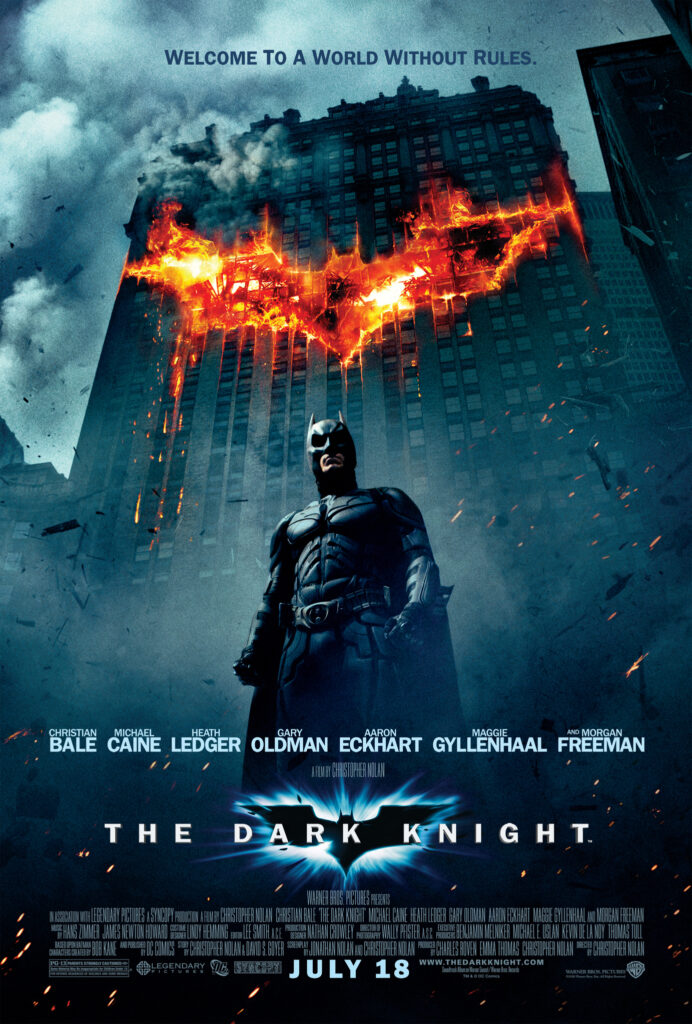
Bruce’s hope is that Dent can succeed where Batman cannot, allowing Bruce to finally retire and pursue a life with his childhood love, Rachel Dawes (Maggie Gyllenhaal). This is the classic arc of the hero seeking redemption, a man desperate to hang up the cape and find peace. But Nolan has no interest in allowing his characters such easy resolutions.
The Joker: An Icon of Chaos
No discussion of The Dark Knight is complete without acknowledging the towering achievement of Heath Ledger’s performance as the Joker. It is, without hyperbole, one of the greatest performances ever committed to film . Ledger disappeared into the role so completely that it is almost impossible to see the actor beneath the makeup.
His Joker is not a clown; he is an agent of chaos, a force of nature with no discernible origin and no clear motive . He isn’t interested in money or power. He tells Batman, “I don’t want to kill you. What would I do without you? You complete me.” This is a villain who exists not to destroy the hero, but to prove that the hero’s existence is a lie.
Ledger’s physicality is mesmerizing. He speaks with a lisp, licks his lips obsessively, and moves with a jerky, unpredictable energy that keeps everyone around him—and the audience—on edge . The “pencil trick” scene, in which he makes a pencil disappear into a gangster’s skull, is a masterclass in controlled menace.
The Joker’s philosophy is the true antagonist of the film. He represents the dark truth that civilization is a fragile construct, and that beneath the surface of order and morality lies a savage chaos that can be unleashed with the right push . His social experiments—the ferry boats loaded with explosives, the choice between saving Harvey Dent or Rachel Dawes—are designed to prove that human beings are inherently selfish and will abandon their principles when survival is at stake .
But here lies the film’s moral complexity: the Joker is not entirely wrong. Harvey Dent’s fall from grace proves that even the best of us can be corrupted. The citizens of Gotham, faced with impossible choices, reveal their capacity for both cruelty and compassion. The Joker is a trickster, a philosopher, and a monster all rolled into one unforgettable package.
The Tragedy of Harvey Dent
If the Joker is the film’s embodiment of chaos, Harvey Dent is its shattered hope. Aaron Eckhart delivers a powerhouse performance as Gotham’s “white knight,” a man whose unwavering belief in justice is both his greatest strength and his ultimate downfall .
Dent is introduced as the solution to Gotham’s problems. He is willing to take on the mob, he is fearless, and he believes in the system. Batman sees in Dent a successor, a man who can carry on the fight without hiding behind a mask. But Dent’s moral foundation is tested when tragedy strikes. The Joker, in his cruelest move, orchestrates the deaths of Rachel Dawes and the disfigurement of Dent’s face, turning the righteous man into the vengeful Two-Face.
Dent’s transformation is devastating because it is so believable. His descent into madness is not a sudden break; it is the natural result of a man who has been pushed too far. He loses his faith in the system, in God, and in the fundamental goodness of humanity. His decision to leave the fate of his enemies to a coin flip is a nihilistic rejection of justice itself. He has become what the Joker always knew he was: a man who could be broken.
The Vigilante and the System
At its core, The Dark Knight is a meditation on the nature of justice and the role of the vigilante. Batman is an outlaw, operating outside the law to protect it . He is a necessary evil, a figure who does what the system cannot or will not do. But the film constantly questions the validity of his methods.
The film asks: Can a hero be effective without becoming a villain? Is Batman’s presence inspiring hope, or is it attracting chaos? Commissioner Gordon (Gary Oldman) and Alfred (Michael Caine) serve as the moral anchors of the film, representing the voice of reason and the hope that Bruce Wayne can find a way out of the darkness.
The film’s climax, in which Batman takes responsibility for the deaths committed by Two-Face, is a profound act of sacrifice . He allows the city to hate him so that Dent’s legacy as a symbol of hope can survive. He becomes the villain to preserve the good. It is a gut-wrenching decision that redefines heroism not as glory, but as selflessness and endurance.
Technical Brilliance and Lasting Impact
Christopher Nolan’s direction is nothing short of visionary. He and his team, including cinematographer Wally Pfister, captured the film’s gritty, realistic aesthetic using IMAX cameras, making Gotham feel both expansive and claustrophobic . The film’s action sequences are grounded in practical effects, lending them a visceral intensity that CG-heavy blockbusters often lack. The truck chase sequence remains one of the most thrilling set pieces ever filmed.
Hans Zimmer and James Newton Howard’s score is a masterpiece of minimalism and menace. The Joker’s theme is a single, dissonant note that builds and builds, creating an unrelenting sense of dread. It is the sound of chaos, and it perfectly complements the film’s themes.
The film’s cultural impact is immeasurable. It became the highest-grossing film of 2008 and the second film ever to cross the $1 billion mark. It won two Academy Awards, including Best Supporting Actor for Ledger, a posthumous and deeply emotional victory .
But its true legacy lies in its influence. The Dark Knight proved that superhero films could be serious, complex, and artistically significant . It paved the way for a new era of “elevated” comic book films and inspired countless imitators. It is the benchmark against which all other superhero films are measured.
Conclusion: The Night Is Darkest Just Before the Dawn
The Dark Knight is a film of immense ambition and profound achievement. It is a story about the fragility of civilization, the cost of heroism, and the terrifying idea that sometimes, the villains are right. It is also a deeply human story about a man who is willing to sacrifice everything, even his own soul, to protect a city that may never truly appreciate him.
Batman’s final monologue to Gordon is the film’s thesis. He tells him: “I am whatever Gotham needs me to be.” He becomes the villain, the outlaw, and the symbol of hope all at once. It is a deeply tragic ending, but also one of profound hope.
Because in the end, the film suggests that heroism is not about glory or recognition. It is about doing what is right, even when the world will hate you for it. It is about being the silent guardian, the watchful protector, the Dark Knight.
And as the film fades to black, we are left with the haunting certainty that Bruce Wayne will carry the weight of his sacrifice alone. But we are also left with the hope that one day, the city he saved will know the truth. Because, as Alfred reminds us, “Sometimes the truth isn’t good enough. Sometimes people deserve more.”
The Dark Knight is that more. It is more than a movie; it is an experience, a mirror, and a masterpiece. It is a film that will be studied, debated, and revered for generations to come. And it is an offer you cannot refuse.