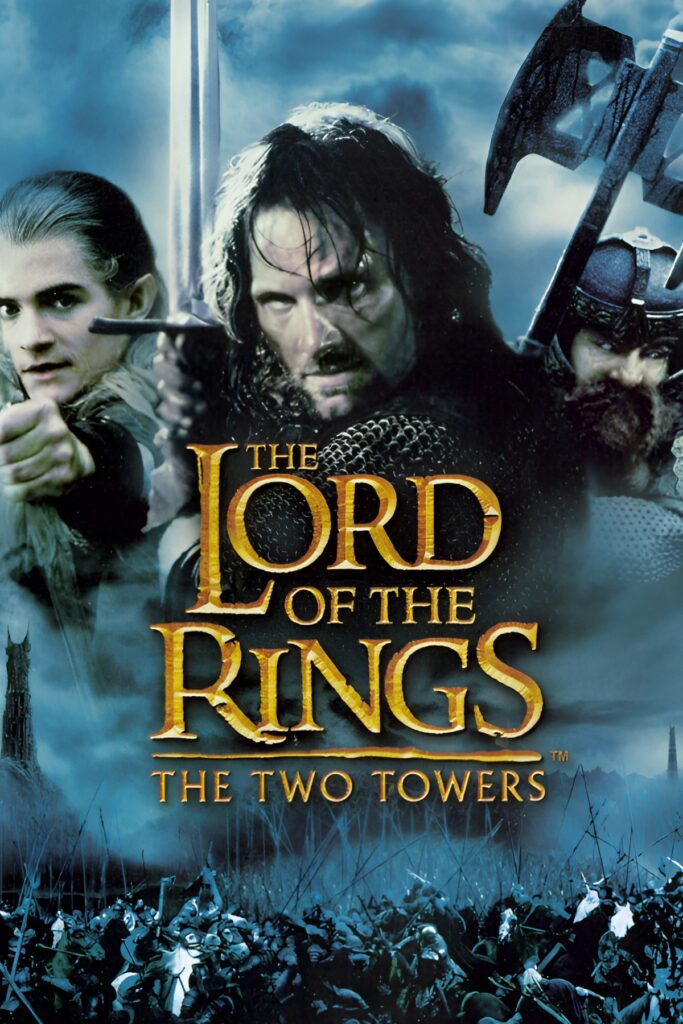
Some films entertain. A rare few transcend entertainment to become something deeper—a cultural milestone, a benchmark of ambition, and a defining moment for an entire genre. Peter Jackson’s The Lord of the Rings: The Two Towers (2002) is one of those rare treasures. It didn’t just continue one of the most ambitious filmmaking projects in history; it deepened the stakes, expanded the world, and delivered a middle chapter so powerful that it stands as the emotional and thematic heart of the entire trilogy.
More than two decades after its release, The Two Towers remains a monumental achievement. It faced the daunting task of being the bridge between the introduction of The Fellowship of the Ring and the epic conclusion of The Return of the King. It needed to darken the tone, raise the stakes, and deepen our investment in the characters—all while maintaining the momentum of a sprawling, nine-hour saga. It didn’t just meet these expectations; it exceeded them, delivering a film of breathtaking spectacle and profound emotional resonance.
A Trilogy Divided: Three Threads, One Purpose
The film’s structure is a masterclass in juggling multiple narratives. Unlike the first film, which followed the Fellowship as a single unit, The Two Towers splits its focus into three distinct storylines, each with its own tone, its own conflicts, and its own emotional arc. This fractured structure mirrors the breaking of the Fellowship itself, creating a sense of dispersion and vulnerability that permeates the entire film.
The Quest of the Ring-Bearer: Frodo and Sam
The heart of the film—and indeed, the entire trilogy—lies with Frodo (Elijah Wood) and Samwise Gamgee (Sean Astin). As they continue their perilous journey toward Mordor, they are joined by a new, deeply unsettling companion: Gollum (Andy Serkis). This is where the film’s emotional and thematic weight truly lies.
Gollum, a creature consumed by his obsession with the Ring, is a tragic figure. He is both a guide and a threat, a being who embodies the Ring’s corrupting power. His fractured personality—the tortured Sméagol and the treacherous Gollum—engages in constant, heartbreaking internal conflict. Andy Serkis’s performance, brought to life through groundbreaking motion-capture technology, is nothing short of revolutionary. He created a character of such depth and complexity that he redefined what was possible in digital performance.
The dynamic between Frodo, Sam, and Gollum is the film’s dramatic core. Frodo, burdened by the Ring’s ever-increasing weight, begins to show sympathy for Gollum, seeing in him a reflection of his own potential fate. Sam, ever the loyal protector, remains deeply suspicious of the creature, his instincts warning him of the danger Gollum represents. Their journey becomes a psychological battle, a test of loyalty, trust, and the limits of endurance. The film’s most devastating moment comes when Gollum’s manipulation causes Frodo to turn on Sam, the one person who has never abandoned him. It is a gut-wrenching scene that exposes the Ring’s power to destroy even the purest bonds.
The War of Men: Aragorn, Legolas, and Gimli
The second narrative thread follows Aragorn (Viggo Mortensen), Legolas (Orlando Bloom), and Gimli (John Rhys-Davies) as they track the hobbits Merry (Dominic Monaghan) and Pippin (Billy Boyd), only to find themselves drawn into the desperate conflict of the kingdom of Rohan.
This storyline delivers the film’s most spectacular action sequences. The Battle of Helm’s Deep, the siege of the ancient fortress by Saruman’s army of 10,000 Uruk-hai, is a staggering achievement in cinematic spectacle. It is a nightmarish, claustrophobic, and deeply visceral depiction of war, shot with a gritty, rain-soaked realism that makes the chaos feel immediate and terrifying.
Yet, amidst the carnage, this thread also provides the film’s most profound character moments. Aragorn’s journey is one of reluctant leadership. He is a man running from his destiny, a king who does not wish to claim his throne. Throughout The Two Towers, he is forced to confront his fears and step into the role he was born to play. His relationship with Éowyn (Miranda Otto), the fierce and lonely niece of King Théoden, is tinged with a tragic, unrequited longing. She sees in him the hope for a future beyond the endless war, but his heart belongs to Arwen (Liv Tyler), who is fading in the distant Elven realm.
Théoden (Bernard Hill) provides another layer of tragic depth. Once a proud king, he has been corrupted by Saruman’s influence, reduced to a broken, listless shell. His restoration by Gandalf (Ian McKellen) is a powerful moment, a reclaiming of agency and dignity. His decision to lead his people to the fortress of Helm’s Deep, even in the face of overwhelming odds, is an act of defiant courage.
The Ents and the War in the North: Merry, Pippin, and Treebeard
The third thread, involving Merry and Pippin, is the film’s most unexpected delight. After escaping the Uruk-hai, they stumble into Fangorn Forest and meet Treebeard (voiced by John Rhys-Davies), the ancient, slow-speaking leader of the Ents—the shepherds of the trees.
This storyline provides moments of levity and wonder amidst the darkness. The relationship between the two hobbits and the ancient Treebeard is charming and poignant. Treebeard, with his deliberate speech and his deep, patient wisdom, represents a power that is older and wiser than the petty conflicts of men and orcs. His eventual decision to march against the fortress of Isengard, with Merry and Pippin riding atop him, is one of the film’s most thrilling and cathartic moments. The destruction of Isengard is a powerful statement about the natural world rising up against industrial destruction, a theme that resonates deeply with Tolkien’s environmentalist concerns.
The Darkening Tone: A World on the Brink
The Two Towers is the darkest film in the trilogy. The world of Middle-earth is on the verge of collapse. The forces of Sauron are growing, Saruman has unleashed an army of ruthless Uruk-hai, and the Fellowship is broken and scattered. The film does not shy away from depicting the brutality of war, the despair of defeat, and the corrupting influence of power.
The introduction of Gollum deepens this darkness. He is a mirror held up to Frodo, a warning of what the Ring can do to a person. His scenes are often uncomfortable, even painful to watch, yet they are essential to the film’s themes. The Ring is not just an object; it is a psychological force, an addiction that consumes the soul. Gollum embodies that addiction, a tragic figure who is both a villain and a victim.
The film also explores the cost of hope. The Battle of Helm’s Deep is a desperate last stand. The characters know they are outnumbered, outmatched, and fighting a losing battle. Yet they fight anyway. Théoden’s speech before the charge is a powerful declaration of defiant hope in the face of overwhelming darkness:
“Forth, and fear no darkness! Arise! Arise, Riders of Théoden! Spears shall be shaken, shields shall be splintered! A sword day, a red day, ere the sun rises! Ride now! Ride now! Ride! Ride for ruin and the world’s ending! Death! Death! Death! Forth Éorlingas!”
It is a moment of pure, raw defiance, a refusal to surrender even when all hope seems lost.
Technical Mastery: Groundbreaking Effects and a Haunting Score
The Two Towers was a landmark in visual effects. The creation of Gollum, in particular, was a technological breakthrough. Andy Serkis’s performance was captured using motion-capture technology, and the character was then animated by the team at Weta Digital. The result was a character who felt real, who had weight, emotion, and a tragic humanity. Gollum became the gold standard for digital characters, paving the way for everything from Avatar to Planet of the Apes.
The Battle of Helm’s Deep was another technical marvel. The use of massive miniature sets, practical effects, and digital compositing created a battle sequence of unprecedented scale and realism. The rain, the mud, the explosions, and the sheer number of combatants made the siege feel like a real, chaotic, terrifying event.
Howard Shore’s score is once again a vital character in the film. The introduction of the Rohan theme, with its haunting violin melody, captures the sadness and nobility of the horse-lords. Gollum’s theme, a discordant, unsettling motif, perfectly captures his fractured psyche. The music elevates every scene, providing emotional depth and narrative cohesion.
Themes of Friendship, Loyalty, and the Fight for Hope
At its core, The Two Towers is about the power of friendship and loyalty in the face of overwhelming darkness. Sam’s unwavering devotion to Frodo is the film’s moral center. He refuses to abandon his friend, even when Frodo pushes him away. His speech at the end of the film is a beautiful articulation of the film’s themes:
“It’s like in the great stories, Mr. Frodo. The ones that really mattered. Full of darkness and danger they were. And sometimes you didn’t want to know the end, because how could the end be happy? How could the world go back to the way it was when so much bad had happened? But in the end, it’s only a passing thing, this shadow. Even darkness must pass. A new day will come. And when the sun shines, it will shine out the clearer.”
This is the heart of Tolkien’s vision—a belief that even in the darkest times, hope is not foolish. It is the only thing that makes the fight worth fighting.
Conclusion: The Soul of the Trilogy
The Lord of the Rings: The Two Towers is often described as the “dark middle chapter,” but it is so much more than that. It is the emotional and thematic heart of the trilogy, a film that deepens our investment in the characters, expands the world, and raises the stakes to a near-unbearable level.
The film’s final moments are a testament to its power. The battle is won, but the war is far from over. Sam stands beside Frodo, promising to carry him if he must, to see the quest through to the end. It is a moment of profound hope, a reminder that the greatest strength lies not in the sword, but in the bond between friends.
The Two Towers stands on its own as a masterpiece, but it also serves as the essential bridge between the beginning of the journey and its epic conclusion. It is a film of spectacular action, profound emotion, and enduring hope. It is the dark heart of the trilogy, and without it, the entire epic would lose its soul.