Some films entertain. A rare few transcend entertainment to become something deeper—a cultural touchstone, a life philosophy, a source of comfort and inspiration revisited time and again. Frank Darabont’s The Shawshank Redemption (1994) is one of those rare cinematic treasures. Its enduring reign at the top of IMDb’s list of greatest films isn’t a statistical anomaly; it’s a testament to a story that speaks to something universal and profound within us all .
Based on Stephen King’s novella Rita Hayworth and Shawshank Redemption, the film tells the story of Andy Dufresne (Tim Robbins), a successful banker wrongfully convicted of murder and sentenced to two consecutive life terms at the brutal Shawshank State Penitentiary . What unfolds is not just a prison drama, but an epic journey through despair, resilience, and the unyielding power of hope.
A Symphony of Performances
The film’s soul rests on the extraordinary performances of its leads. Tim Robbins delivers a career-defining performance as Andy Dufresne. He doesn’t play Andy with grand theatrics or explosive emotion; instead, he portrays a man of quiet, unshakeable internal fire. It’s in the steady gaze, the measured words, and the subtle defiance that Robbins makes Andy’s resilience so deeply compelling . He is a man whose spirit, even when caged, refuses to be broken.
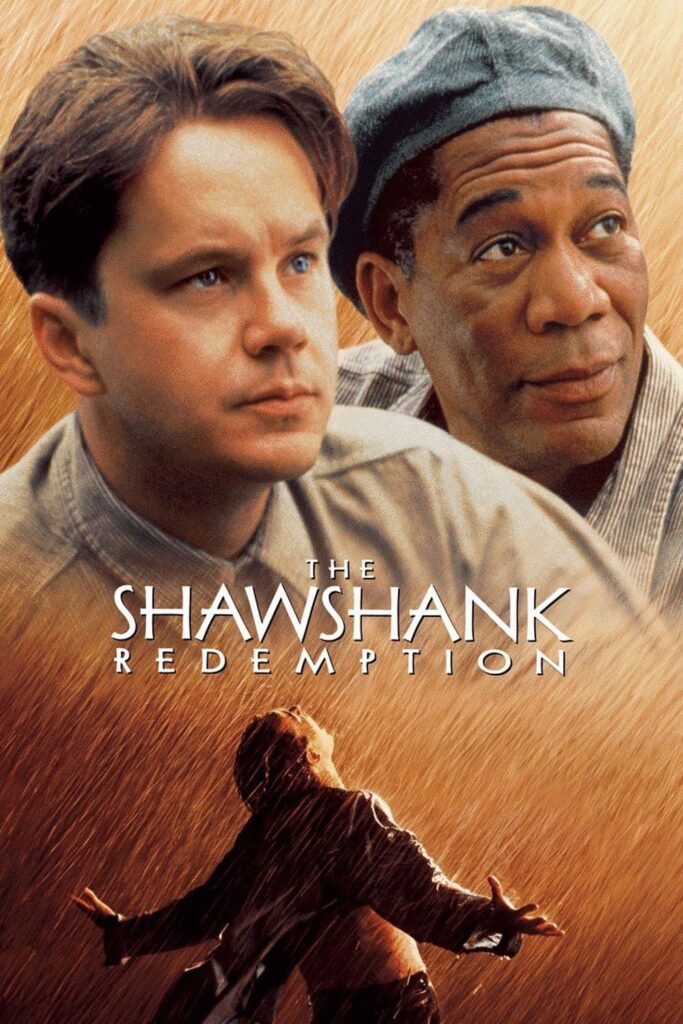
Opposite Robbins is Morgan Freeman as Ellis “Red” Redding, the prison’s “man who can get things.” Freeman’s performance is nothing short of iconic . His voice, rich and comforting as a gospel hymn, serves as the film’s moral compass and narrative anchor . As Red, Freeman embodies a man who has been institutionalized, accepting his life sentence as his reality. His journey, alongside Andy’s, from cynicism to renewed hope provides the film’s emotional core and most poignant moments. The chemistry between Robbins and Freeman is so natural and grounded that their friendship feels less like a plot point and more like a lifeline .
More Than a Prison Movie: Themes That Endure
The true power of The Shawshank Redemption lies in its profound exploration of enduring themes that resonate far beyond the prison walls.
Hope and Freedom
The film poses a central question: how does one survive when hope seems like the cruelest joke? Andy tells Red, “Hope is a good thing, maybe the best of things, and no good thing ever dies” . This isn’t naive optimism; it’s a defiant philosophy. Andy’s hope is an active, tangible force. It’s the determination to write letters for six years to build a library, the audacity to play Mozart’s Figaro over the prison’s loudspeaker, and the patience to spend 19 years carving an escape route with a rock hammer . For the men of Shawshank, even simple moments, like sharing a beer on a hot roof while tarring it, become powerful acts of reclaiming their humanity and tasting freedom .
The Weight of Institutionalization
Perhaps the film’s most heartbreaking theme is the concept of “institutionalization”—the process by which prisoners become so dependent on the prison’s routines and walls that they can no longer function outside them . This is tragically personified by Brooks Hatlen (James Whitmore), an elderly librarian who, after serving 50 years, is released into a world he no longer understands. His suicide is a devastating reminder that prison doesn’t just take away freedom; it can rob a person of the very ability to live. Red himself nearly falls into the same trap, the institutionalization “creeping up on him,” as he puts it, until Andy’s promise of a life in Zihuatanejo, Mexico, rekindles his will to truly live . The film’s powerful mantra, “Get busy living, or get busy dying,” becomes the ultimate rejection of a half-life of resignation .
The Mechanics of a Masterpiece
Darabont’s direction is masterful in its restraint. He allows the story to unfold with the same meticulous patience Andy employs for his escape . The 142-minute runtime is never a burden; every scene adds depth and meaning . This is amplified by Roger Deakins’ stunning cinematography, which captures both the bleak, gray oppression of the prison and the transcendent beauty of the world beyond its walls . The score by Thomas Newman is haunting and unforgettable, weaving through the narrative like a quiet, persistent whisper of hope and redemption . The film is a technical triumph that never lets its craft overshadow its emotional and thematic weight.
Conclusion: An Enduring Legacy
The Shawshank Redemption is more than just a movie; it is an experience, a parable, and for many, a companion through their own dark times . Its themes of hope, resilience, injustice, and the profound need for human connection are timeless and universal . It reminds us that while circumstances can confine our bodies, they cannot imprison our minds and spirits.
It is a film that affirms our deepest humanity, whispering to us that even in the deepest darkness, a sliver of light can be found. It teaches us that hope is not a weakness, but a weapon of the soul. And it leaves us with the simple, powerful wish: “I hope to see my friend and shake his hand. I hope the Pacific is as blue as it has been in my dreams. I hope” . That is the legacy of this brilliant film, an eternal reminder that the story of the human spirit is always one of endurance, friendship, and the audacious belief in a better tomorrow.