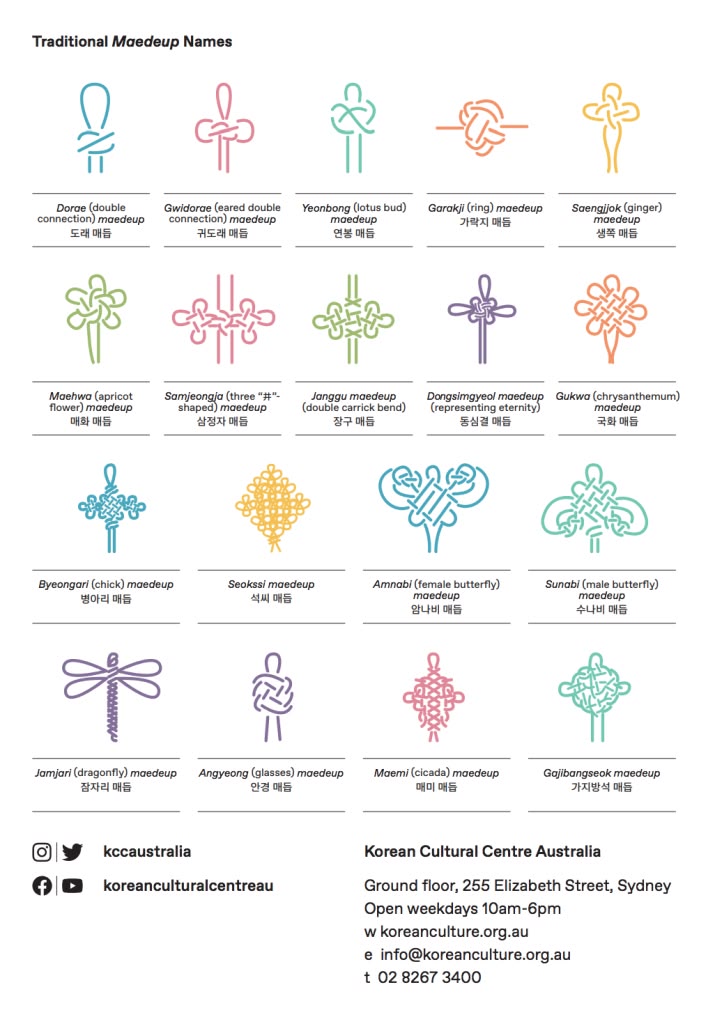
Maedeup (매듭) is the traditional Korean art of decorative knotting. For centuries, these knots have adorned clothing, accessories, wedding ceremonies, and Buddhist rituals. Unlike purely practical knots, Maedeup is a refined craft where the knot itself is the decoration — beautiful, symmetrical, and rich with meaning.
Traditional Korean Maedeup: Complete Guide to 18 Decorative Knots
In this guide, you will learn:
The full meaning of 18 traditional Maedeup knot names
Korean pronunciation (Hangul and romanization)
Cultural symbolism and traditional uses
English equivalents and descriptions
This guide is based on information from the Korean Cultural Centre Australia (KCC Australia) , located in Sydney.
Why Learn Korean Maedeup?
Benefit
Explanation
Rich cultural heritage
Maedeup is an important part of Korean traditional arts (along with hanbok, hanji, and jangseung)
Unique knot styles
Korean knots have distinctive shapes and symmetrical beauty
Symbolic meanings
Each knot carries wishes for luck, love, longevity, or protection
Used in modern crafts
Incorporate Maedeup into jewelry, keychains, bookmarks, and accessories
Meditative practice
Tying Maedeup requires focus and patience, similar to meditation
Part 1: Basic & Connection Knots
1. 도래 매듭 (Dorae Maedeup) — Double Connection Knot
Attribute
Detail
Hangul
도래 매듭
Romanization
Dorae Maedeup
English
Double Connection Knot
Similar to
Chinese 双联结 (Double Connection), Japanese 双連結び
Symbolism
Unity, connection, harmony
Difficulty
Easy
Use
Joining two cords, starting and ending many Maedeup projects
How to identify: Two interlocking loops that lie flat against each other. The most fundamental Korean knot.
“가지” (gaji) = branch; “방석” (bangseok) = cushion / mat
Difficulty
Hard
Use
Complex decorative pieces, traditional norigae
18. 석씨 매듭 (Seokssi Maedeup) — Seok Family Knot
Attribute
Detail
Hangul
석씨 매듭
Romanization
Seokssi Maedeup
English
Seok Family Knot
Meaning
“석씨” (Seokssi) = the Seok family name — this knot may be named after a specific knotting master or family tradition
Difficulty
Expert
Use
Heirloom pieces, master-level work
Part 6: Complete Quick Reference Table
#
Hangul
Romanization
English
Difficulty
Symbolism
1
도래 매듭
Dorae
Double Connection
Easy
Unity
2
귀도래 매듭
Gwidorae
Eared Double Connection
Easy–Med
Connection + ears
3
연봉 매듭
Yeonbong
Lotus Bud
Medium
Purity, enlightenment
4
매화 매듭
Maehwa
Apricot Flower
Med–Hard
Resilience, spring
5
국화 매듭
Gukwa
Chrysanthemum
Hard
Longevity, autumn
6
병아리 매듭
Byeongari
Chick
Medium
New life, cuteness
7
잠자리 매듭
Jamjari
Dragonfly
Med–Hard
Courage, happiness
8
매미 매듭
Maemi
Cicada
Hard
Rebirth, immortality
9
암나비 매듭
Amnabi
Female Butterfly
Hard
Marital joy (female)
10
수나비 매듭
Sunabi
Male Butterfly
Hard
Marital joy (male)
11
가락지 매듭
Garakji
Ring
Medium
Eternity
12
생쭉 매듭
Saengjjak
Ginger
Medium
Organic texture
13
삼정자 매듭
Samjeongja
Three “#” shape
Hard
Abundance, order
14
장구 매듭
Janggu
Double Carrick / Hourglass
Med–Hard
Music, rhythm
15
동심결 매듭
Dongsimgyeol
Eternal Unity / Same Heart
Hard
Everlasting love
16
안경 매듭
Angyeong
Glasses
Medium
Whimsy
17
가지방석 매듭
Gajibangseok
Branch Cushion
Hard
Traditional decoration
18
석씨 매듭
Seokssi
Seok Family
Expert
Master-level work
Part 7: Traditional Use — Norigae (노리개)
Maedeup knots are most commonly seen on norigae (노리개) — traditional Korean pendant ornaments worn by women on their hanbok (traditional clothing). A typical norigae consists of:
Component
Description
Maedeup (knot)
The decorative centerpiece
Sulp (술)
Tassel hanging below
Pendant
Jade, silver, or gold ornament attached below the tassel
Confusing Maehwa (apricot) with Gukwa (chrysanthemum)
Both are flower knots
Maehwa has 5 petals; Gukwa has many more
Butterfly knots look the same
Need to see male vs. female
Female (Amnabi) = rounder wings; Male (Sunabi) = sharper wings
Dorae and Gwidorae mixed up
Both are double connections
Gwidorae has extra ear loops
Janggu (drum) knot collapses
Hourglass shape not pinned
Use pins to hold the narrow center while tightening
Norigae tassel uneven
Cut without measuring
Wrap tape around the tassel before final trim
SEO Blog Post Optimization
Meta Tag
Suggested Content
Title
Traditional Korean Maedeup: Complete Guide to 18 Decorative Knots
Meta Description
Learn 18 traditional Korean Maedeup knots, including Dorae, Yeonbong, Maehwa, Butterfly, Dragonfly, Cicada, and Dongsimgyeol. Meanings, uses, and cultural context.
URL slug
/korean-maedeup-knots-guide
Keywords
Korean maedeup, 매듭, traditional Korean knots, dorae maedeup, yeonbong maedeup, norigae, Korean Cultural Centre Australia
Alt text for image
Traditional Korean Maedeup knot chart from the Korean Cultural Centre Australia showing 18 knot names in Hangul and English including Dorae, Gwidorae, Yeonbong, Garakji, Saengjjak, Maehwa, Samjeongja, Janggu, Dongsimgyeol, Gukwa, Byeongari, Seokssi, Amnabi, Sunabi, Jamjari, Angyeong, Maemi, and Gajibangseok
Final Pro Tip: Visit the Korean Cultural Centre
Your image includes the address of the Korean Cultural Centre Australia:
Detail
Information
Location
Ground floor, 255 Elizabeth Street, Sydney
Hours
Weekdays 10am–6pm
Website
koreanculture.org.au
Email
info@koreanculture.org.au
Phone
02 8267 3400
If you are in Sydney, visit the centre to see traditional Maedeup demonstrations, attend workshops, or view historical norigae in person.
Summary: You Can Now Identify 18 Korean Maedeup Knots