Thank you for sharing this Paracord Projects Guide – Shark Jaw Bone Bracelet page. This is a complete pattern that combines multiple techniques: a diamond lanyard knot, a loop closure, and a structured weave (possibly a variation of the cobra or shark jaw pattern). Below is a complete how-to guide, full meaning, and full understanding of every step.
How to Make a Shark Jaw Bone Paracord Bracelet: Complete Guide & Understanding
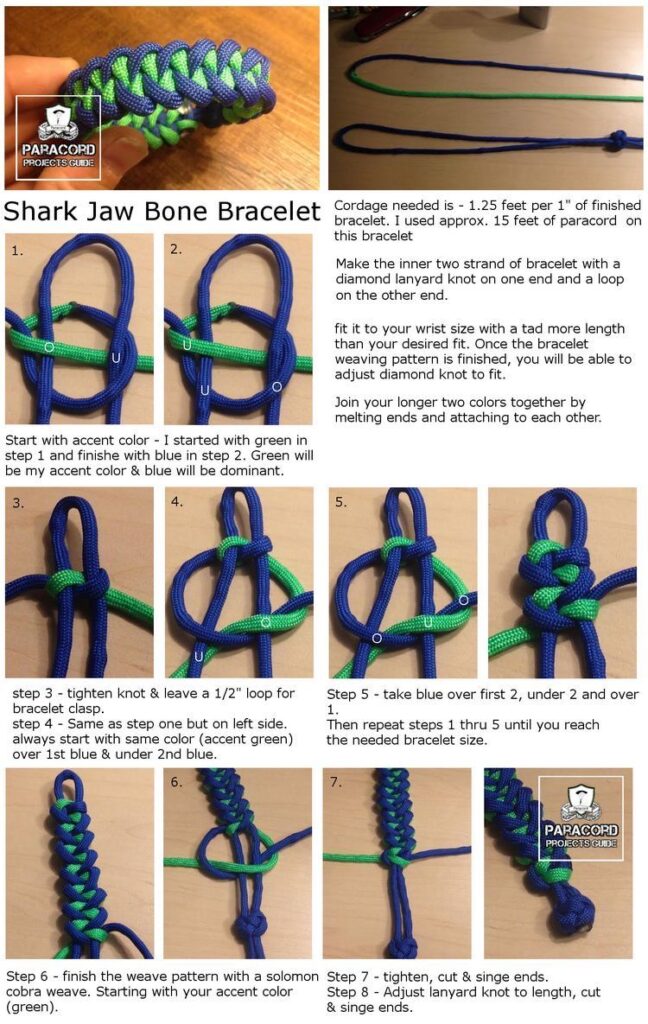
Full Meaning of “Shark Jaw Bone Bracelet”
| Term | Meaning |
|---|---|
| Shark Jaw Bone | A paracord weave pattern that creates a jagged, interlocking V-shape resembling the teeth or jawbone of a shark |
| Appearance | Alternating diagonal bands that cross each other, forming a zigzag “bite” pattern |
| Structure | Uses two colors (accent and dominant) with a specific over/under sequence |
| Origin | A more complex relative of the cobra weave and turbine blade |
Unlike a standard cobra (which is flat and horizontal), the shark jaw creates pointed, tooth-like projections along the edges.
Full Understanding: Cordage Formula
| Formula | Meaning |
|---|---|
| 1.25 feet per 1 inch of finished bracelet | For every inch of final bracelet length, you need 1.25 feet of cord |
| Example: 15 feet used | That means the finished bracelet length was approximately 12 inches (15 ÷ 1.25 = 12) |
Applying to Your Wrist
| Wrist Size | Cord Length Needed (Total) |
|---|---|
| 6 inches | 7.5 feet |
| 7 inches | 8.75 feet |
| 8 inches | 10 feet |
| 9 inches | 11.25 feet |
This total cord length is split between the inner core strands and the two weaving colors.
Full Understanding: Structure Breakdown
The Shark Jaw Bone bracelet has three structural elements:
| Element | Description |
|---|---|
| Inner two strands | Core of the bracelet; made with a diamond lanyard knot on one end and a loop on the other |
| Accent color (green) | Starts the weave; becomes the visible “teeth” |
| Dominant color (blue) | Finishes the weave; fills the background |
Step-by-Step Color Roles
| Step | Color Role |
|---|---|
| Step 1 | Green (accent) starts |
| Step 2 | Blue (dominant) finishes |
| Throughout | Always start the same side with accent color (green) |
How-To Guide: Shark Jaw Bone Bracelet
Materials
- Total cord length = wrist size (inches) × 1.25 feet
- Split into:
- Two inner core strands (length = wrist size + 6 inches each)
- Accent color (green) – approximately 40% of total
- Dominant color (blue) – approximately 60% of total
- Lighter (for melting paracord ends)
- Scissors
Step 1 — Make the Inner Core with Diamond Lanyard Knot
Take the two inner strands. Tie a diamond lanyard knot at one end. At the other end, create a small loop (large enough to fit the diamond knot through).
The diamond lanyard knot is a cylindrical, four-strand stopper knot. If you haven’t tied one before, it resembles a rounded, woven bead.
Step 2 — Fit to Wrist Size
Place the inner core around your wrist. Adjust so it is slightly longer than your desired fit (about 1/2 inch extra). After the outer weave is finished, you will adjust the diamond knot to tighten or loosen.
Step 3 — Join the Two Longer Colors
Melt the ends of the green and blue cords and attach them to each other (end-to-end weld). This creates one continuous cord with a color change in the middle.
Alternatively, you can use two separate cords and just switch which one is active.
Step 4 — Start with Accent Color (Green)
Position the joined cord so green is the working end.
Cross green over the first blue (core strand?), under the second blue, and pull through.
(The image text is partially cut, but the pattern is a specific over/under sequence.)
Step 5 — Tighten and Leave a ½” Loop
Pull the knot tight. Leave approximately ½ inch of loop at the start — this will become the bracelet clasp (the diamond knot will pass through it).
Step 6 — Mirror on the Left Side (Step 4 repeated)
Repeat the same motion on the left side:
Always start with the same color (accent green) over first blue, under second blue.
Step 7 — Dominant Color Pass (Step 5)
Take the blue (dominant) cord:
- Over the first 2 strands
- Under 2 strands
- Over 1 strand
Then repeat steps 1 through 5 (the green accent sequence) until you reach the needed bracelet size.
This alternating sequence (green accent sequence → blue dominant pass → green accent sequence) creates the shark jaw “teeth.”
Step 8 — Finish with Solomon Cobra Weave (Step 6)
After completing the shark jaw pattern, finish the bracelet with a Solomon cobra weave (standard cobra/square knot weave) starting with your accent color (green).
This cobra section acts as a transition or decorative end band.
Step 9 — Tighten, Cut & Singe Ends (Step 7)
Pull all knots firm. Cut excess cord close to the knot. Singe (melt) the ends with a lighter and press flat.
Step 10 — Adjust Lanyard Knot (Step 8)
Slide the diamond lanyard knot along the inner core to adjust the bracelet length to your wrist. Cut any remaining excess from the inner core and singe.
Shark Jaw vs. Other Weaves You Know
| Weave | Shape | Color Role | Difficulty |
|---|---|---|---|
| Cobra | Flat, horizontal | Two colors alternating | Easy |
| Turbine blade | Diagonal, spiral | Unequal lengths | Medium–Hard |
| LIND-Z | Dense diagonal, Z-shaped | Unequal lengths (1.73:1) | Hard |
| Shark jaw bone | Jagged, tooth-like V-shape | Accent starts, dominant finishes | Hard |
The shark jaw is unique because:
- The accent color always starts the sequence
- The dominant color always finishes the sequence
- The over/under counts change (over 1, under 2, over 1)
Applying to Your Artisanal Purple Macrame Bracelet
Color Suggestions
| Role | Purple Color | Length (for 7″ wrist) |
|---|---|---|
| Inner core | Dark eggplant | 7″ + 6″ = 13″ each (two strands) |
| Accent (starts weave) | Lavender | ~3.5 ft |
| Dominant (finishes weave) | Deep violet | ~5.25 ft |
Step-by-Step Purple Version
- Inner core: Tie a diamond lanyard knot in dark purple cord. Leave a ½” loop at the other end.
- Join colors: Melt and weld lavender and deep violet together.
- Start weave: Lavender over first deep violet core, under second deep violet core.
- Mirror left: Same lavender sequence on left side.
- Dominant pass: Deep violet over first 2, under 2, over 1.
- Repeat until bracelet reaches desired length.
- Finish with cobra in lavender.
- Adjust diamond knot to fit wrist.
Common Mistakes & Fixes
| Mistake | Cause | Fix |
|---|---|---|
| Shark “teeth” not visible | Over/under sequence incorrect | Review: accent over 1 core, under 2 core; blue over 2, under 2, over 1 |
| Bracelet too long/short | Inner core not fitted before weaving | Test fit the inner core around your wrist before adding the outer weave |
| Diamond knot won’t move | Tied too tight or glued | Do not glue the diamond knot; it must slide for adjustment |
| Colors reversed | Started with dominant instead of accent | Always start each sequence with the accent color |
| ½” loop too small or large | Clasp loop not measured | The diamond knot must fit through; test before finishing |
Final Pro Tip: The “Solomon Cobra” Finish
The instructions mention finishing with a Solomon cobra weave. This is simply another name for the standard cobra/square knot weave you already learned from your French and paracord guides. Use the accent color (lavender) for this final section to tie the design together visually.
Summary: Shark Jaw Bone Bracelet at a Glance
| Element | Specification |
|---|---|
| Cord formula | 1.25 ft per 1 inch of finished bracelet |
| Structure | Inner core + two-color weave + cobra finish |
| Key technique | Accent always starts, dominant always finishes |
| Closure | Diamond lanyard knot + ½” loop |
| Difficulty | Hard (requires precise over/under counting) |
| Best for | Statement bracelets, two-tone designs, masculine styles |


