How Game Developers are Hacking Your Brain: The Science of ‘zigzag’ Daily Rewards
Discover the psychological science behind daily login rewards in mobile game. Learn how developers use variable ratio reinforcement, loss aversion, and habit loops to keep you coming back.
Keywords: daily reward psychology, game addiction science, variable ratio reinforcement, loss aversion gaming, mobile game engagement mechanics
Introduction: That Little Inbox Notification Isn’t an Accident
You know the feeling. It’s 11:45 PM. You’re exhausted. Tomorrow is an early meeting. But you haven’t claimed your daily login reward yet. One more day and you get the premium currency you’ve been saving for.
So you open the app. You tap the icon. You watch the animation play. And you finally go to bed.
That little dopamine hit wasn’t accidental. It was engineered.
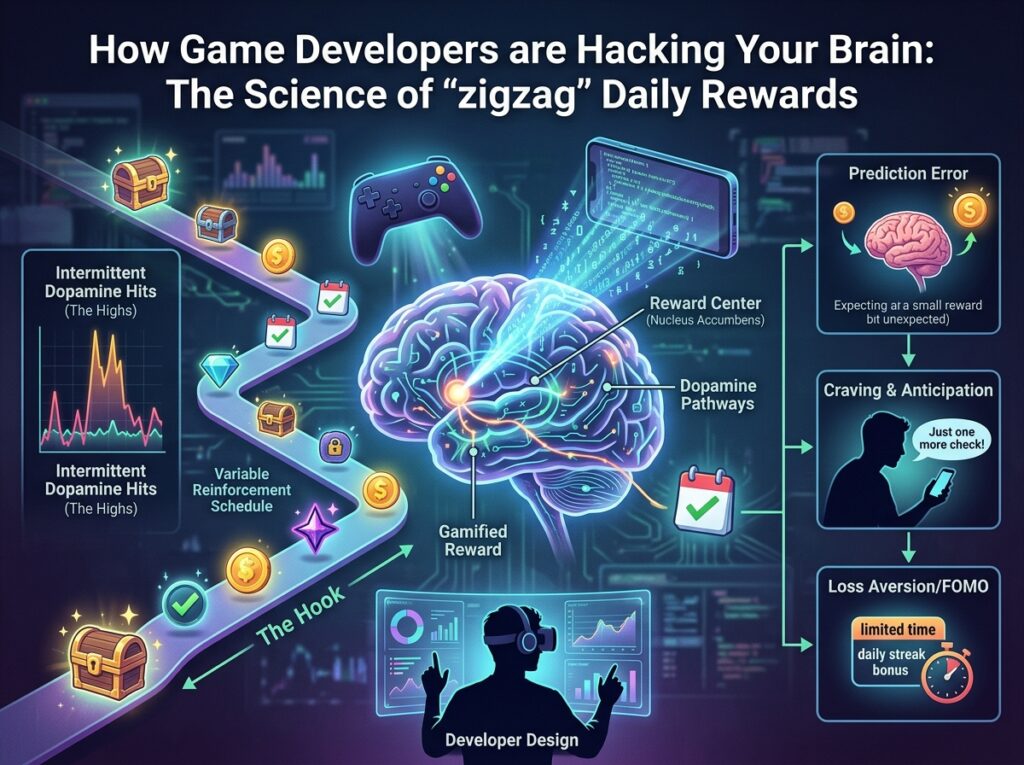
Game developers aren’t just making entertainment anymore. They’re applying decades of behavioral psychology research to create engagement systems that hack directly into your brain’s reward pathways. And one of the most powerful—yet least understood—tools in their arsenal is the “zigzag” daily reward system.
Let me show you how it works and why your brain can’t resist it.
The Psychology of Variable Rewards: Why Surprise Beats Certainty
The Dopamine Difference
Here’s the fundamental truth that game designers know and exploit: your brain releases more dopamine when a reward is unpredictable than when it’s guaranteed.
Think about it. If someone tells you, “I’ll give you $10 tomorrow,” you feel mildly pleased. But if they say, “I’ll give you either $1 or $100 tomorrow, and you won’t know which until you show up” — you’re far more likely to actually show up. The uncertainty creates anticipation. Anticipation drives behavior.
This is the core principle behind what psychologists call variable ratio reinforcement.
The Four Reinforcement Schedules
Behavioral psychology identifies four distinct ways to deliver rewards. Understanding these is key to understanding why games feel the way they do:
| Schedule Type | How It Works | Example in Gaming |
|---|---|---|
| Fixed Interval | Reward after a set amount of time | Daily login bonus (every 24 hours) |
| Variable Interval | Reward after unpredictable time | Random event rewards, surprise gifts |
| Fixed Ratio | Reward after set number of actions | “Win 5 battles for a reward” |
| Variable Ratio | Reward after unpredictable number of actions | Loot boxes, random drops from enemies |
The daily login system is a classic fixed interval schedule. You perform the same action (logging in) at the same interval (every 24 hours) and receive a predictable reward.
But here’s where it gets interesting: the most addictive games layer variable rewards on top of fixed ones. That’s the “zigzag” effect. You get your guaranteed daily reward, but you also might get something extra — a random bonus, a rare item drop, an unexpected gift.
That uncertainty is what keeps you checking, even when you know your guaranteed reward is days away.
The Slot Machine in Your Pocket
Loot boxes represent the purest form of variable ratio reinforcement in gaming. They’re digital slot machines dressed up as treasure chests or card packs.
You know roughly what’s inside. You don’t know specifically. This creates tension. It resolves into either excitement or disappointment. And either way, you’re already thinking about the next one.
The psychological mechanism is identical to what makes gambling addictive. The unpredictability produces a high and steady rate of responding — meaning players keep pulling that lever long after the rewards stop being worthwhile.
The Zigzag Effect: How Daily Rewards Create Psychological Hooks
Now let’s talk specifically about daily reward systems and why they’re so effective at forming habits.
The Habit Loop Engine
Streak systems are built directly upon the habit loop model from behavioral psychology: Cue → Action → Reward.
The cue is time-based and externalized — often a notification, a countdown timer, or a visual reminder that “today’s reward is waiting.”
The action has minimal friction: opening the app, logging in, performing a single tap.
The reward is rarely the tangible item itself. The true reward is continuity — the preservation of the streak.
Over time, the loop becomes self-reinforcing. You no longer log in for the reward. You log in to maintain the pattern. What required conscious decision-making becomes automatic behavior.
Escalating Rewards: Why Day 7 Feels More Valuable Than Day 3
Think about how most daily reward calendars are structured:
- Day 1: 50 coins
- Day 2: 60 coins
- Day 3: 75 coins
- Day 4: 90 coins
- Day 5: 100 coins + a common item
- Day 6: 120 coins
- Day 7: 200 coins + a rare item
This is the escalation pattern. The rewards get progressively better the longer you maintain the streak. Day 7’s reward is significantly more valuable than Day 1’s.
But here’s the psychological twist: the value of the streak itself grows disproportionately over time.
A 30-day streak feels far more precious than thirty individual logins. As the number increases, so does the psychological weight of maintaining it. The longer the streak, the higher the perceived cost of failure.
The “Use It or Lose It” Mechanic
Some games have taken this further with what developers call the “Use It or Lose It” mechanic. Rewards expire if not claimed within a specific timeframe.
This activates a powerful cognitive bias called loss aversion: humans feel losses more intensely than equivalent gains. Losing a $5 bill feels worse than finding a $5 bill feels good.
When your daily reward will vanish if you don’t claim it, missing that claim isn’t just failing to gain something. It feels like losing something you already owned.
The system converts absence into punishment. Nothing is taken away except the streak itself — yet the emotional response often includes guilt, anxiety, and regret.
Loss Aversion and FOMO: The Real Drivers of Daily Logins
Let’s dive deeper into the two psychological forces that make daily rewards so effective: Loss Aversion and FOMO (Fear of Missing Out).
Loss Aversion: Why Breaking a Streak Hurts
Research in behavioral economics has consistently shown that losses hurt about twice as much as gains feel good.
Game designers exploit this relentlessly.
When you have a 30-day streak, you’ve invested 30 days of consistent behavior. That streak represents accumulated effort, time, and consistency. Breaking it doesn’t just mean missing a reward — it means losing something you’ve built.
The system never explicitly punishes you. Yet you feel punished anyway. That feeling isn’t a bug. It’s the feature.
FOMO: The Countdown Timer Effect
Limited-time events and expiring rewards trigger a distinct psychological response called Fear of Missing Out.
When you see a countdown timer showing that an exclusive reward will disappear in 2 hours, your brain’s urgency response activates. Rational decision-making gets bypassed. You act quickly to avoid the anticipated regret of missing out.
This is why so many games prominently display:
- “Reward resets in: 02:14:33”
- “Last chance to claim!”
- “Only 24 hours remaining!”
These aren’t helpful reminders. They’re psychological triggers designed to create urgency and drive immediate action.
The Soft Behavioral Contract
From a design perspective, streaks function as soft contracts. They impose no legal or financial obligation, yet create strong psychological commitment through visibility and continuity.
Visual progress indicators — numbers, flames, chains, badges — play a key role here. They externalize commitment and make it measurable. Once visible, progress demands protection. The system doesn’t need to coerce; the user self-polices.
How Different Game Genres Use Appointment Mechanics
Not all daily reward systems are created equal. Different genres use different approaches based on their player psychology.
Casual Games
Casual games focus on simple, daily gift systems without complex task layers. The barrier to entry is extremely low — open the app, tap the button, get your reward.
These games rely on the sheer weight of repetition to form habits. The reward itself is often secondary to the ritual of claiming it.
Mid-Core Games
Mid-core games add a task/quest layer to their appointment mechanics. You don’t just get a reward for logging in. You get rewards for completing specific actions: winning battles, upgrading characters, finishing challenges.
These games tie daily engagement directly to progression. If you don’t log in and complete your dailies, you fall behind.
Casino Games
Casino games stand out for offering multiple rewards per day. Players can collect chip handouts every few hours, not just once daily.
This creates multiple touchpoints throughout the day and increases the total time players spend thinking about the game.
RPGs and Gacha Games
These games often feature online time rewards — bonuses for keeping the application open. This incentivizes not just logging in, but staying logged in for extended periods.
They also leverage limited-time banners for rare characters or items. The 48-hour countdown creates extreme urgency and drives impulsive spending.
The Sunk Cost Trap: Why You Can’t Quit
Here’s where the system gets really insidious. Every hour played and every dollar spent makes quitting harder. Games leverage this through what psychologists call the sunk cost fallacy.
Account-Bound Progress
Your account represents years of accumulated items, completed achievements, and ranked progress — and it exists only in that game. Starting fresh means abandoning not just the content but the investment itself.
Many players stopped enjoying a game long ago. They continue playing out of reluctance to waste what they’ve built.
Money Spent = Rationalization Required
Players who’ve spent money rationalize grinding to get their money’s worth. They’re not having fun anymore? Doesn’t matter. The more spent, the harder it becomes to admit the game isn’t worth it.
Developers understand this progression. Small initial purchases lower psychological barriers. Then they introduce higher-priced options. Before you know it, you’ve spent $100 on a free game.
Social Investment
This might be the strongest hook of all. Friendships formed through gameplay become reasons to keep playing. Guild responsibilities create expectations. Competitive rankings establish identities.
The game becomes a social platform as much as entertainment. The decision to quit becomes about more than just the game itself — it feels like abandoning relationships and responsibilities.
The Ethical Question: Engagement or Exploitation?
At what point does encouraging healthy habits become extracting compliance?
The Case for Engagement
Proponents of gamification argue that daily reward systems create positive habits. Language learning apps like Duolingo have demonstrated that streaks can significantly improve learning outcomes. Learners who reach a 7-day streak are 2.4 times more likely to continue using the app than learners without streaks.
When used ethically, these systems can help users achieve personal goals: learning a language, exercising regularly, meditating daily.
The Case Against Exploitation
The ethical tension is that streak systems are indifferent to user context.
Life interruptions — illness, travel, burnout — are treated identically to disinterest. The system offers no distinction between inability and choice. It reinforces a rigid model of engagement that prioritizes consistency over well-being.
When streaks are paired with monetization — paid streak recovery, premium bonuses, time-limited offers — the line between motivation and exploitation becomes even thinner.
Research on Psychological Harm
Studies report that manipulative game mechanics lead to “emotional exhaustion, decreased enjoyment, anxiety, depression, and compromised trust among gamers”.
Your gameplay patterns become datasets for more effective psychological targeting. The system learns what keeps you hooked and refines its approach.
How to Protect Yourself While Still Enjoying Games
You can still enjoy games while recognizing these tactics. Here’s how:
Notice Artificial Urgency
When you see a countdown timer, pause. Ask yourself: “Do I actually want this reward, or am I just responding to the timer?”
Making the urgency conscious reduces its power over you.
Question the “Reward”
Is this “reward” actually enhancing your experience, or is it just creating an obligation? Many daily rewards have no real value — they’re just tokens in a system designed to keep you logging in.
Set Exit Points
Decide your stopping point before you start. “I will stop playing after I complete this chapter” or “I will not spend more than $5 on this game.”
Write it down. Tell a friend. Create accountability.
Take Intentional Breaks
If you feel anxious about breaking a streak, break it on purpose. Miss a day intentionally. See what happens.
You’ll likely discover that nothing bad occurs. The game still works. Your progress isn’t erased. The only thing you lose is the psychological weight of obligation.
Limit Your Daily Games
You cannot maintain streaks in 10 different games. That’s not discipline failure — that’s math. There are only 24 hours in a day.
Choose one or two games for daily engagement. Everything else? Let the streaks break.
Conclusion: Knowledge Is the Best Defense
Game developers aren’t evil for using these techniques. They’re running businesses in a competitive market, and engagement drives revenue. The science of behavioral psychology simply works.
But knowledge is the best defense.
When you understand that the anxiety you feel about missing a daily login isn’t a reflection of your character but an engineered response to a reinforcement schedule, you regain some control. When you recognize that the “reward” is often just a token designed to trigger a habit loop, you can choose whether to participate or opt out.
The best games respect your time and agency. They don’t need to manipulate your psychology to keep you engaged.
So by all means, claim your daily rewards. Just know why you’re doing it.
Frequently Asked Questions
What is a “zigzag” daily reward system?
A “zigzag” system refers to daily rewards that vary in value unpredictably. Some days give small rewards, others give large ones. This unpredictability creates more dopamine release than fixed, predictable rewards.
Why do I feel anxious about missing a daily login?
That anxiety is caused by loss aversion — your brain treats a broken streak as a loss, and losses feel twice as painful as equivalent gains feel good.
Are daily rewards gambling?
No, but they use similar psychological principles. The variable ratio reinforcement that makes slot machines addictive is the same mechanism used in loot boxes and random reward drops.
Can daily rewards be used positively?
Yes. Language learning apps, fitness trackers, and productivity tools use streaks to build positive habits. The key difference is whether the reward serves your goals or the platform’s engagement metrics.
How do I stop feeling obligated to log in?
Break your streak intentionally. Miss a day on purpose. You’ll likely discover that nothing bad happens — and you’ll break the psychological spell.