Beyond the Tutorial: 15 Cords that define the Master daily Bonus Structure
Move beyond basic daily login rewards. Discover the 15 architectural pillars (the “cords”) that professional game developers use to build retention-driving daily bonus systems.
Keywords: daily bonus system design, game retention mechanics, reward system architecture, player engagement strategy, daily login rewards
Introduction: The Tutorial Didn’t Tell You Everything
Most daily reward tutorials show you the same things: how to increment a counter, how to display a calendar, how to give the player 50 coins when they log in.
That’s not a system. That’s a feature. A feature is what you build in an afternoon. A system is what keeps players coming back for months.
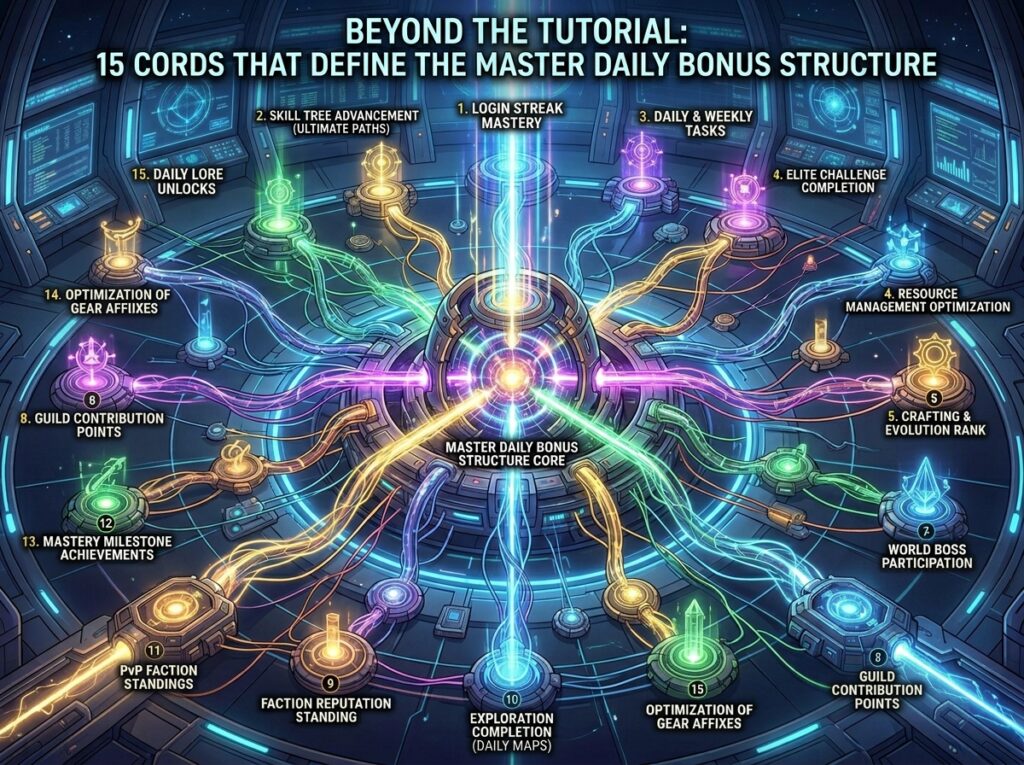
The difference between a forgettable daily login and an unshakeable daily habit lies in what I call the 15 cords — the architectural pillars that hold a master daily bonus structure together. These are the decisions that separate amateur implementations from professional retention engines.
Let me walk you through each one.
Cord #1: The Streak Integrity Engine
At its core, every daily bonus system must answer one question: What counts as a “day”?
This sounds simple. It is not.
Professional systems implement a dual-layer validation system that checks two things:
- Last claim timestamp — When did the player last receive a reward?
- Midnight boundary — Has the calendar date advanced?
The logic looks something like this:
function canUserClaimDailyReward(dailyReward) {
    var d = new Date();
    d.setHours(0, 0, 0, 0);  // Midnight today
    return dailyReward.lastClaimUnix < msecToSec(d.getTime());
}
Why does this matter? Because players will test your system. They will change their device clock. They will log in at 11:59 PM and again at 12:01 AM. Your streak engine must handle edge cases gracefully — or players will exploit them until your economy breaks.
The master cord here is deterministic fairness. The player should never wonder whether their login “counted.”
Cord #2: The Reset Time Architecture
Every daily system needs a reset moment — the instant when “today” becomes “yesterday” and a new reward becomes available.
Professional implementations offer two distinct reset models:
| Reset Type | Behavior | When to Use |
|---|---|---|
| Local Time | Resets at a fixed hour in the player’s time zone | Global games where players are spread across time zones |
| Server Time | Resets at a universal moment for all players | Competitive games where fairness requires synchronized resets |
The master cord here is choosing the right model for your game. Use local time for casual games where convenience matters most. Use server time for competitive games where everyone should start the “day” together.
Some systems even offer a hybrid: fetch the current time from an external API to prevent device clock manipulation. This adds a layer of security at the cost of requiring internet connectivity.
Most critically, the reset time must be communicated clearly. Players should never have to guess when rewards refresh. Display the remaining time prominently — and update it in real time.
Cord #3: The Reward Escalation Curve
Flat rewards kill engagement. If Day 1 gives 100 coins and Day 30 also gives 100 coins, why should the player care about maintaining a streak?
The master cord here is non-linear reward escalation.
Consider how Microsoft Rewards structures its daily engagement: users earn 30-50 points for completing daily sets, but consecutive daily completions trigger additional bonus points. The base reward is modest. The streak bonus is where the magic happens.
Professional reward curves follow one of three patterns:
- Linear escalation — Each day adds a small, fixed increment (e.g., +5 coins per day)
- Geometric escalation — Rewards multiply at certain thresholds (e.g., Day 7 = 2x Day 1)
- Milestone spikes — Most days are flat, but specific days (7, 14, 30) offer dramatic jumps
The third pattern is most effective for retention. It creates anticipation. Players don’t just log in for today’s reward — they log in because Day 7 is coming, and Day 7 is special.
A critical nuance: You must also decide how to handle missed claims. The Unity Daily Rewards template offers a player-friendly option: allow claiming a previous day’s reward if the player missed it, but often requiring watching an ad to do so. This turns a failure state into an engagement opportunity.
Cord #4: Streak Reset Logic
What happens when a player misses a day?
The strict approach: Back to Day 1. This creates urgency and loss aversion. The player knows that missing a single login erases progress, which is a powerful motivator — until it becomes a punishment that drives them away.
The lenient approach: Grace periods or streak protection. Some systems allow 1-3 missed days per month. Others offer “streak freeze” items that players can purchase or earn.
The master cord is knowing your player’s psychology. Hardcore players respond to strict resets — they want the challenge. Casual players will quit if a vacation destroys a 30-day streak.
The smart compromise: strict reset logic paired with recovery mechanics. A player who misses a day can watch an ad, spend premium currency, or complete a challenge to restore their streak. The system remains strict, but the player has agency to fix mistakes.
Cord #5: Reward Calendar Types
Not all daily rewards are created equal. Professional systems support two distinct calendar archetypes:
Login Rewards (User-Dependent): The timer starts when the player first logs in. Day 1 for Player A might be different from Day 1 for Player B. This is ideal for onboarding and new player retention.
Reward Calendar (Global): All players see the same reward on the same calendar day. A player who joins on Day 4 of the promotion starts at Day 4, not Day 1. This is ideal for seasonal events and limited-time promotions.
The master cord is using both types in concert. A new player gets a personalized 7-day login streak to build the habit. Simultaneously, all players see a monthly calendar with escalating rewards. The two systems reinforce each other without competing.
Cord #6: Claim Verification & Anti-Exploit
Players will attempt to exploit your daily reward system. The professional implementation anticipates this.
Server-side validation is non-negotiable. Every claim must be verified on your backend. Client-side checks are convenience features — they cannot be trusted for security.
The claim flow should follow this pattern:
- Client requests eligibility check (
canClaimDailyReward) - Server validates against storage (last claim timestamp)
- If eligible, server processes the reward (wallet update, inventory grant)
- Server updates the last claim timestamp
- Client receives confirmation
Why this matters: without server-side validation, a malicious player could send repeated claim requests and accumulate unlimited rewards.
The master cord is defense in depth. Validate at every layer. Assume the client is hostile. And always, always use optimistic concurrency control (OCC) when writing to storage to prevent race conditions.
Cord #7: The Loss Aversion Amplifier
This cord is pure psychology — and it’s one of the most powerful retention tools available.
Loss aversion is the cognitive bias where losses feel twice as painful as equivalent gains feel good. Daily reward systems amplify this by making streaks visible.
When a player sees “Day 27 of 30” displayed prominently, that number represents accumulated effort. Breaking the streak doesn’t just mean missing a reward — it means losing something they’ve built.
The master cord is making streaks visible and emotionally salient. Use:
- Visual streak counters (🔥 flames, chains, badges)
- Progress bars showing “days until major reward”
- Celebration animations when streaks reach milestones
- Warnings when a streak is about to expire
But be ethical about it. The goal is motivation, not psychological exploitation. The line is crossed when players feel trapped rather than engaged.
Cord #8: Social Reinforcement Loops
Daily rewards become exponentially more powerful when they connect to other players.
The master cord here is tying individual streaks to social systems:
- Guild bonuses — The entire guild earns extra rewards if enough members maintain streaks
- Leaderboards — Players see how their streak compares to friends
- Gifting — Players can send daily reward bonuses to friends
- Referral bonuses — Inviting new players grants extra daily rewards
When a player’s streak matters to their guild, the decision to skip a day becomes a social decision, not just a personal one. This dramatically increases retention — and dramatically increases the responsibility of the designer to avoid creating negative social pressure.
Use social reinforcement carefully. It works. That’s exactly why you need guardrails.
Cord #9: The Booster Interlock
This is where most tutorials stop — and where master systems begin.
A daily reward shouldn’t exist in isolation. It should interlock with other systems to create compound value.
Consider the booster taxonomy from the Octalysis Framework:
| Core Drive | Booster Type | Daily Reward Application |
|---|---|---|
| Development & Accomplishment | XP Boost | Daily login grants 2x XP for 1 hour |
| Ownership & Possession | Resource Accumulation | Daily reward includes compounding interest on held currency |
| Unpredictability & Curiosity | Luck Amplification | Daily login gives increased drop rates for 30 minutes |
| Loss & Avoidance | Safety Net | 7-day streak grants “streak freeze” item |
The master cord is treating daily rewards as boosters, not just gifts. A gift is consumed and forgotten. A booster changes how the player experiences the next hour of gameplay.
When daily rewards grant temporary power-ups, players don’t just log in — they log in and then play immediately to maximize the booster’s value. This is the difference between a daily active user and an engaged daily active user.
Cord #10: Ad Integration Economics
If your game is free-to-play, daily rewards and ads are natural partners.
The professional pattern:
- Standard claim: Free reward
- Bonus claim (same day): Watch an ad to claim an additional day’s reward
This creates a win-win. The player gets extra value. You get ad revenue. And the player’s streak advances faster, deepening their investment.
The master cord is voluntary ad engagement. Never force ads for basic rewards. Make ads an optional accelerator. Players who hate ads can ignore them. Players who don’t mind ads get extra value. Everyone wins.
Also consider rewarded ads for streak recovery: “Missed a day? Watch an ad to restore your streak.”
Cord #11: Transaction History & Transparency
Players need to trust your economy. That requires transparency.
Every daily reward claim should be recorded in the player’s transaction history, including:
- Timestamp of claim
- Reward type and amount
- Current streak count
- Any multipliers applied
The master cord is making this history accessible. Provide an endpoint where players can view their claim history. This builds trust and reduces support tickets from players who claim they “didn’t receive” a reward.
Additionally, transaction history is essential for debugging and fraud detection. When something goes wrong, you need the data to investigate.
Cord #12: Point Expiration as Engagement Driver
Counterintuitive but effective: points that never expire reduce urgency.
If players know their daily reward currency will sit in their wallet forever, there’s no rush to spend it. No rush to spend means less engagement with your economy.
The master cord is strategic expiration:
- Currency earned from daily rewards expires after 30 days if unused
- Players receive notifications before expiration
- Expiring points can be converted to a different currency at a penalty
This drives regular engagement with your store or economy systems. Players don’t just log in to earn — they log in to spend before their points vanish.
But be transparent. Surprise expiration destroys trust. Communicate expiration policies clearly and provide warnings.
Cord #13: Special Event Layering
Daily rewards shouldn’t be static. The master system overlays special event bonuses on top of the base structure.
Examples:
- Double reward week (all daily claims grant 2x)
- Holiday bonuses (special items added to the reward track)
- Limited-time calendars (30-day event with unique rewards)
These overlays create temporal scarcity. The player knows that today’s reward is different from yesterday’s — and that tomorrow’s might be gone forever.
The master cord is making events predictable enough to anticipate, but varied enough to feel fresh. Announce events in advance. Build anticipation. Then deliver.
Cord #14: The Self-Reinforcing Loop
This is the architectural crown jewel.
A basic daily reward system is linear: log in → claim → repeat. A master system is compounding: each login makes the next login more valuable.
The loop works like this:
- Day 3 reward includes a temporary XP booster
- Player uses XP booster to level up faster
- Leveling up unlocks a new booster that increases daily reward value
- Day 4 reward is now more valuable because of the unlocked booster
The psychological effect: progression accelerates. Each milestone feels less distant than the last. The player isn’t grinding — they’re snowballing.
The master cord is designing boosters that reference each other. An XP booster that helps you reach the level where you unlock a resource booster. A resource booster that helps you afford a streak protection item. Each system feeds the next.
Cord #15: The Exit Ramp (Ethical Retention)
The final cord is the one most designers ignore: allowing players to leave gracefully.
A master daily bonus system doesn’t trap players. It doesn’t use dark patterns to prevent uninstallation. Instead, it respects the player’s autonomy — which paradoxically makes them more likely to return.
The ethical architecture includes:
- No deceptive countdowns that claim “last chance” when it’s not
- Clear explanations of what will happen to unused currency
- The ability to “freeze” streaks during known vacations
- No punishment for taking breaks
The master cord is building retention through value, not captivity. Players should stay because they want to, not because leaving feels impossible.
Bringing It All Together: The System Architecture
When you implement all 15 cords, your daily bonus system transforms from a feature into an ecosystem. Here is how the pieces fit together:
| Layer | Components |
|---|---|
| Validation & Security | Streak integrity engine, reset time architecture, claim verification (Cords 1, 2, 6) |
| Reward Structure | Escalation curve, calendar types, point expiration (Cords 3, 5, 12) |
| Psychology | Loss aversion amplification, booster interlock, self-reinforcing loop (Cords 4, 7, 9, 14) |
| Social & Economic | Social reinforcement, ad integration, transaction history (Cords 8, 10, 11) |
| Operational | Event layering, exit ramp (Cords 13, 15) |
Each cord reinforces the others. A player joins because of Cord 5 (a welcoming calendar). They stay because of Cord 4 (streak loss aversion). They return daily because of Cord 9 (boosters make gameplay better). They invite friends because of Cord 8 (social rewards). And they respect the system because of Cord 15 (ethical design).
The Bottom Line
Most daily bonus tutorials teach you how to build a counter. That’s step one. The remaining 14 steps are what turn a counter into a retention engine.
The 15 cords aren’t optional features. They are the architectural pillars that separate amateur implementations from professional systems. Skip one, and the entire structure weakens. Implement them all, and you have a daily bonus system that players actually look forward to — not one they feel obligated to engage with.
Now go build something worth logging in for.
Frequently Asked Questions
What is the most important cord for a first-time implementation?
Start with Cord 1 (streak integrity) and Cord 2 (reset time). Everything else depends on these working correctly.
Can I implement all 15 cords at once?
No. Build incrementally. Start with the validation layer, then add the reward structure, then layer in boosters and social features.
How do I test a daily reward system?
Test edge cases aggressively: claiming at 11:59 PM, claiming across time zones, claiming with poor network connectivity, attempting to claim twice in the same day.
What’s the biggest mistake beginners make?
Flat rewards. A daily system where every day gives the same value trains players to ignore it. Escalate or die.
How do I know if my system is working?
Track two metrics: daily active user retention (did they come back?) and time-to-claim (are they logging in early in their session or late?). Early claims indicate anticipation. Late claims indicate obligation.