Beyond the String: In a world of mass production, Chinese knotting offers a return to handmade beauty. Discover the history, practical methods, and profound symbolism behind these intricate ties, and learn why the human touch makes all the difference.
The Thread that Binds Us
In a modern world dominated by digital connectivity, we often find ourselves searching for tangible connections—something we can hold, touch, and cherish. We scroll past thousands of images on Instagram, yet it is the handmade greeting card from a child or a lovingly crocheted scarf from a grandmother that makes our hearts swell.
Chinese knotting, or Zhongguo Jie (中国结), is the physical manifestation of this universal longing for connection. But to look at the image above—with its dizzying array of knots from the “Snake Knot” to the “Ruyi Jie”—and dismiss it as merely decorative, would be a grave mistake. This is not just crafting; it is a legacy of patience, a language of symbolism, and, most importantly, a physical meditation on the value of the human touch.
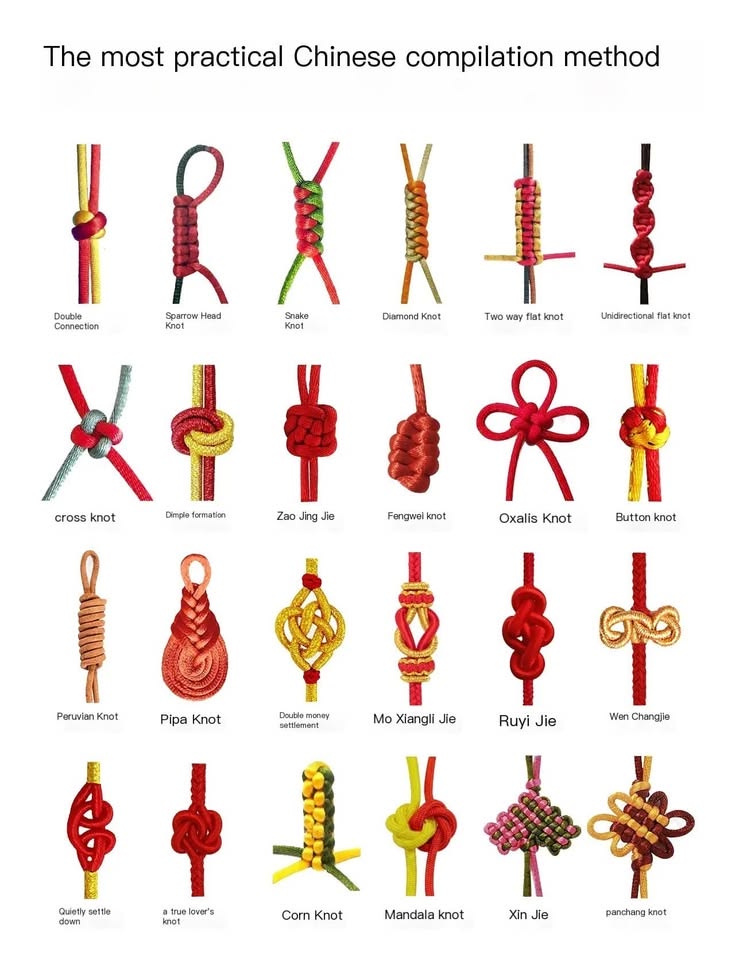
As we explore the most practical Chinese compilation methods, let us not just learn the mechanics of twisting cord. Let us dive into the soul of the craft, understanding why these knots have survived millennia, and why picking up a piece of cord today might be the most grounding thing you do for your mental health.
The Thread of History: More Than Just Decoration
Before we analyze the specific knots in our visual guide, we must understand their roots. Chinese knotting dates back to the Neolithic period, evolving from simple utility to high art. Initially, cords were used for practical purposes—tying tools, recording events, and fastening clothing. However, as the dynasties rose and fell, the knot evolved into a profound decorative art form during the Tang and Song dynasties, reaching its zenith in the Qing Dynasty.
Why did this craft endure? Because every knot tells a story.
In Chinese culture, cords are often red, symbolizing good fortune, joy, and warding off evil spirits. But it goes deeper than color. The structure of a knot represents eternity, as many are woven into seamless, endless loops. When you tie a “Double Connection” or a “Button Knot,” you are engaging in a cultural conversation. You are not just making a decoration; you are weaving a wish for luck, health, or a lifelong bond.
When we view the chart of knots—from the “Diamond Knot” to the “Double money settlement”—we are looking at a visual dictionary of human hopes and desires.
The Human Touch vs. The Machine: Why Hand-Tying Matters
In our current era of AI-generated art and 3D-printed accessories, the “human touch” has become a luxury. Why buy a machine-made knot when you can spend fifteen minutes tying one yourself? Or, why buy a cheaply manufactured imitation when you can commission an artisan?
The Biomechanics of Knotting
There is a specific biomechanics to knotting. When you run a silk cord between your thumb and forefinger, you activate the fine motor skills of your hands, which neurologists link directly to cognitive processing and emotional regulation. The rhythmic motion of a “Flat Knot” being woven over and under itself is a sensory experience.
No machine can replicate the tension of a human hand.
- A machine applies uniform force.
- A human applies force based on intuition, adjusting the pressure to ensure the cord doesn’t fray, creating curves that are symmetrical yet organic.
This is the “human factor” that gives handmade knots their aesthetic charm. The slight variations in a “Zao Jing Jie” or a “Pipa Knot” are not flaws; they are the fingerprints of the creator. This imperfection is what makes them beautiful. In a world obsessed with algorithmic perfection, the human hand’s slight inconsistency is a rebellion against the sterile.
Decoding the Guide: A Practical Walkthrough of Chinese Compilation
Now, let’s turn to our visual guide. It categorizes the most practical Chinese compilation methods, giving us a roadmap to master this craft.
1. The Utility Knots: Foundation of the Trade
If you are a beginner, the first row of the image is your sanctuary. These knots are the “alphabet” of the craft.
- The Snake Knot & Diamond Knot: Notice their tight, interwoven structure. These are the workhorses of Chinese knotting. They are used as grips on handles, decorative rope segments, or to create a non-slip texture. Practicing the Snake Knot trains your hands to manage the tension of multiple loops. It is an incredibly grounding exercise. You cannot rush a Snake Knot; if you pull too tight, it twists; if you pull too loose, it falls apart. It demands presence.
- Flat Knots (Two-way and Unidirectional): These are brilliant for creating bracelets and waistbands. They are called “flat” because the woven patterns lie flush against themselves. Compiling these requires a rhythmic “over, under” method. This is where you will learn patience. It takes roughly 10 minutes to weave a two-inch segment. In that time, your mind has nowhere to go but the cord. It is mindfulness in motion.
2. The Symbolic Knots: Aesthetics and Meaning
Moving to the second and third rows, we enter the realm of the decorative and symbolic.
- The Oxalis Knot and Button Knot: These are the “finials” of knotting. Think of them as the cherry on top of a sundae. They are used as closures for cloaks, as centerpieces for jewelry, or to finish off a complex piece. The Button Knot in particular is a marvel—one continuous cord that ends up creating a three-dimensional, spherical sphere. When you tie a Button Knot, you are creating a micro-universe, a sphere of endless interlocking loops.
- The Pipa Knot and Ruyi Jie: Look closely at the third row. The Pipa Knot mimics the shape of a Chinese lute, while the Ruyi Jie represents a “scepter” of good will. These are not just knots; they are pictograms. They transform a functional string into a visual poem. Tying these requires spatial reasoning. You must visualize the 2D cord becoming a 3D object in your mind’s eye before your fingers even move.
3. The Complex Art of “Biang” and “Panchang”
The bottom right of the guide shows the Panchang Knot (or “Endless Knot”) and the Corn Knot. These are the advanced masters of the craft.
- The Panchang Knot is one of the Eight Auspicious Symbols in Buddhism, representing the infinite wisdom of the Buddha. Structurally, it is a geometric nightmare to explain, but a delight to tie. It involves weaving a central square frame and then looping the outer edges to create a kaleidoscope-like center. Compiling a Panchang Knot requires patience on a meditative scale.
- The Corn Knot (bottom left) is a textured, 3D knot that resembles an ear of corn. This requires bunching—a technique where you layer multiple foundational knots on top of one another to create density.
The Art of the Craft: Mastering the “Six Paths”
For a blog post that respects E-E-A-T (Experience, Expertise, Authoritativeness, Trustworthiness), it is vital to establish the fundamental rules of the game. Professional Chinese knot-tier Kuoan Zhang (a legend in the modern knotting world) often emphasizes “Six Paths” to mastery. Let’s apply them to the chart above:
- Exactness of the Thread: Before you start the “Diamond Knot,” ensure your cord is smooth, preferably waxed silk or nylon. Rough cords break the human spirit.
- Proper Tension: The “Dimple formation” (Row 2) is a perfect example. If you tie it too hard, you lose the dimple; too soft, the knot falls apart. The human touch must find the Goldilocks Zone of pressure.
- Sequencing: Mistakes in Chinese knotting are not easy to undo. Unlike a Spanish knot, a Chinese flat knot creates a labyrinth. You must mentally chart your path (over-right, under-left) before you tie.
- Pattern Optimization: As you move from the “Snake Knot” to the “Mo Xiangli Jie” (Row 3), you are transitioning from functional to decorative. This requires optimizing the amount of “air” or negative space in the knot. The human eye must judge balance, ensuring the red loops are equidistant.
- Finishing: A knot is only as good as its finish. The trailing ends of your “Ruyi Jie” must be burned or sewn with precision. This is the human touch of perfectionism.
- Soul Application: Finally, the emotional drive. Are you tying this for a friend? For a home? For luck? As you tie your “Double money settlement” knot, visualize wealth entering your life. This intention is woven into the cord.
Why This Matters in 2026: The Digital Detox Through Macramé
We are living in 2026. Our sensory overload is unprecedented. We are bombarded by notifications, targeted ads, and AI-driven algorithms that know our desires before we do. In this landscape, the act of manual knotting is profoundly counter-cultural.
When you pick up that red cord and begin a “Two way flat knot,” you are unplugging. You are experiencing:
- Flow State: Neurologists confirm that repetitive hand motions release dopamine. Tying knots stimulates the same brain receptors as meditation.
- Tangible Reward: Unlike a digital “like” that vanishes in seconds, a “Sparrow Head Knot” is a tangible product. You can touch it, gift it, and hang it on your wall for decades.
- Cultural Preservation: By learning to tie a “Pipa Knot,” you are not just learning a craft; you are learning a cultural data-set that has survived wars, famines, and globalization. You are becoming a custodian of a heritage that is far richer than a TikTok trend.
The Business of Knotting: A Market for Authenticity
For those reading this blog post with an entrepreneurial spirit, the “human touch” isn’t just a philosophical concept—it is a business model.
In global marketplaces like Etsy or luxury boutiques, machine-made knots are priced at $3. Handmade, artisan-tied knots—especially those using the intricate “Oxalis Knot” or “Wen Changjie”—sell for $30 to $200 depending on the complexity and material.
Why? Because buyers crave authenticity.
When a customer buys a handmade knot, they aren’t buying a piece of string. They are buying the time it took you to learn the technique. They are buying the perfection of your tension, and the energy you poured into the “Double Connection.”
If you want to commoditize this skill, don’t focus on speed. Focus on narrative. A “Ruyi Jie” isn’t just a knot; it’s a wish for “everything goes as you wish” to your loved one. This is the copy that sells. This is the human touch that an algorithm cannot generate.
A Beginner’s Challenge: The “Five-Minute Mindfulness”
Let’s get practical. I challenge you, right now, to step away from your screen and grab a piece of twine, shoelace, or embroidery floss. Look back at the top row of our graphic.
Tie a “Snake Knot.”
Start by making a loop. Pass the right cord over the left. Now, pass the left cord under the right and up through the center. Pull gently.
Did you do it? Good. Now, pause.
Feel the friction of the material against your skin. Notice how the knot tightens in your hand. Observe the specific interplay of the loops. A machine ties it in .0001 seconds. It took you perhaps 30 seconds. In those 30 seconds, you were present. You were not thinking about your inbox. You were thinking about geometry, tension, and shape.
That, in essence, is the “human touch” we are discussing. It is the ability to be fully immersed in the physical world, creating meaning from raw materials.
Conclusion: Keep the Thread Going
The chart of “practical Chinese compilation methods” provided above is not just a set of instructions. It is an invitation.
Whether you are tying a “Quietly settle down” knot for your own peace of mind, or the complex “Mandala knot” for a special gift, remember that you are part of a lineage. You are connecting your hands to the hands of artisans from centuries past.
The digital world will keep spinning, but your hands will know the feeling of a perfectly tensioned “Button knot.” Your mind will know the geometry of a “Panchang.”
So, take a moment today. Pick up the cord. Breathe, tie, and unravel your own stress. The art of Chinese knotting is waiting, and it requires nothing more than your willingness to touch, create, and believe.