The Cobra Weave Paracord Bracelet, We spend our waking hours swiping, clicking, and doom-scrolling through digital feeds, yet we often feel more disconnected than ever. There is an irony to modern connectivity: the more we type, the less we actually touch. If you are looking for a digital detox that doesn’t require retreating to a mountain cabin, let me introduce you to a wildly satisfying, highly tactile hobby: weaving paracord bracelets.
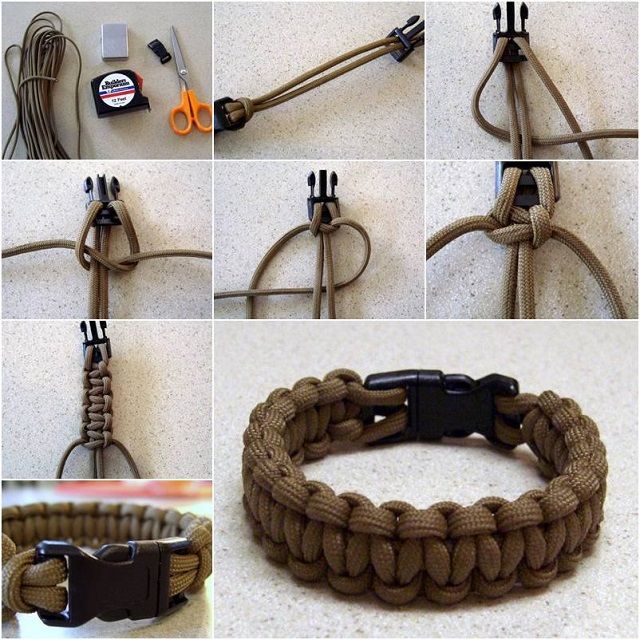
Look at the image above—that neat collection of spools, a lighter, some scissors, and a black plastic buckle. It looks deceptively simple, doesn’t it? But what you are looking at isn’t just a DIY craft project. You are looking at a roadmap to unlocking an ancient flow state. We are going to break down the specific “Cobra Weave” technique shown in those visual steps, diving deep into the mechanics, the gear, and the surprisingly therapeutic “human touch” that makes this hobby stick.
Welcome to the ultimate beginner’s guide to the paracord bracelet. Let’s tie one together.
Why 550 Paracord? More Than Just a Rope
Before we even touch a strand of cord, let’s address the million-dollar question: What is so special about this boring-looking tan string? In the crafting world, it is affectionately known as “550 cord.” This isn’t marketing fluff; the number is a literal specification. It means this small, woven nylon rope can withstand a dead weight of up to 550 pounds before it snaps.
The Unexpected Versatility of a Simple String
Why do survivalists, military personnel, and weekend campers swear by it? Because it is a lifeline. In an emergency, a paracord bracelet can be unwound in seconds. That 6-inch bracelet holds upwards of 8 to 10 feet of rope. It can secure a makeshift shelter, hoist a gear bag up a tree to keep it away from bears, or even serve as a shoelace when yours blows out.
But for us, the everyday creators, it is simply the Goldilocks of crafting materials. It doesn’t stretch like cotton, and it doesn’t fray instantly like cheap twine. It has a “grippy” texture that holds knots with satisfying friction. When you pull on a Cobra Weave, you can feel the tension holding the structure together. That feeling is addictive.
Inner Cores vs. Outer Sheath
Here is a pro-tip that will instantly elevate your understanding of this material. The 550 cord is actually a composite. It has a woven, diamond-patterned outer sheath, but inside, it holds seven distinct, smaller inner strands. Why does this matter? Because those inner strands are life-saving.
If you ever get lost in the woods, you can strip the outer sheath, pull out those inner threads, and use them as high-strength fishing line, sewing thread for a torn jacket, or even as fire tinder (yes, nylon burns beautifully). Keep that little bit of lore in your back pocket. It makes you appreciate the complexity of the piece you are wearing.
The Gear You Actually Need (Skip the Fluff)
Beginner crafter syndrome is real. We tend to overcomplicate things, thinking we need professional-grade rotary cutters, specialized workbenches, and expensive jigs. Let me stop you right there. To build the bracelet shown in the collage, you need precisely four items:
- A single paracord spool: (Typically, a 7-foot length is perfect for a standard 8-inch wrist). Get a neutral color like olive drab or coyote brown for your first time—mistakes are less visible.
- A side-release plastic buckle: These cost about fifty cents.
- A tape measure: Because anatomy is a thing. Not all wrists are created equal.
- A lighter and sharp scissors: Do not grab the kitchen shears. You need sharp, pointed cutters to ensure a clean slice.
The “Secret Sauce” of the Lighter
Notice the lighter in the first panel of that photo? That isn’t there for ambience. Paracord is made of nylon. When you cut nylon, the ends fray into a fuzzy mess. The secret to a professional-looking bracelet is melting those ends.
Using a lighter, you quickly pass the flame near the tip of the cord (without letting it catch fire). The plastic will bubble and melt. You press that molten end against a hard, cool surface (like a metal ruler) to flatten it into a “weld.”
The Golden Rule: If you melt the cord, do NOT touch the hot, liquid plastic with your bare fingers. I’ve done it. It sticks to your skin, and the burn is real. Trustworthiness requires honesty: this is a craft that respects heat.
The “Cobra Weave”: A Step-by-Step Walkthrough
If you look closely at the progression of images we are working with, you’ll see the evolution of the “Cobra Weave” (also known as the Solomon Bar). It is the foundational knot of the paracord world. It is essentially a glorified square knot, repeated endlessly. Here is how we execute it with a human touch.
The Setup – Tension is the Key
Look at the second panel of the collage. You see the cord threaded through both sides of the plastic buckle. This is called “anchoring.” The most common mistake beginners make here is pulling the initial cord too tight against the buckle.
Expert Insight: You actually need about a quarter-inch of space between the webbing of the buckle and where your knot starts. Why? Because if it is too tight, your wrist will have zero room to move, and the hard plastic will dig into your skin. It’s a comfort detail that distinguishes a beginner’s piece from an artisan’s. Measure your wrist, add an inch for comfort, and lock that buckle into place.
The Weave in Motion
Now, here is where the “human touch” activates. You are going to create a loop.
- Take the cord from the right side of the buckle and cross it over the two center pieces, going to the left.
- Take the cord from the left side, bring it over the right cord, go under the two center pieces, and come up through the loop you created on the right side.
- Pull it tight.
That is one Cobra knot. Now, you repeat the exact same motion in reverse. Next time, you cross the left cord over the center, and route the right cord under and through.
Here is what I want you to feel while doing this: the rhythm. After about ten knots, you won’t have to think about which side goes over. Your hands will take over. You will enter a state of “flow.” Your brain waves will slow down because the mental load has shifted from your prefrontal cortex to your motor cortex.
The Finish Line – Securing the Bitter End
The collage shows the finished bracelet, but it hides the secret of the “clean finish.” You have woven the bracelet until you are approximately an inch away from the other half of your plastic buckle. Now, you have two leftover tail cords sticking out of the bottom.
Here is how you hide them. Cut the tails so they are roughly an inch long. Take your lighter, melt the tips, and press them into the weave. Melt them just enough to “glue” them to the underside of the bracelet. When done correctly, you won’t even see the seam; it will look like a continuous, unbreakable loop.
Crucial Safety Warning: Do not skip the melting step. If you leave raw cord ends, the bracelet will unravel the second you pull it tight. That is a trusty, durable piece of gear made completely useless by a lazy finish.
Adding the “Human Touch”: Why This Craft is Therapy
Let’s shift gears from mechanics to psychology. Why are we seeing a resurgence of macrame, crochet, and paracord weaving in the digital age? Because your brain is starved for tactile feedback.
During a 45-minute zoom call where you are silently listening to a presentation, picking up a spool of paracord can be a lifeline. You are engaging your fine motor skills. You are building a physical object in real-time. We live in a world where a “task” usually involves typing something into a box and hitting ‘enter.’ There is no physical reward.
When you tie a Cobra Weave, the progress is visible. You see the pattern growing inch by inch. The slight twinge in your fingertips from pulling the string tight is a signal to your nervous system that you are present. You are doing something rather than just consuming something.
Embracing the “Fumbling” Phase
I want to be upfront: your first paracord bracelet is going to look janky. The tension will be uneven—some knots will be fat, others skinny. It will look like a very tired snake.
And you know what? That is perfectly okay.
We have an obsession with “instant perfection” fed to us by social media. But in the physical world, craft requires failure. It requires you to undo a knot three times until your fingers remember the pattern. That fumbling phase is the humbling, human part of the process.
When you give that first, slightly crooked bracelet to a friend, they won’t judge the tension. They will admire the fact that you spent an hour of your life, hands-on, creating something specifically for them. That is the “human touch” that a factory-made, mass-produced bracelet can never replicate.
Wearing and Caring for Your Handmade Bracelet
Once you have successfully clamped that final buckle shut and slipped it onto your wrist, your job isn’t entirely done. This is a rugged piece of gear, but even the strongest nylon requires a little TLC.
Cleaning your bracelet: Because it is made of nylon, it is entirely washable. If it starts to smell like sweat or campfire, simply soak it in lukewarm water with a drop of dish soap. Scrub it with an old toothbrush, rinse it, and hang it to dry. It will be as good as new.
The “Sag” Factor: Over a few weeks of everyday wear, the nylon will stretch slightly. This isn’t a defect; it’s the cord settling into its natural shape. If it gets too loose, you can actually manipulate the knots slightly to tighten them back up toward the buckle.
The Survival Instinct: If you ever find yourself in a pinch (pun intended), don’t be afraid to cut it off your wrist. Remember those inner cores? You are wearing an emergency kit. It’s better to sacrifice a bracelet than to get stuck without a way to secure a tent or splint a broken ankle.
Conclusion: From a String to a Statement
There is a quiet pride that comes from glancing down at your wrist and seeing something you built. It’s a small rebellion against a world of disposable trinkets.
The paracord bracelet is utilitarian, rugged, and practical. But the process of making it—the measuring, the weaving, the melting, and the sheer patience required—is what transforms it into something deeply personal. It becomes a meditation in nylon.
If you have a spool of cord sitting in your garage or a discarded backpack gathering dust, I urge you to dig it out. Grab a buckle, sit down, and give the Cobra Weave a try. Don’t stress about the finish line. Enjoy the feel of the cord moving through your fingers. Enjoy the rhythm.
And when you look down at that finished, rough-around-the-edges bracelet, remember this: you didn’t just tie knots. You carved out time for yourself in a world that never stops spinning.
I’d love to hear from you: What was the first thing you ever tried to weave or craft with your hands? Drop your stories in the comments below—let’s build this community one knot at a time.