Some films entertain. A rare few transcend entertainment to become something deeper—a cultural earthquake, a benchmark of ambition, and the film that redefined what a movie sequel could achieve. Irvin Kershner’s Star Wars: Episode V – The Empire Strikes Back (1980) is one of those rare treasures. It didn’t just follow one of the most beloved films in history; it dared to be darker, more complex, and emotionally devastating, proving that the middle chapter of a trilogy could be the best of all.
More than four decades after its release, The Empire Strikes Back remains the gold standard for franchise filmmaking. It is a film that took the swashbuckling adventure of A New Hope and transformed it into a mythic, operatic tragedy. It gave us Yoda, the Imperial March, and one of the most shocking reveals in cinematic history. It is, as countless critics and fans have declared, a masterpiece—and the reason Star Wars became more than just a movie.
A Galaxy in Retreat: The Plot Thickens
The film opens with the Rebel Alliance in a desperate position. Forced to flee their base on the ice world of Hoth after the Empire discovers them, they are scattered and vulnerable . Princess Leia (Carrie Fisher), Han Solo (Harrison Ford), Chewbacca, and the droids are on the run, pursued by Darth Vader’s forces across the galaxy. Meanwhile, Luke Skywalker (Mark Hamill), guided by a vision of Obi-Wan Kenobi, travels to the swampy planet of Dagobah to find the legendary Jedi Master Yoda and complete his training .
This structure—two parallel storylines, one focused on spiritual growth and the other on action and escape—was a departure from the first film’s more straightforward narrative. It allowed the film to deepen its characters while maintaining the breakneck pace of the original . The action strand follows Han and Leia as they seek refuge on Bespin’s Cloud City, only to be betrayed by Han’s old friend Lando Calrissian (Billy Dee Williams) and fall into Vader’s trap . The spiritual strand sees Luke struggling with Yoda’s teachings, learning that the Force is not a simple tool but a complex, morally ambiguous energy that requires patience and discipline .
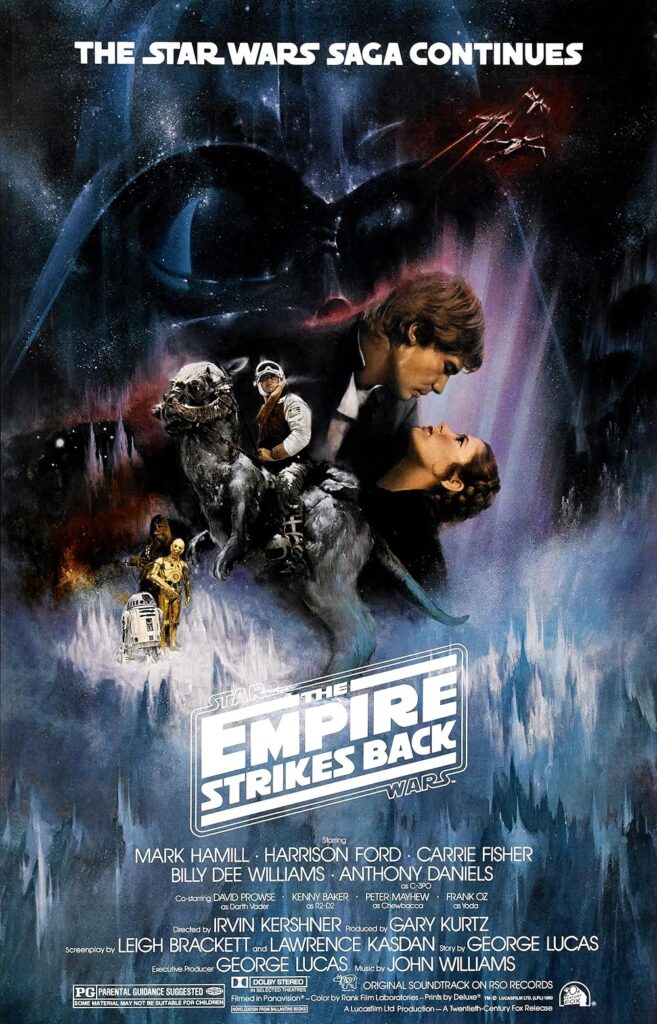
The climax is a masterclass in tension and tragedy. Luke, ignoring Yoda’s warnings, abandons his training to rescue his friends and confronts Vader in the bowels of Cloud City. The lightsaber duel that follows is not merely an action sequence; it is a psychological and emotional battle that culminates in the revelation that will define the saga: Darth Vader is Luke’s father . Luke loses his hand, his innocence, and his idealized vision of his father. Han Solo is frozen in carbonite and taken by Boba Fett. The Rebels are scattered, defeated, and in retreat . It was a bold, shocking ending that left audiences desperate for more, forever changing the rules of franchise storytelling .
The Team Behind the Magic: Kershner, Kasdan, and a Fresh Vision
One of the key reasons Empire succeeded so spectacularly is the team George Lucas assembled to bring his vision to life. Exhausted by the grueling production of A New Hope, Lucas chose not to direct the sequel . Instead, he selected Irvin Kershner, his former film professor at USC, to helm the project . Kershner was known for character-driven dramas, not sci-fi spectacles, but this was precisely the point. Lucas wanted a director who would focus on the actors and the emotional depth of the story .
Kershner’s approach was collaborative and actor-focused. He worked closely with the cast to develop their characters, bringing a new level of nuance to their performances . Hamill has noted that Kershner pushed him to explore Luke’s darker emotions, his anger, and his fear, making the character more complex and interesting .
Lucas also enlisted Lawrence Kasdan to co-write the screenplay with him and Leigh Brackett . Kasdan, who would later write Raiders of the Lost Ark and direct The Big Chill, brought a sharpness and wit to the dialogue that elevated the script. The bickering romance between Han and Leia, the philosophical weight of Yoda’s teachings, and the chilling menace of Vader’s dialogue all bear his signature .
As Suschitsky himself noted, Lucas “intelligently decided to choose two people who were not obviously the right choice” to direct and shoot the film, resulting in a “fresh eye” that brought new depth to the universe . The visual effects team, led by Dennis Muren, also pushed the boundaries of what was possible, creating the breathtaking Battle of Hoth and the dizzying chase through an asteroid field .
Themes: Defeat, Sacrifice, and the Darkness Within
The thematic depth of The Empire Strikes Back is what truly sets it apart from its predecessor and many of its successors. It is a film about loss, about the cost of heroism, and about the difficult journey of self-discovery .
The Empire Strikes Back: The Good Guys Lose
As the title suggests, this is a film where the Empire finally pushes back. The Rebels are on the run from the opening crawl to the final scene. “Sometimes the bad guy wins,” as the official Star Wars website notes . Han is frozen, Luke is maimed, and the future of the Rebellion is uncertain . This bleak, downbeat tone was a radical departure from the triumphant ending of A New Hope, but it gave the story immense dramatic weight. It showed that the fight against evil would not be easy and that victory would come at a terrible cost.
Sacrifice and the Hero’s Journey
The film is also a profound exploration of sacrifice. Han risks his life to save Luke from the frozen wastes of Hoth, a selfless act that hearkens back to his earlier individualism . Later, Luke must choose between his own destiny as a Jedi Knight and his loyalty to his friends, sacrificing his training to try and save them . The film’s final image—our heroes gazing out at the stars, battered but unbroken, with Han’s fate unknown—is a powerful testament to the resilience of the human spirit in the face of overwhelming odds .
The Shadow of the Father
The core of the film’s mythology is Luke’s confrontation with his own darkness. On Dagobah, Yoda warns him that a Jedi must confront the “cave of evil” . When Luke enters the cave, he fights a vision of Darth Vader and cuts off his head, only to see his own face beneath the mask . This is not just a visual trick; it is a revelation that Luke’s greatest enemy is the potential for evil within himself . This theme is underscored by Yoda’s comment that Luke “has much anger in him, like his father” . The final revelation that Vader is his father is the ultimate expression of this internal struggle: Luke must accept that his father has fallen to the dark side, and that he himself is susceptible to the same corruption.
An Enduring Legacy
The legacy of The Empire Strikes Back is immeasurable. It popularized the concept of the ongoing, serialized film franchise, proving that a sequel could be more than just a cash grab . It established the template for the “middle chapter,” where the heroes suffer defeat and the stakes are raised to new heights. This structure has been imitated by countless franchises, from The Lord of the Rings to the Marvel Cinematic Universe .
It also deepened the mythological and spiritual themes of Star Wars, turning it from a simple adventure into a modern myth . The introduction of Yoda and the exploration of the Force’s gray areas added layers of complexity that continue to resonate .
But above all, The Empire Strikes Back is a testament to the power of storytelling. It is a film that is not afraid to break its heroes, to make them suffer, and to leave them in a place of uncertainty. It is a film that trusts its audience to handle complex emotions and ambiguous endings. It is, as one fan put it, “the best sequel of all time,” a film that “defined a generation” and continues to inspire and amaze new ones . It stands as a testament to what happens when a visionary creator surrounds himself with talented collaborators and dares to take risks. It is, quite simply, a masterpiece.