Some films entertain. A rare few transcend entertainment to become something deeper—a cultural earthquake, a philosophical manifesto, and a mirror held up to the dawning digital age. The Wachowski sisters’ The Matrix (1999) is one of those rare treasures. It didn’t just tell a story; it rewired our collective imagination, popularizing concepts like the “red pill” and “bullet time,” and posing uncomfortable questions about reality, control, and human freedom that feel more urgent today than ever before.
More than two decades after its release, The Matrix remains a landmark of science fiction cinema. It is a film that seamlessly blends Hong Kong action choreography, cyberpunk aesthetics, religious allegory, and philosophical inquiry into a package that is both intellectually stimulating and viscerally thrilling. It is a film that refuses to be ignored, a movie that, as one critic noted, “defined the late 1990s and predicted the 21st century”.
The Red Pill and the Rabbit Hole
The film introduces us to Thomas Anderson (Keanu Reeves), a mild-mannered computer programmer by day and a hacker known as “Neo” by night. He is a man haunted by a nagging sense that something is fundamentally wrong with the world. He is contacted by the enigmatic Morpheus (Laurence Fishburne), a figure from the underground who offers him a choice: take the blue pill and remain in blissful ignorance, or take the red pill and learn the truth about the world.
Neo chooses the red pill, and the world as he knows it dissolves. He awakens in a pod, floating in a vast ocean of amniotic fluid, connected to a world-spanning network of machines. The reality he knew—the 1990s, his job, his life—was a sophisticated simulation, the Matrix, created by intelligent machines to subjugate the human race and harvest their bioelectric energy.
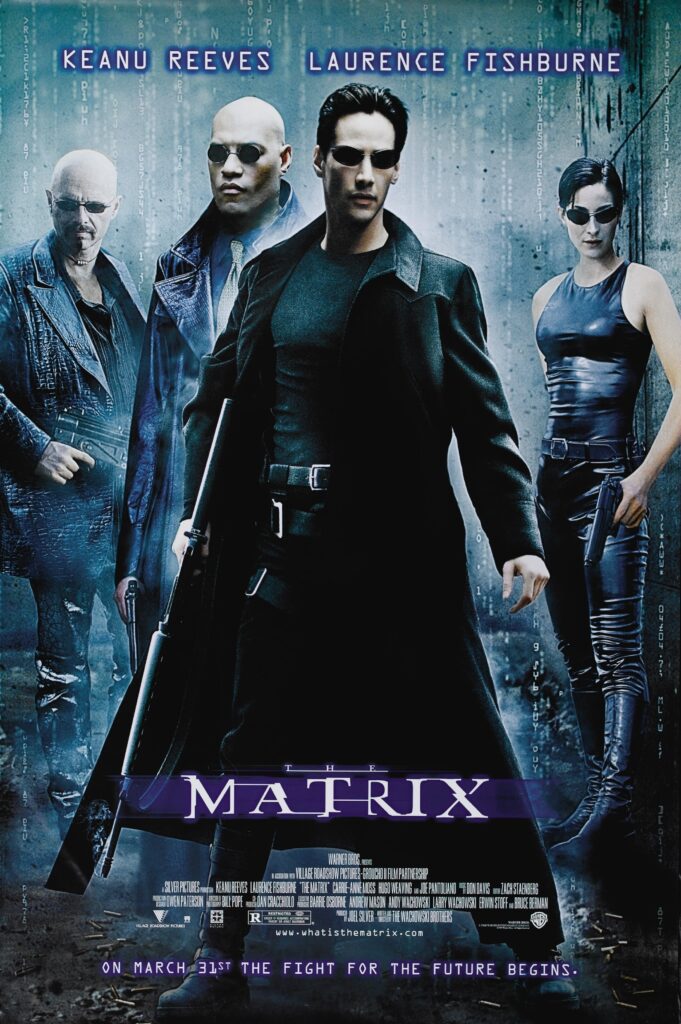
This revelation is the film’s central premise, a concept that has seeped into the cultural lexicon. To “take the red pill” has become shorthand for choosing to see an uncomfortable truth, a phrase that has been adopted by everyone from political movements to conspiracy theorists. As one analysis puts it, The Matrix captured the anxieties of a generation on the cusp of a new millennium, a generation that saw technology advancing at an unprecedented rate and wondered whether it was leading to liberation or control.
Action as Philosophy: Bullet Time and Kung Fu
The Matrix was a revolution in action filmmaking. To depict the impossible feats of the human mind freed from the laws of physics, the Wachowskis developed “bullet time,” a visual effect that allowed the camera to slow down time while circling the action. This technique, achieved through a rig of 120 cameras firing in sequence, created a breathtaking, fluid, and instantly iconic visual language.
The action sequences were choreographed by Yuen Woo-ping, the legendary Hong Kong action director. Reeves, Fishburne, and Hugo Weaving underwent months of intense martial arts training to learn the wire-fu style that became the film’s signature. The result was action that was both balletic and brutal, a fusion of Eastern and Western sensibilities that redefined what was possible in a Hollywood blockbuster. As one critic wrote, the film’s “visceral and thrilling action scenes practically move to their own heartbeat”.
A Philosophical Feast: Beyond the Action
Beneath its surface of stunning action and groundbreaking visual effects, The Matrix is a deeply philosophical film. It is a meditation on reality, free will, and the nature of human existence, drawing on a rich tapestry of philosophical and religious traditions.
Plato’s Cave and Descartes’ Demon
The film’s central premise—that our perceived reality is an illusion—is a direct echo of Plato’s Allegory of the Cave, where prisoners mistake shadows on a wall for reality. It also resonates with René Descartes’ famous thought experiment: how can we know that our experiences aren’t being manipulated by an evil demon? The Matrix is that demon, and Neo’s journey is a quest for true knowledge.
Existentialism and the Search for Meaning
The film also engages with existentialist themes. Cypher (Joe Pantoliano), a member of the human resistance who betrays his comrades, embodies the existential anguish of a universe without inherent meaning. He is so horrified by the “real world”—a desolate, post-apocalyptic wasteland—that he prefers the comforting illusion of the Matrix. His famous line, “Ignorance is bliss,” is the opposite of Neo’s embrace of painful truth. As one analysis noted, Cypher is a tragic figure, a man who “bets his life on his own freedom and finds he cannot stand the weight”.
Religious Allegory: The One
The film is rich with messianic imagery. Neo is “The One,” a figure prophesied to free humanity from the Matrix. His journey is a Christ-like passion, culminating in a resurrection and ascension. He is guided by Morpheus, a John the Baptist figure, and his mission is to liberate the enslaved. This religious subtext was not accidental; the Wachowskis intentionally wove spiritual themes into the narrative to give it a sense of mythic grandeur.
Transgender Allegory
In the years since its release, a new and powerful interpretation of The Matrix has emerged. Both Lana and Lilly Wachowski, the film’s directors, have come out as transgender women, and many have read the film as a metaphor for the transgender experience. The idea of being trapped in a body that doesn’t reflect one’s true self, the choice to “take the red pill” and see the truth, and the struggle to become one’s authentic self all resonate deeply with the trans experience. As one scholar noted, the film is “a powerful metaphor for the experience of being closeted or trying to live a life as a trans person in a cis-normative society”. This interpretation has added a new layer of depth to the film, making it even more relevant and resonant for contemporary audiences.
The Cast: Perfectly Assembled
The film’s cast is impeccable. Keanu Reeves, often dismissed as a limited actor, delivers a career-defining performance. He is perfectly cast as Neo, a man who is initially lost, confused, and unsure of himself. As he transforms into “The One,” Reeves’s performance subtly shifts, gaining confidence and gravitas. He is a great actor in this role, portraying Neo’s “steady development from a kind of bummed-out software nerd into a soulful hero”.
Laurence Fishburne is magnetic as Morpheus, delivering his lines with a preacher’s cadence and a prophet’s conviction. His performance gives the film its spiritual weight.
Hugo Weaving is perfectly cast as Agent Smith, the film’s chilling, bureaucratic villain. His performance is “oozing with menace,” a man who despises humanity and sees their emotions as a disease. His monologue about the smell of humanity is a highlight of the film.
Carrie-Anne Moss is Trinity, a character who is as skilled and determined as her male counterparts. She is not just a love interest; she is a warrior, a hacker, and a key member of the resistance. Her dynamic with Neo is one of the film’s emotional anchors.
And Joe Pantoliano brings a tragic vulnerability to Cypher, the film’s Judas figure. His betrayal is not born of pure evil but of a desperate, nihilistic desire for comfort and pleasure.
The Matrix in a Modern World
The legacy of The Matrix is immense. It popularized the concept of the “chosen one” in a sci-fi context, a trope that has been imitated by countless films and franchises . It revolutionized action filmmaking, paving the way for a new era of visually spectacular, wire-fu inspired choreography . And it inspired a generation of thinkers, filmmakers, and audiences to question the nature of reality.
Perhaps most importantly, the film’s central premise—that our world might be a simulation—has become a serious topic of philosophical debate. Visionaries like Elon Musk have publicly considered the possibility that we are living in a simulation, a direct echo of the film’s themes. As one writer put it, “The Matrix predicted the digital future: the film captured ‘the vibe’ of technology that would come to dominate our lives” .
Conclusion: Wake Up, Neo
The Matrix is a film of contradictions: it is a blockbuster entertainment and a philosophical treatise; it is a celebration of human freedom and a cautionary tale about the dangers of technology; it is a product of its time and a film that feels increasingly prescient.
It is a film that invites you to question everything—your perceptions, your beliefs, your place in the world. It is a film that, as one critic put it, “always leaves you wanting more”. And that is perhaps its greatest achievement. It doesn’t just tell a story; it invites you to wake up to the possibilities of your own life.
The choice is yours: the red pill or the blue pill. But once you’ve seen The Matrix, you’ll never see the world the same way again.