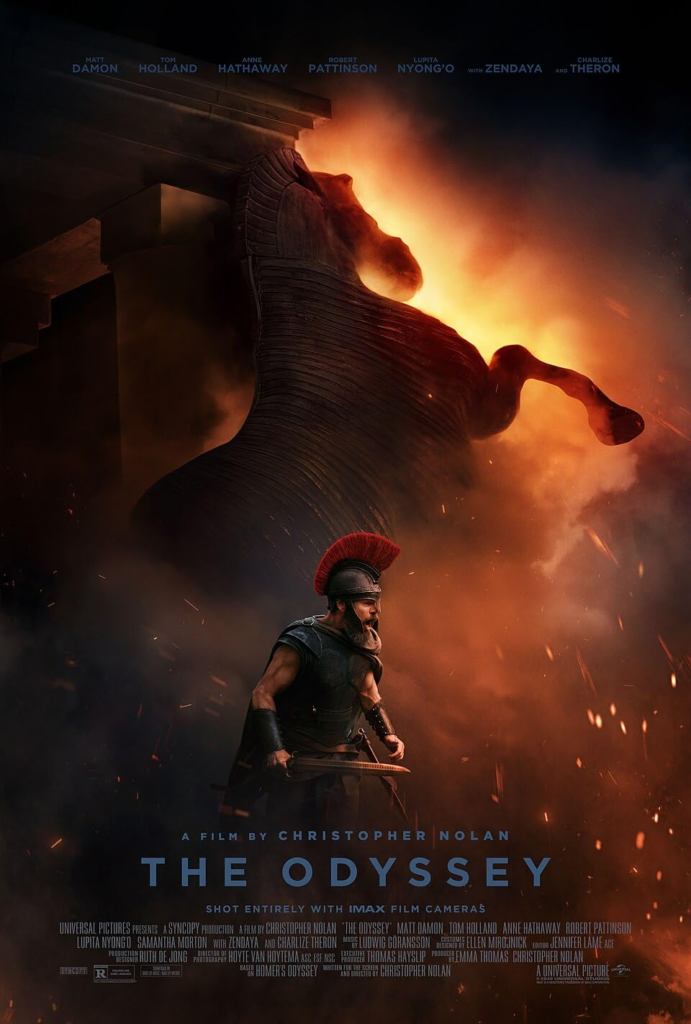
Christopher Nolan’s The Odyssey (2026) redefines the epic. With Matt Damon, Tom Holland, and Anne Hathaway, we review the monumental, mind-bending take on Homer’s ancient voyage.
In the year 800 BCE, a blind poet known as Homer sat down and told a story about a man who spent ten years fighting a war, and then another ten years trying desperately to get home. For over 2,700 years, that story—The Odyssey—has survived empires, plagues, world wars, and the shifting sands of human culture. It is the grandfather of all adventure tales.
Now, imagine giving that ancient, blood-soaked myth to the most ambitious, boundary-pushing director of our modern age—Christopher Nolan.
The Odyssey (2026) is finally here. And I need to tell you right now, this is not just a movie. It is an event. With a colossal budget, groundbreaking practical effects, and a staggering cast led by Matt Damon, Tom Holland, and Anne Hathaway, Nolan has achieved something remarkable. He has taken a 3,000-year-old poem and turned it into a visceral, psychological, and deeply intimate survival thriller that feels like it was shot yesterday.
The Odyssey | Official New Trailer
Let’s sail into the treacherous waters of this cinematic epic.
The Nolan Touch: Why This Isn’t Your Grandfather’s Odyssey
If you know anything about Christopher Nolan, you know he doesn’t do “standard” blockbusters. From the fractured timeline of Memento to the wormholes of Interstellar to the atomic fire of Oppenheimer, Nolan is obsessed with the human mind under extreme pressure.
The Man Behind the Lens
Nolan is the absolute perfect filmmaker to adapt The Odyssey. Why? Because The Odyssey is not just a travelogue; it is a psychological exploration of a man who is slowly losing his grip on reality. Nolan understands that the monsters Odysseus faces aren’t just mythical beasts—they are manifestations of his trauma, his guilt, and his desperate longing to return home.
A Return to Ithaca… Through the IMAX Lens
True to his style, Nolan has shot the majority of this film using massive IMAX film cameras, with absolutely zero reliance on digital green screens. I cannot stress how important this is. When you watch Odysseus’s ship being battered by a monstrous, god-sent storm, you are watching actual ships in actual water tanks. The spray of the salt water hits the lens. The wood groans and splinters with terrifying realism. This isn’t a cartoon; it’s a brutal, physical, grimy experience.
The Cast That Breathes Life into Olympus
A film of this magnitude requires actors capable of carrying both the physical weight of battle and the emotional weight of ancient grief. This cast delivers on every single level.
Matt Damon as Odysseus: The Wounded King of Wits
Matt Damon’s Odysseus is a revelation. He doesn’t play the character as a muscle-bound, Homeric superhero. He plays him as a battle-worn, exhausted, deeply traumatized strategist.
In the opening scenes, as the ships set sail from Troy, you can see the madness creeping into his eyes. He has been fighting for a decade. He is covered in scars. He is so close to home that he can almost smell the olive trees of Ithaca, but the gods keep throwing obstacles in his path. Damon brings a heartbreaking weariness to the role. There is a scene where he looks at the horizon and whispers, “I just want to stop.” It hits you like a spear to the chest.
Tom Holland as Telemachus: The Son Waiting in the Wings
We all know Tom Holland as the charming, quippy Spider-Man. But in The Odyssey, he is unrecognizable. Holland plays Odysseus’s son, Telemachus, a young man who has grown up entirely without his father. While Odysseus is fighting monsters, Telemachus is fighting a different kind of war at home.
He is trying to protect his mother, Penelope, from the 108 greedy suitors who have invaded their palace, eating them out of house and home while they wait for the “dead” king to return. Holland strips away his easy charm. His Telemachus is a desperate, anxious boy forced to become a man overnight. The scene where he watches from the cliffs as a massive ship appears on the horizon—not knowing if it is his father or an invader—is gut-wrenchingly tense.
Anne Hathaway as Penelope: The Silent Queen of Survival
Anne Hathaway is given the difficult, and brilliantly executed, task of playing two roles: Penelope, the faithful wife, and Calypso, the seductive goddess.
As Penelope, Hathaway is a masterclass in quiet power. She is not a passive trophy. She is a political genius. She has managed to keep a kingdom from imploding for four years using nothing but her wits and her patience. You can feel the silent, agonizing ache she carries for her husband.
The Monsters of the Mind: From Cyclops to Sirens
Nolan’s interpretation of the mythological creatures is where the film truly transcends the genre.
Polyphemus the Cyclops: The Brutality of Impulse
The sequence with the Cyclops, Polyphemus, is shot like a claustrophobic horror film. Nolan doesn’t give us a CGI cartoon beast. Through masterful use of practical prosthetics and forced perspective, Polyphemus is a terrifying, towering creature made of raw muscle and primal rage.
When Odysseus and his men are trapped in the Cyclops’s cave, the dread is suffocating. We watch Polyphemus casually snatch up crew members and crush them like insects. Odysseus doesn’t beat this monster with a sword; he beats it with his mind, tricking the Cyclops and blinding him. It is a thrilling, terrifying, and profoundly clever sequence that honors Homer while feeling fresh for modern cinema.
The Sirens: The Seduction of Regret
The Sirens are not depicted as mermaids. Nolan reimagines them as metaphysical ghosts. Their song doesn’t lure sailors with promises of pleasure; it lures them by playing back the memories of everything they have lost.
We see Odysseus’s men being drawn to the shore because the Sirens show them visions of their dead mothers, their lost children, and their former lives. It is a psychological assault, not a physical one. The sequence forces the audience to confront the idea that Odysseus’s journey isn’t physical—it is a battle against his own immense grief.
Calypso: The Island of Stagnation
Hathaway’s portrayal of Calypso is stunningly unsettling. Calypso is the goddess who holds Odysseus captive on her island for seven years. In Nolan’s vision, the island isn’t a paradise; it is a prison of beautiful stagnation.
Calypso represents the ultimate temptation: Just stop. Stop fighting. Stop hurting. Stay here and let the world forget you. Hathaway plays her with a terrifying combination of maternal warmth and possessive cruelty. She loves Odysseus, but it is a cage of love.
The Technology and Spectacle: A “Lived-In” Mythology
We have to talk about the sheer, staggering scale of the production. Nolan has outdone himself.
Practical Effects Over CGI
There is a sequence where Odysseus’s ship is caught in a storm sent by Poseidon. The waves are not computer-generated. Nolan shot this using massive, reinforced ships in a specially constructed ocean tank in London. The crew was genuinely tossed around. The freezing water was genuinely dumped on Matt Damon.
This commitment to reality means the film has a “lived-in” texture. The bronze armor shines with scratches. The ropes are frayed. The blood is sticky and wet. It grounds the epic in a physical reality that makes the emotional stakes feel dangerously high.
The Soundscape of the Aegean
Hans Zimmer’s accompanying score is a masterpiece of sound. He uses ancient Greek instrumentation—the lyre, the aulos (a double-reed pipe)—but layers them with deep, booming orchestral bass that resonates in your chest when played in a Dolby Atmos theater. The sound of the Cyclops’s roar is so low and guttural that it literally vibrates your seat.
The Philosophical Core: What Does It Mean to Be “Home”?
If you strip away the monsters and the gods, The Odyssey is a story about one question: What does it mean to go home?
The War Never Ends
The film’s most devastating thesis is that the Trojan War never ended for Odysseus. When he killed Trojans, he didn’t just kill enemies; he killed a part of his own humanity. The ten-year voyage is a descent into his own personal hell. The monsters—the Cyclops, the Sirens, the giant whirlpool Charybdis—are physical manifestations of his PTSD. The war didn’t stop when the wooden horse rolled into Troy. It just moved inside his head.
The Question of Ithaka
The film’s final act, the return to Ithaca, is not a triumphant victory lap. It is a somber, painful homecoming. When Odysseus finally reunites with Penelope and Telemachus, the joy is deeply undercut by a haunting realization: he is a stranger to them. He has been gone for twenty years. His son is a man he has never met. His wife has aged while he has been trapped in a time bubble.
The film asks a brutal question: Does Odysseus truly find peace when he returns, or does he realize that the journey was the only place he ever knew how to survive? The ambiguity of the final frame will leave you debating for days.
Is The Odyssey Right for You?
If you are looking for a light, simple popcorn movie, this is not for you. But if you want cinema that demands your full attention and rewards you with an emotional avalanche, you must see this on the biggest screen available.
The Epic That Demands Your Full Attention
This film is a spiritual sibling to Gladiator, The Revenant, and Nolan’s own Interstellar. It is a sprawling, three-hour epic that refuses to hold your hand. You are dropped into the ancient world, and you have to swim to keep up. The runtime feels massive, but it never feels bloated.
The Trigger Warning for Intense Content
I want to offer an honest, empathetic trigger warning here. This film is graphically violent. The battle scenes are brutal; limbs are severed, blood sprays across the camera, and the crew suffers horrifying deaths. Additionally, the psychological weight of survivor’s guilt, grief, and depression is heavy throughout. It is an emotionally draining experience, but a deeply cathartic one.
Conclusion: The Modern Epic We Desperately Needed
The Odyssey (2026) is a staggering achievement. Christopher Nolan has done the impossible: he has taken the oldest story in the western literary canon and made it feel urgent, terrifying, and profoundly relevant to our modern lives.
He reminds us that the epic isn’t about gods and monsters. It is about a tired man, covered in salt and blood, who just wants to look into his wife’s eyes one more time. It is a story of endurance, of cunning, and of the terrifying realization that going home is sometimes harder than going to war.
If you walk into the theater expecting pure spectacle, you will get it. But you will also leave with a piece of Odysseus’s weary soul embedded in your own.
Alright, let’s talk in the comments. What is your favorite mythological adaptation of all time? Do you think Nolan’s Odyssey surpasses the 1997 miniseries, or does it stand entirely on its own? And, most importantly—who do you think should play the Greek gods in the inevitable sequel? Drop your thoughts below. I’m dying to hear your takes on this monumental film.