Backrooms (2026) turns internet nightmare into cinematic gold. We review Kane Parsons’s terrifying film starring Chiwetel Ejiofor, where a therapist must save a patient from a reality-bending dimension.
Do you know the feeling of walking into an empty hotel corridor at 3 AM? The fluorescent lights hum with that distinct, sickly buzz. The carpet is patterned in a way that makes your eyes ache. There are no windows, no clocks, and no signs of life. There is just an endless, suffocating emptiness.
Now, imagine being trapped there forever.
This is the terrifying premise of Backrooms (2026), the feature-film debut of internet sensation Kane Parsons. What started as a viral YouTube short film—a five-minute found-footage exploration of this liminal nightmare—has been expanded into a psychologically devastating, visually oppressive masterpiece. With an incredible cast led by Chiwetel Ejiofor, Renate Reinsve, and Mark Duplass, this movie takes an internet meme and transforms it into one of the most deeply unsettling horror experiences of the modern era.
BACKROOMS Official Trailer (2026)
Let’s step into the yellow halls, leave our sense of reality at the door, and explore this cinematic nightmare.
The Phenomenon: From Creepypasta to Cinematic Event
Before we talk about the film, we have to understand the cultural phenomenon that spawned it.
The Birth of the Backrooms
In 2019, an anonymous user on the 4chan board “/x/” (the forum dedicated to the paranormal) created a thread asking users to share “disquieting images that feel off.” Someone posted a picture of a vast, empty, yellow office room—an actual, real-life hallway photographed in an abandoned building. The caption read: “If you’re not careful and you noclip out of reality in the wrong areas, you’ll end up in the Backrooms…”
The concept exploded. The Backrooms became a digital folkloric monster for a generation raised on the internet. It tapped into a specific, primal fear: the fear of being completely, irreversibly lost in a world designed for corporate productivity that has been entirely abandoned.
Kane Parsons: The Director Who Respects the Source
Kane Parsons is not a Hollywood outsider trying to cash in on a fad. He is a young filmmaker who grew up on this lore. He started by making short, found-footage documentaries about the Backrooms on YouTube, garnering tens of millions of views.
When he was approached to make a full feature, he did the smartest thing possible: he respected the source material. He didn’t turn the Backrooms into a blockbuster monster movie. He stayed true to the vibe—the stillness, the isolation, the dreadful boredom of an endless empty world. Parsons understands that the most terrifying thing about the Backrooms isn’t the monsters; it is the crushing realization that nobody is coming to save you.
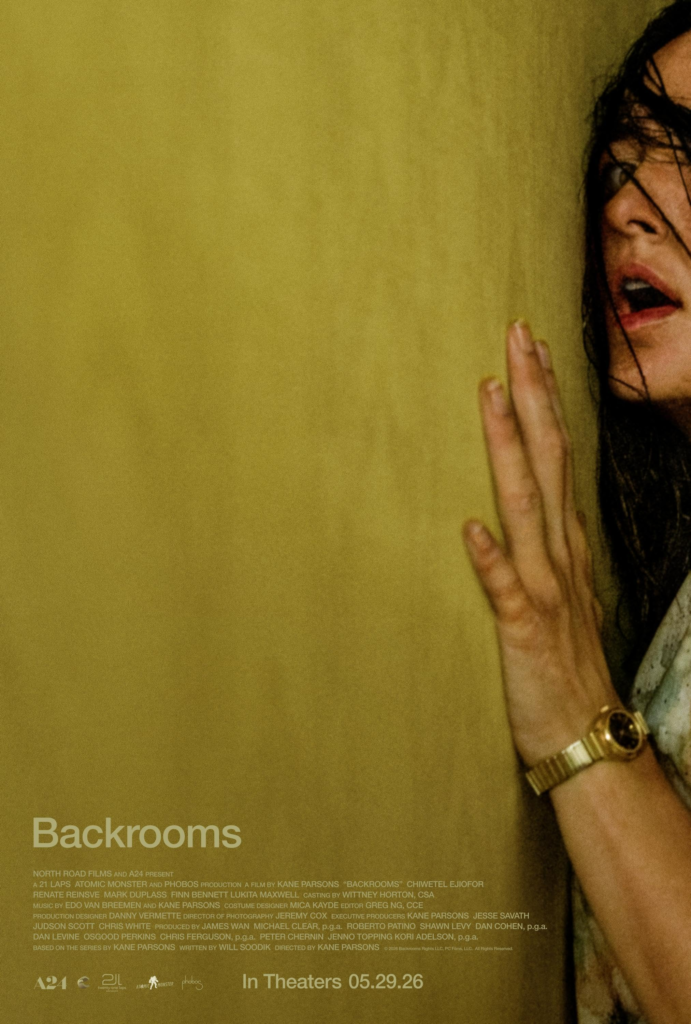
The Cast That Anchors the Unreality
A horror film about empty rooms can easily become boring. You need elite actors to carry the emotional weight. The cast of Backrooms is exceptional.
Chiwetel Ejiofor as Dr. Helen Carter: The Rationalist in the Void
Ejiofor plays Dr. Helen Carter, a clinical therapist who specializes in trauma. When her patient, Elara, mysteriously disappears into a “dimension beyond reality,” Helen makes the irrational choice to follow her.
Ejiofor’s performance is a masterclass in controlled disintegration. In the early scenes, he plays Helen as a calm, rational professional. He is the kind of man who checks his watch and takes notes. But when the fluorescent lights of the Backrooms flicker and die, leaving him in complete darkness, we watch his professional mask crumble. The terror in his eyes is not cartoonish. It is a slow, agonizing realization that the laws of physics he has spent his life trusting simply do not apply here.
Renate Reinsve as Elara: The Patient Who Fell Through
Renate Reinsve plays Elara, the missing patient. Her screen time is brief, but her presence haunts the entire film. We learn through therapy sessions (scattered in flashbacks) that Elara was a severely traumatized young woman who felt disconnected from the physical world.
The film subtly hints at a terrifying truth: some people are naturally drawn to the Backrooms because they no longer feel at home in reality. Elara didn’t “noclip” by accident; she was pulled into this dimension because her soul was already half-gone. Reinsve plays Elara with a heartbreaking, fragile resignation. She isn’t screaming for help; she is almost relieved to be somewhere that matches the emptiness inside her.
Mark Duplass as The Archivist: The Trapped Informant
Mark Duplass delivers a performance that will give you nightmares. He plays the Archivist, a man who has been trapped in the Backrooms for decades. He has gone feral. His hair is long, his skin is pale, and his eyes are adjusted to the endless fluorescent hum.
Duplass is terrifying, but he is also deeply tragic. He acts as Helen’s guide, whispering warnings about the entities that lurk in the dark. But his warnings are often cryptic and rambling, revealing that his mind has been fractured by years of isolation. He is a walking spoiler alert for what happens if you stay too long—you lose yourself entirely.
The Descent: Building a World of Absolute Isolation
The production design of this film is staggering in its commitment to realism.
The Aesthetic of the “Liminal”
Here is the genius of the visuals: there is almost no CGI. The film was shot in real, abandoned office buildings, disused nursing homes, and massive, empty warehouse complexes in Europe. The production team painted the walls in that exact, sickly yellow-beige tone. They installed hundreds of actual, working fluorescent lights that buzz and hum.
The result is a film that feels palpably real. When Helen walks through a seemingly endless corridor that stretches into infinity, the camera doesn’t cut. We watch her walk for minutes on end, her footsteps echoing off the walls, the repetitive pattern of the carpet making us feel dizzy. Parsons uses the technique of “liminal space”—the transition areas of architecture—to create a nightmare of disorientation.
The Levels of Hell
The film isn’t stuck in one place. Helen “noclips” through several different “levels.” She stumbles into a pitch-black, flooded basement where she must wade through freezing water, terrified of what might be brushing against her legs. She finds herself in an infinite, empty hotel with thousands of identical doors. She even walks onto a suburban street where the sky is a permanent, oppressive grey and the houses are entirely empty. Each level is meticulously designed to feel like a different circle of psychological torment.
The Psychological Terror: More Than Just Monsters
The true horror of Backrooms is existential, not visceral.
The Horror of Forgetting
Parsons introduces a brilliant, heartbreaking mechanic. The longer you stay in the Backrooms, the more your memory deteriorates. You forget your name. You forget the faces of your loved ones. You forget what natural sunlight feels like.
This creates an agonizing ticking clock for Helen. He isn’t just fighting to physically escape; he is fighting to remember why he is even here. He starts writing notes on his own arms to remember his own name. The film uses this to explore the fragility of human identity. If you forget who you love, do you even exist anymore?
The Entities: The Horror of the Unseen
Yes, there are monsters in the Backrooms. They are called “Entities.” They are tall, pale, elongated humanoid figures that skitter through the ventilation systems and stand motionless in the dark corners.
But Parsons uses them with extreme restraint. Most of the Entity scenes are auditory. We hear them skittering above us in the drop-ceiling. We hear a wet, choking breath coming from behind a locked door. When we finally see one, it is only for a split second—a pale, faceless silhouette disappearing around a corner. This “less is more” approach makes the Entities infinitely more terrifying than any CGI beast.
The Emotional Core: A Therapist’s Guilt
Behind the horror, there is a profoundly human story.
Helen’s Unspoken Trauma
As the film progresses, we learn why Helen is so obsessed with saving Elara. It is not just professional duty. Years ago, Helen failed another patient—a young man who committed suicide under his care. Helen has been carrying that guilt like a chain around his neck.
The Backrooms, in a brilliant narrative twist, are not just a physical place. They are a manifestation of Helen’s own guilt. The endless halls represent the endless cycles of “what if” he has replayed in his head. To save Elara, he must literally walk through his own trauma.
The Bond Formed in the Dark
The relationship between Helen and the Archivist (Duplass) is the heart of the film. The Archivist is a cautionary tale of what happens when you give up hope. Helen, despite his own fear, refuses to let the Archivist succumb to the void. Their moments of camaraderie—a shared whisper, a silent nod of understanding—are fleeting, but they provide the only light in this suffocating darkness.
Is Backrooms Right for You?
If you are looking for a fast-paced, jump-scare-heavy horror film, you might be disappointed. But if you want a slow, dread-inducing descent into pure psychological terror, this is the movie of the decade.
For Fans of Psychological, Atmospheric Horror
This film belongs in the same conversation as The Lighthouse, The Shining, and Annihilation. It is a slow-burn that uses sound design, lighting, and existential dread to get under your skin. It respects your intelligence and refuses to explain everything.
A Crucial Trigger Warning for Sensory Overload
I have to offer an honest, empathetic trigger warning. The film utilizes intense low-frequency bass vibrations that are designed to cause physical anxiety. The claustrophobic cinematography, with endless shots of narrow hallways and locked doors, might induce severe panic in viewers with claustrophobia. If you are prone to sensory overload, watch this film with the lights on, and perhaps lower the bass on your sound system.
Conclusion: The Void That Reflects Our Own Isolation
Backrooms (2026) is not just a horror movie. It is a metaphor. The endless, yellow, empty corridors are a reflection of the digital age. We scroll through social media, we doom-watch, and we interact through screens. We are increasingly isolated, walking through the “halls” of the internet without ever truly connecting with the people beside us.
When Helen finally finds Elara in the deepest, darkest level of the Backrooms, their reunion is not a triumphant rescue. It is a quiet, desperate embrace between two souls who have found each other in the void. The film ends on a note of profound, aching hope.
Kane Parsons has proven that the monsters of the internet can be harnessed to tell stories of real, deep, human emotion. Backrooms will scare you, yes. But it will also remind you to hold onto the people you love, look up at the real sky, and never, ever let yourself slip away into the endless halls of disconnection.
Alright, let’s talk in the comments. Did you fall down the Backrooms rabbit hole back in 2019? Are you brave enough to watch this film alone in the dark? And most importantly—what is your deepest fear about being completely lost? Drop your thoughts below. I’ll be right here, keeping the lights on.