A nearly perfect final season that celebrates growth over grand gestures, wrapping up Yumi’s journey with quiet, earned satisfaction.
Yumi’s Cells 3 is the kind of final season that reminds you why you fell in love with a show in the first place. After a three-year hiatus, the beloved K-drama returned in April 2026 to conclude Kim Yumi’s story. And while it might be shorter than its predecessors, it delivers an emotionally resonant and mature finale that feels just right for its heroine.
What Is This Season About? A New Chapter
Picking up three years after the events of Season 2, the third season finds Yumi (Kim Go-eun) as a successful romance novelist. She has achieved her professional dreams, but her life has become monotonous. Her “Cell Village,” once a bustling hub of emotion, has grown dormant. Yumi is stuck in a rut, “bland” and unable to feel excited about anything.
Everything changes with the arrival of her new editor, Shin Soon-rok (Kim Jae-won). He is logical, formal, and a strict homebody. His rational nature initially frustrates Yumi, but this friction surprisingly reawakens her dormant emotions. This is the beginning of a new, “unpredictable romance” that brings her cell village back to life.
The Good: Why It’s a Triumphant Final Season
🎭 Phenomenal Performances and Perfect Chemistry
Kim Go-eun is, and always has been, the heart of this show. She embodies Yumi so completely that it’s hard to imagine anyone else in the role. This season, she portrays a more mature and guarded version of the character, where her “hopeful, bubbly core” is “quieter at times, but still there”. Her performance allows us to see the woman Yumi has become: a “dependable and mature woman” who is more vocal about what she wants.
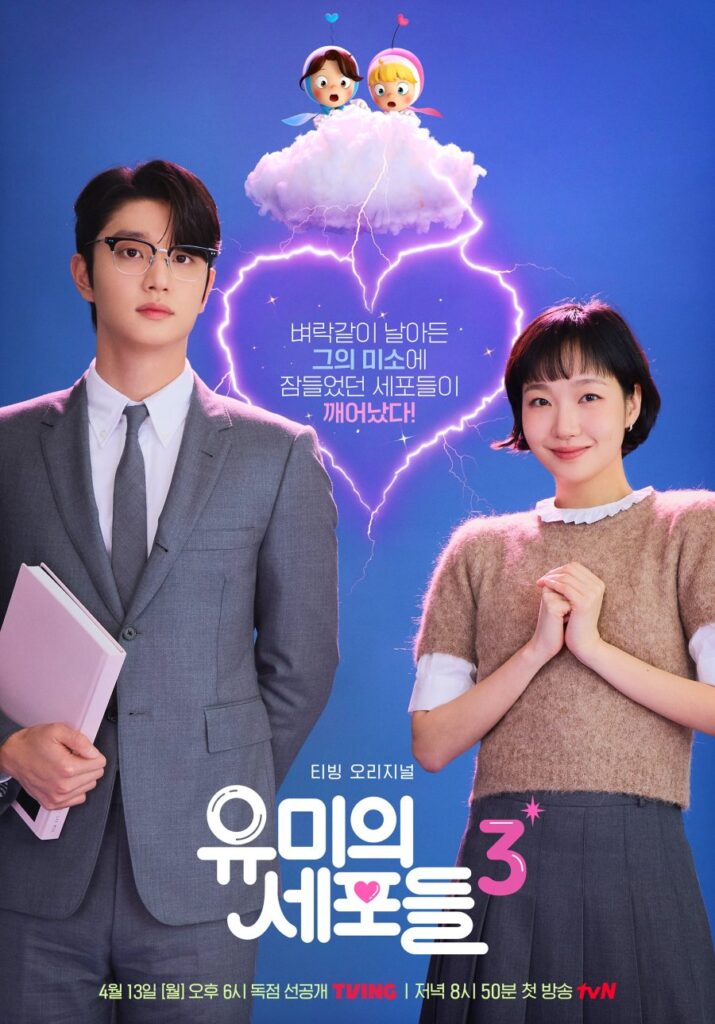
The casting of Kim Jae-won as Shin Soon-rok was a pleasant surprise. Despite an 11-year age gap between the actors, their chemistry felt “effortless and real”. Kim Jae-won holds his own opposite Kim Go-eun, portraying Soon-rok’s introverted nature with depth and nuance. He makes his character feel “realistic and yet such a romantic and perfect main lead”. Their on-screen relationship is described as “thoughtful” and a perfect match for Yumi’s more mature approach to love.
✍️ Intelligent and Honest Writing
The show’s greatest strength is its writing. The third season is praised for being “so honest, witty, and personal that it genuinely felt like reading Yumi’s diary”. The season’s plot is tightly paced, never wasting a second.
One of the most lauded aspects is the character development of Soon-rok. The show initially presents him through Yumi’s eyes as frustrating and anti-social. However, it later reveals his side: he is a major introvert with a low social battery who shuts off all his cells during the workday to be professional, saving his energy for his private life at night. This empathetic portrayal makes him deeply relatable.
🧠 A Flawless Finale
The ending is a masterclass in mature storytelling. In the final episodes, Soon-rok proposes after just a month of dating. Yumi, having survived two previous engagements that ended in heartbreak, does not immediately say yes. This is not a rejection but a sign of her growth; her Writer and Rational cells now work alongside her Love Cell, allowing her to ask for time. As one source notes, she “understands that a healthy relationship requires readiness rather than just momentum”.
This quiet moment of maturity, where she focuses on “mutual respect and individual stability,” is a beautiful testament to how far she’s come. A post-credit scene rewards patient fans with a glimpse of a simple wedding, confirming their happy ending without a loud or dramatic celebration.
The Divisive: What Some Viewers Criticized
⏳ The Eight-Episode Run Feels Rushed
The biggest criticism by far is the season’s length. At only eight episodes, it’s significantly shorter than the 14-episode first and second seasons. While many felt the story was complete, they also “wanted one more episode”. One reviewer notes that “the ending felt far too rushed,” saying more time was needed for a “slower build up”. For some, this condensed format didn’t allow the love story to develop at its preferred pace.
🏡 A Familiar, “Ordinary” Story
For those looking for high-stakes drama or a shocking twist, this might not be the season for you. The series is praised for telling an “ordinary” story in an “honest” and “personal” way. However, for some, the focus on Yumi’s mature, introspective journey and a “calm and realistic” ending might feel less exciting than the drama of the previous seasons.
Yumi’s Cells 3 vs. The Other Dramas We’ve Reviewed
How does this introspective K-drama compare to the other shows and games we’ve explored?
| Feature | Yumi’s Cells 3 | The Scarecrow | The Legend of Zelda: BotW | Red Dead Redemption 2 |
|---|---|---|---|---|
| Core Experience | Mature romance & personal growth | Crime thriller & systemic injustice | Exploration & puzzle-solving | Narrative-driven western sim |
| Storytelling | Intimate, character-driven, witty | Gripping, dark, emotionally devastating | Visual, fragmented, player-driven | Deep, character-driven drama |
| Ending Tone | Quietly satisfying, implied certainty | Uncompromising, realistic, frustrating | Open, player-dependent | Slow, melancholic |
| Key Complaint | Too short, ending felt rushed | Unsatisfying lack of justice | Weapon durability, repetitive shrines | Slow pace, clunky controls |
Unlike the brutal realism of The Scarecrow, which denies viewers a feel-good ending, Yumi’s Cells 3 provides a heartwarming and earned conclusion. It trusts its audience to appreciate a mature, quiet resolution over a dramatic, cinematic one, and for most fans, it hits perfectly.
Final Verdict: Is It Worth Watching in 2026?
Absolutely. For fans of the series, this final season is essential viewing. It’s a beautiful, heartfelt conclusion that does justice to the character’s journey.
- If you have watched the previous seasons: This is a must-watch. It provides a satisfying and emotional conclusion to a story you’ve invested in. Watching her growth from the beginning is part of what makes this season so “beautiful”.
- If you are new to the series: It is possible to watch as a standalone romantic comedy, but you would be missing the full emotional weight of Yumi’s evolution. The context from past heartbreaks is crucial to understanding her mature decisions in this season.
My Recommendation: If you love character-driven stories, realistic romance, and shows that blend live action with animation in a unique way, Yumi’s Cells is one of the best. While the short runtime is a minor flaw, the season’s strengths—its writing, performances, and beautiful, mature ending—far outweigh it. It’s a show that will make you laugh, cry, and feel all the “dokidokis”. Prepare to be left with a warm heart and a smile on your face.