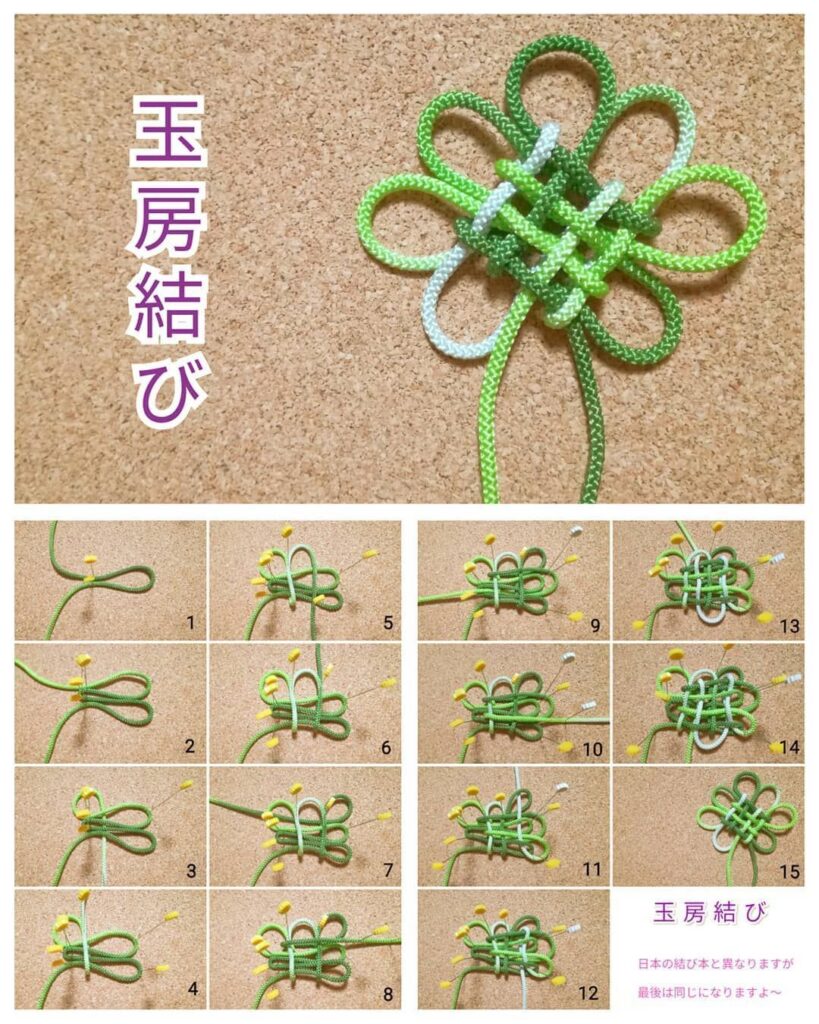
The 玉房結 (Gyokubō Musubi or Tamafusa Musubi) is a traditional Japanese decorative knot that combines a jewel-like spherical top (玉 / gyoku) with a flowing tassel (房 / fusa). It is used as a netsuke (toggle), purse charm, keychain, bookmark ornament, or obidome (kimono cord decoration).
How to Tie the 玉房結 (Gyokubō Musubi) — Japanese Jewel Tassel Knot
In this guide, you will learn:
The full meaning of the knot’s name and its cultural significance
Step-by-step understanding of the diagram (steps 10–15)
How to complete the knot based on the phrase “最後同”
Practical applications for jewelry and accessories
Note: Your image is a partial diagram. This guide provides the most likely interpretation based on traditional Japanese knotting techniques and the numbered steps visible.
Part 1: Full Meaning of 玉房結
Japanese
Romaji
Literal Meaning
Cultural Meaning
玉
gyoku / tama
Jewel / ball
Precious, beautiful, complete
房
fusa / bō
Tassel / cluster
Flowing ends, abundance
結
musubi
Knot
Connection, binding
Together: “Jewel Tassel Knot” — a knot that looks like a jewel sitting atop a silken tassel.
Symbolism
Element
Symbolism
Jewel (ball)
Completeness, perfection, preciousness
Tassel
Flowing energy, abundance, grace
The knot itself
Connection between heaven (jewel) and earth (tassel)
Part 2: Understanding the Diagram Numbers
Your image shows step numbers:
Step Number
Likely Action (based on traditional Gyokubō Musubi)
10
Beginning to form the jewel (ball) section
12
Shaping the upper loops of the jewel
13
Tightening and arranging the jewel layers
15
Beginning the tassel section or completing the lower loops
What “最後同” (Saigo Dō) Means
Japanese
Romaji
English
最後
saigo
Last / final
同
dō
Same / identical / together
Meaning: “Final same” or “the last step is the same” — likely indicating that the final tightening or finishing action is the same as a previous step, or that the two sides should be made identical.
In knotting instructions, “最後同” often appears at the end of a multi-step diagram to say: “Now complete the knot by repeating the same action on the opposite side” or “The finishing method is the same as step X.”
Part 3: How to Tie the Gyokubō Musubi (Reconstructed)
Since your image shows only partial steps, below is the traditional method for tying a jewel tassel knot, based on standard Japanese knotting techniques.
Materials Needed
Material
Specification
Cord
Silk satin cord, kumihimo cord, or rattail (2–3mm thickness)
Length
Approximately 60–80cm for a standard size
Tools
T-pins, knotting board (foam board), scissors, lighter or fray check
Step 1 — Create the Jewel (Ball) Base
Action
Detail
Fold the cord
Find the midpoint and fold to create a loop
Form loops
Create a series of interlocking loops that will become the spherical jewel
Pin in place
Use pins to hold the loop structure on a foam board
This corresponds to steps 10–12 in your diagram.
Step 2 — Shape the Jewel Layers
Action
Detail
Arrange the loops
Pull loops outward to form a rounded, ball-like shape
Create symmetry
The jewel should have 4–8 “petals” or segments
This corresponds to steps 13–14 in your diagram.
Step 3 — Tighten the Jewel
Action
Detail
Pull working ends
Slowly and evenly pull the cord ends to tighten the jewel
Adjust loops
Use a pin or needle to arrange each loop into position
The jewel should be firm
Tight enough to hold its shape, but not so tight that loops disappear
Step 4 — Form the Tassel (房)
Action
Detail
Allow cords to hang
Below the jewel, let the remaining cord ends hang freely
Create the tassel
The hanging cords become the “tassel” part
Trim evenly
Cut the ends to the same length (typically 5–10cm)
This corresponds to step 15 in your diagram.
Step 5 — Final Step (最後同)
Action
Detail
“Same as before”
Repeat the tightening or loop-arranging action on the opposite side
Or “finish together”
Pull both working ends simultaneously to lock the knot
Secure ends
Apply a drop of fray check or carefully singe (if nylon/synthetic)
Before final tightening, arrange all loops so they are the same size
Tassel is uneven
Cut ends without measuring
Wrap a piece of tape around the tassel before cutting, or use a tassel cutter
Jewel collapses
Did not tighten enough
Pull working ends more firmly; use a pin to hold the center while tightening
Knot looks like a mess
Loops were not pinned in the correct order
Start over with a fresh cord; pin each loop immediately after forming
“最後同” confusing
Missing the previous step
Look at the full diagram; the final action mirrors an earlier step (e.g., step 10 or 12)
Part 6: What to Make with Gyokubō Musubi
Project
How to Use
Netsuke (toggle)
Attach to the end of a braided cord to secure a pouch or inro
Keychain
Add a key ring to the jewel top; the tassel hangs below
Bookmark
Attach to a flat bookmark cord; the tassel marks your page
Purse charm
Clip to a handbag zipper pull
Obidome (kimono ornament)
Hang from the obijime (obi cord) as a decorative accent
Bracelet charm
Attach to a macrame bracelet as a dangle
Part 7: “日本の本” (Japanese Book) — Source Context
Japanese
Romaji
Meaning
日本の本
Nihon no hon
Japanese book
This indicates the diagram comes from a Japanese knotting instruction book. Japanese craft books (手芸本 / shugei bon) are known for their clear, diagram-heavy instructions. The numbers (10, 12, 13, 15) are likely step numbers within a larger sequence.
Part 8: Related Japanese Knots
Knot
Japanese
Relationship to 玉房結
玉結び (Tama Musubi)
玉結び
Jewel knot (just the ball, no tassel)
房結び (Fusa Musubi)
房結び
Tassel knot (just the tassel)
玉房結 (Gyokubō Musubi)
玉房結
Jewel + tassel combined
玉房結ボタン (Gyokubō Botan)
玉房結ボタン
Jewel tassel button (no hanging tassel)
SEO Blog Post Optimization
Meta Tag
Suggested Content
Title
How to Tie 玉房結 (Gyokubō Musubi) — Japanese Jewel Tassel Knot
Meta Description
Complete guide to the Japanese Jewel Tassel Knot (玉房結 / Gyokubō Musubi). Step-by-step instructions, diagram understanding, and cultural meaning.
URL slug
/gyokubo-musubi-japanese-jewel-tassel-knot
Keywords
玉房結, Gyokubō Musubi, Tamafusa Musubi, Japanese jewel tassel knot, Japanese decorative knot, 房結び, 玉結び
Alt text for image
Diagram of Japanese Gyokubō Musubi (Jewel Tassel Knot) showing steps 10, 12, 13, 15, with Japanese text “玉房結” and “最後同”
Final Pro Tip: Practice with Two Colors
The hardest part of the Gyokubō Musubi is tracking which cord goes where. Use two different colored cords for your first attempt (e.g., one red, one gold). When you pull the final tightening, you will clearly see which color becomes which part of the jewel. Once mastered, switch to a single color for an elegant, traditional look.
Summary: You Can Now Understand the 玉房結 Diagram
Element
You Can Now…
玉房結
Identify the Jewel Tassel Knot
Steps 10–15
Understand the general sequence (jewel → tassel)
最後同
Recognize the final step (repeat previous action or finish together)
日本の本
Know this comes from a Japanese knotting book
The knot itself
Attempt to tie a jewel tassel using the reconstructed method
While the full 99-step project from earlier requires extensive practice, the 玉房結 is a standalone, intermediate-level knot that you can master in 30–45 minutes.