Some films entertain. A rare few transcend entertainment to become something deeper—a cultural touchstone, a cinematic scripture, a meditation on the very nature of power, legacy, and the soul’s corrosion. Francis Ford Coppola’s The Godfather Part II (1974) is one of those rare treasures. It didn’t just follow one of the greatest films ever made; it dared to equal it—and for many, to surpass it .
More than fifty years after its release, The Godfather Part II remains the gold standard for what a sequel can achieve. It is the first sequel in history to win the Academy Award for Best Picture, a testament to its extraordinary ambition and flawless execution . It is not merely a continuation but a grand, operatic expansion of the first film’s universe, weaving together a sequel and a prequel in a tapestry of breathtaking scope and devastating emotional power . It is, as one critic put it, “an epic vision of the corruption of America” .
The Architecture of a Masterpiece: Two Stories, One Tragedy
The film’s genius lies in its structure. Unlike most sequels, which simply extend the narrative, Part II is both a sequel, chronicling Michael Corleone’s (Al Pacino) reign as the new Don, and a prequel, depicting the rise of his father, Vito (Robert De Niro), from a penniless Sicilian immigrant to the powerful Godfather of the original film . These parallel narratives are not just a clever narrative device; they are the film’s very soul. They create a devastating contrast between the warmth and community that built the Corleone empire and the cold, ruthless isolation that sustains it. Coppola masterfully juxtaposes the father’s ascent with the son’s descent, creating “a breathtaking display of filmmaking” that explores how a family’s greatest strength can become its most tragic curse .
The prequel segments, set in turn-of-the-century Sicily and New York, are captivating. Robert De Niro delivers an iconic performance as the young Vito Corleone, flawlessly echoing Marlon Brando’s mannerisms and voice while making the role entirely his own . We witness Vito’s survival of a brutal vendetta in Sicily, his lonely arrival at Ellis Island, and his gradual, shrewd ascent from a grocery store clerk to the neighborhood’s respected “Godfather.” His killing of the local bully, Don Fanucci, is a masterclass in quiet, efficient violence—the birth of a king. These scenes show a man who kills out of necessity and loyalty, whose power is rooted in the love and respect of his community . Vito’s story is one of creation; he is building a family and a legacy from the ashes of his own destroyed childhood.
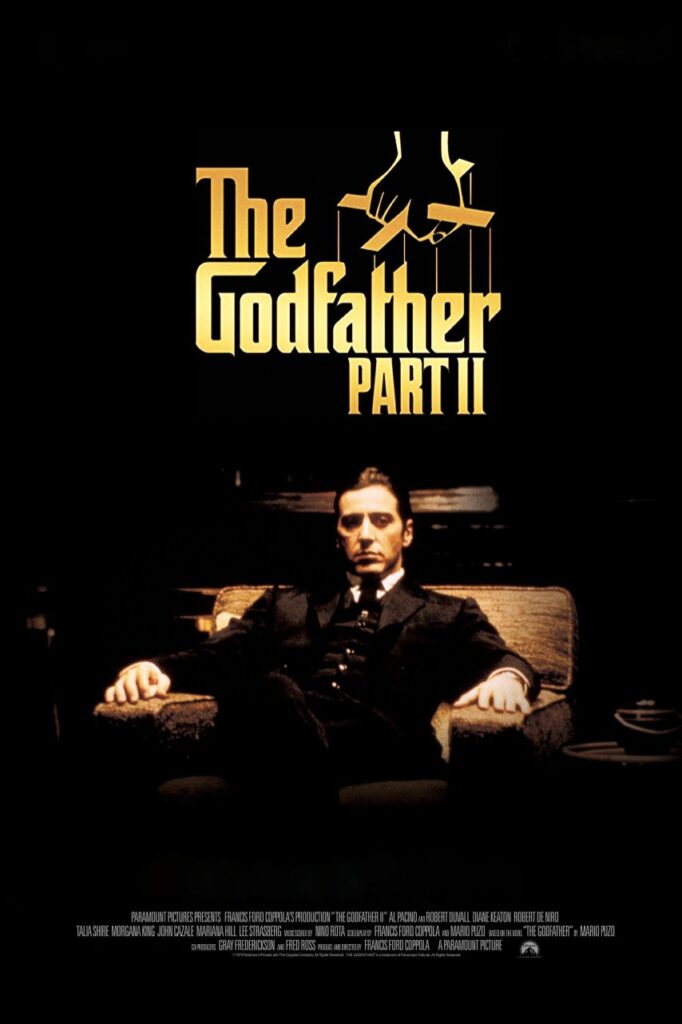
In stark contrast, Michael’s story is one of destruction. Al Pacino, in a performance of chilling restraint, portrays a man who has inherited his father’s throne but not his wisdom. Michael is colder, more paranoid, and ruthlessly “modern.” He is attempting to legitimize the family business, moving them from New York to Nevada and expanding into Cuba. Yet, his very success isolates him. “In the original film, Don Vito is preparing to pass his empire on,” notes a cultural analysis, but in the sequel, Michael’s struggle is different . He is not merely inheriting a legacy; he is trying to remake it, and in doing so, he is systematically destroying the human connections his father cherished. Where Vito built an empire on love and respect, Michael’s empire is built on “fear and violent treachery” . He becomes a man who can only see threats and treachery, even in those closest to him.
The Tragic Corrosion of Michael Corleone
Michael’s arc in Part II is a descent into a moral abyss that is both horrifying and deeply tragic. The film’s narrative force lies in witnessing a man we once rooted for become the architect of his own damnation . He starts the film as a powerful but seemingly composed leader, yet we quickly see him wrestling with his father’s legacy. He is haunted by the expectation to be the patriarch, a role for which he is emotionally ill-suited.
His marriage to Kay (Diane Keaton) crumbles. She represents the normal, legitimate life he once wanted, but he has become a stranger to her, and her desperate, failing attempts to understand him only drive them further apart . In one of the film’s most chilling scenes, after Kay reveals she had an abortion rather than bring another Corleone child into the world, Michael is not enraged but utterly cold. He banishes her from his life with the finality of a business transaction.
The film’s climax hinges on Michael’s ultimate betrayal of his own blood: the murder of his brother, Fredo (John Cazale). Fredo’s jealousy and naivety made him a pawn in an assassination attempt on Michael’s life. Despite the brothers’ reconciliation, and despite Fredo’s pathetic plea, “I didn’t know it was you, Mike, I swear to God!”, Michael cannot forgive a betrayal of the family. He orders Fredo’s execution. The tragedy is amplified by a brilliant flashback immediately following Fredo’s death . The film cuts to a memory of the Corleone family on the night of Vito’s birthday in 1941. It is a moment of innocence and potential. A young, fresh-faced Michael, recently returned from the Marines, proudly announces to his brothers that he has enlisted. Everyone is angry; they had plans for him. But Fredo, in a moment of genuine warmth, is the only one who supports him, offering him a cigar and a smile. This brief, bittersweet scene reminds us of the bond between the brothers and the man Michael might have been.
He is the one left alone at the table, the outsider. In that final moment, “the film concludes with Michael sitting alone in a dark room, contemplating all that he has done in order to emerge victorious,” and we are left to wonder: was the cost worth the alienation? The film ends with a haunting close-up of Michael, utterly alone, having won the war but lost his soul. As one analysis succinctly puts it, “the story is about a man’s life-long struggle” and the price of power .
Technical Brilliance: A Visual and Aural Masterpiece
The storytelling power of Part II is amplified by its impeccable craftsmanship. Cinematographer Gordon Willis, the legendary “Prince of Darkness,” returns with an even more profound visual language . His use of shadow and contrast, often referred to as chiaroscuro, is integral to the film’s meaning . The film is famously dark. The darkness isn’t just an aesthetic; it represents the moral ambiguity and the encroaching evil that consumes Michael’s soul. The scenes in Michael’s home are often lit with harsh, single light sources, casting deep shadows across his face, symbolizing his fragmented humanity . In contrast, the scenes of Vito’s rise are often shot in warmer, more open light, evoking a sense of community and ambition, even in their violence.
Nino Rota’s haunting score returns, its melancholic waltz weaving through the film, “foretelling death and evil” . It is the emotional pulse of the saga, a music of lament that conditions us to feel a profound sadness for the characters we are watching destroy themselves. It creates a deep, almost operatic sense of tragedy.
The film’s cultural and political commentary also adds to its depth. The sequence in Havana, Cuba, during the New Year’s Eve celebrations of 1958, is not just a backdrop; it’s a metaphor. As Fulgencio Batista’s regime crumbles, the American mobsters’ hopes for a lucrative future in Cuba crumble with it. This collapse parallels Michael’s own crumbling empire. The film functions as a “cautionary capitalist parable, as a metaphor of the corruption of American power, post-Vietnam, post-Watergate” .
Conclusion: An Offer You Can’t Refuse—and a Warning You Should Heed
The Godfather Part II is more than a film; it is an epic poem about the American Dream, the immigrant experience, and the tragic cost of power. It is a film that rewards every viewing with new layers of meaning. It doesn’t just ask us to watch a story; it asks us to feel the weight of legacy, the tragedy of a man who becomes a monster in his pursuit of an empire. It is a story that teaches us that the greatest enemy is often within, and that the quest for power can be a journey of profound loss.
As one audience member perfectly summarized their experience, the final scene left them watching the credits “in absolute silence for minutes trying to process the masterpiece I just saw” . That is the power of this brilliant, devastating film. It is not just a sequel; it is a companion piece, a mirror held up to the original, and an unflinching portrait of a family’s damnation. It remains, as it has for fifty years, an offer you cannot refuse.