Some films entertain. A rare few transcend entertainment to become something deeper—a cultural touchstone, a cinematic revolution, and a genre-defining statement that echoes through the decades. Sergio Leone’s The Good, the Bad and the Ugly (1966) is one of those rare treasures. It didn’t just conclude the “Man with No Name” trilogy; it elevated the Spaghetti Western from a dismissed imitation of American cinema to a towering artistic achievement that continues to shape how we think about the genre.
More than five decades after its release, this epic tale of greed, betrayal, and shifting alliances stands as the definitive Spaghetti Western, a film so influential that its iconic theme music and climactic Mexican standoff have been parodied and recreated countless times, yet remain as powerful as ever. As one critic put it, the film is “surely one of the most compelling validations of the western genre’s most elemental touchstones”.
A Symphony of Character: The Good, The Bad, and The Ugly
The film’s genius lies in its three central characters, each representing a different facet of human nature, each driven by the same all-consuming greed for $200,000 worth of buried Confederate gold.
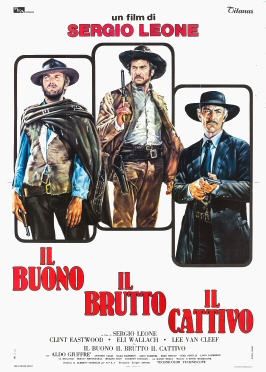
The Good: Blondie (Clint Eastwood)
Clint Eastwood delivers an iconic performance as “Blondie,” the film’s so-called Good. But this is not the conventional hero of American Westerns. He is a man of few words, a poker-faced opportunist who operates by his own moral code. Eastwood’s character is defined more by his actions and his piercing stare than by dialogue—a deliberate choice by Leone that made the actor a global superstar. As Roger Ebert observed, “The Man With No Name never talks; Tuco never stops”. Blondie is the cool, calculating center of the storm, a man whose loyalty is as flexible as his trigger finger, yet who possesses a strange, unspoken decency—as shown when he covers a dying Civil War soldier with his trench coat.
The Bad: Angel Eyes (Lee Van Cleef)
Lee Van Cleef’s “Angel Eyes” Sentenza is the embodiment of ruthless, cold-blooded evil. With his narrowed eyes gleaming with “insane obsession,” Van Cleef creates a villain of chilling professionalism. He is a mercenary who kills his own employer for information about the gold, a man who tortures Tuco without hesitation, and a Union sergeant who betrays his uniform for personal gain. If Blondie is the film’s moral compass—however skewed—Angel Eyes is its moral void, a man for whom greed is the only guiding principle.
The Ugly: Tuco (Eli Wallach)
And then there is Eli Wallach’s Tuco Benedicto Pacifico Juan Maria Ramirez, one of the most unforgettable characters in cinema history. Tuco is the film’s chaotic, desperate, and surprisingly human heart. He is a bandit, a liar, and a clown, but also a survivor who has been abandoned by his brother, betrayed by his partner, and left for dead in the desert. Wallach, a Method-trained stage veteran, took this “low-rent role seriously and made something evocative out of it”. His frenzied energy—whether frantically digging for gold or screaming curses at Blondie—provides a stark contrast to Eastwood’s stoicism. And yet, there is a tragic depth to Tuco: his reunion with his brother, who chose the priesthood over family, reveals a man haunted by rejection and desperate for connection.
The Architecture of an Epic: Visual Style and Direction
Sergio Leone’s direction is the film’s defining feature. He creates a world that is both hyper-real and dreamlike, a brutal, unforgiving landscape where the line between life and death is measured in inches and milliseconds. “John Ford made Monument Valley the home turf of his Western characters,” Ebert wrote, “but there is something new and strange about Leone’s menacing Spanish vistas. We haven’t seen these deserts before. John Wayne has never been here”.
Leone’s signature technique was the juxtaposition of extreme close-ups with sweeping long shots. He would zoom in on a character’s sweat-drenched face, capturing every bead of perspiration and every twitch of the eye, then cut to a vast, desolate landscape that seemed to swallow the characters whole. This visual language creates a constant sense of tension and unease, making even the quietest moments feel charged with potential violence.
The film’s opening shot is a masterclass in this technique: a wide, empty desert landscape suddenly transforms into an extreme close-up of a sunburned, desperate face as a man straightens up into the frame. “The long shot has become a closeup without a cut,” Ebert observed, “revealing that the landscape was not empty but occupied by a desperado very close to us”. This establishes Leone’s rule: “what the camera cannot see, the characters cannot see,” giving him the freedom to surprise us with entrances that defy practical geography.
The Sound of Silence and Gunfire: Ennio Morricone’s Score
No discussion of this film would be complete without acknowledging the monumental contribution of Ennio Morricone. His score is not merely music; it is the film’s soul, a haunting, operatic soundscape that elevates every moment with “haunting brilliance”.
The main theme, with its famous two-note coyote howl, has become a cultural touchstone, so familiar that “even an abbreviated soundbite… is enough to conjure images of desolate desert plains, rolling tumbleweeds, and a cowboy-booted figure standing ominously in the distance”. Morricone’s composition is complex and layered, featuring soprano recorder, drums, bass ocarina, chimes, electric guitar, trumpets, whistling, and a choir—an eclectic mix that defied convention and became instantly iconic.
But the score is more than just a memorable melody. Morricone’s music often seems to emanate from the action itself, as when a Confederate P.O.W. band plays a slow lament while Tuco is being tortured—a haunting juxtaposition that transforms the scene into something profoundly unsettling. The film’s climax, the famous three-way standoff, was choreographed to Morricone’s pre-recorded music, demonstrating Leone’s total commitment to integrating sound and image.
The Art of the Standoff
The final, extended Mexican standoff in the circular cemetery is one of the most celebrated sequences in cinema history. A fortune in gold is buried in one of the graves, and three men have assembled, each hoping to claim it for themselves. Each points a pistol at the other. If one shoots, they all shoot. Unless two decide to shoot the third. But which two? And which third?
Leone draws this scene out beyond reason, beginning in long shot and working in to extreme close-ups of firearms, faces, eyes, sweat, and flies. The editing grows faster, Morricone’s guitar plucks become more urgent, and the camera zooms closer and closer until all that’s visible are shifting eyes and hands slowly reaching for holsters. As one film scholar noted, the editing in this sequence “visualizes the main characters’ thoughts” and cooperates with the music to construct a nearly-hypnotic rhythm. It is “not a story, but a celebration of bold gestures”.
Redefining the Western and Its Legacy
Initially, the film received mixed reviews, with critics dismissing it as “dramatically feeble and offensively sadistic”. But audiences embraced it, and over time, its critical reputation grew into full-blown reverence. The film was a financial success, grossing over $38 million on a $1.2 million budget, and it catapulted Eastwood into superstardom.
Its true legacy, however, lies in its impact on cinema. It paved the way for a new, more cynical, more morally ambiguous vision of the Old West, influencing everyone from Sam Peckinpah to Quentin Tarantino. It proved that a film about greed and betrayal could also be a work of high art, that the Spaghetti Western could stand shoulder to shoulder with the American classics.
Conclusion: A Tale of Greed, Survival, and Moral Ambiguity
The Good, the Bad and the Ugly is a film of contradictions: it is epic and intimate, brutal and beautiful, cynical and strangely sentimental. It celebrates greed and violence while also exposing their emptiness. It is, as Leone himself stated, a film about what “good,” “bad,” and “ugly” really mean, suggesting “We all have some bad in us, some ugliness, some good. And there are people who appear to be ugly, but when we get to know them better, we realise that they are more worthy”.
The film’s ending is a mean joke: Blondie leaves Tuco standing on a flimsy grave marker with a noose around his neck, then shoots him down just as his screams become unbearable, leaving him face-down in the gold he so desperately sought. “Seems like old times,” Blondie says, referencing their earlier con game.
It’s a conclusion that is both darkly comic and strangely just. The Bad lies dead in a ditch. The Ugly is humiliated and bound, unable to immediately reap his reward. And the Good rides off into the distance, money in tow, a man who has proven that quick hands and cold-blooded wit are the only tools that matter in this unforgiving world.
The Good, the Bad and the Ugly is more than a Western; it is an operatic symphony of greed, survival, and the shifting nature of loyalty. It is a film that, as one critic put it, “continues to define what a western can be”. It is a masterpiece, plain and simple—a towering achievement that will forever stand as one of the greatest films ever made.