Some films entertain. A rare few transcend entertainment to become something deeper—a cultural touchstone, a box office phenomenon, and a lightning rod for debate that endures for decades. Robert Zemeckis’s Forrest Gump (1994) is one of those rare treasures. It didn’t just tell a story; it became a cultural event, a box office juggernaut, and one of the most polarizing Best Picture winners in Hollywood history.
More than three decades after its release, Forrest Gump remains an inescapable part of the cinematic landscape. It is a film that has been both embraced as a heartwarming modern fable and criticized as a manipulative, conservative fantasy. It is a film that makes audiences weep and critics groan. It is, in every sense, a phenomenon—and its legacy is as complicated and fascinating as its hero is simple.
The Journey of a Simple Man
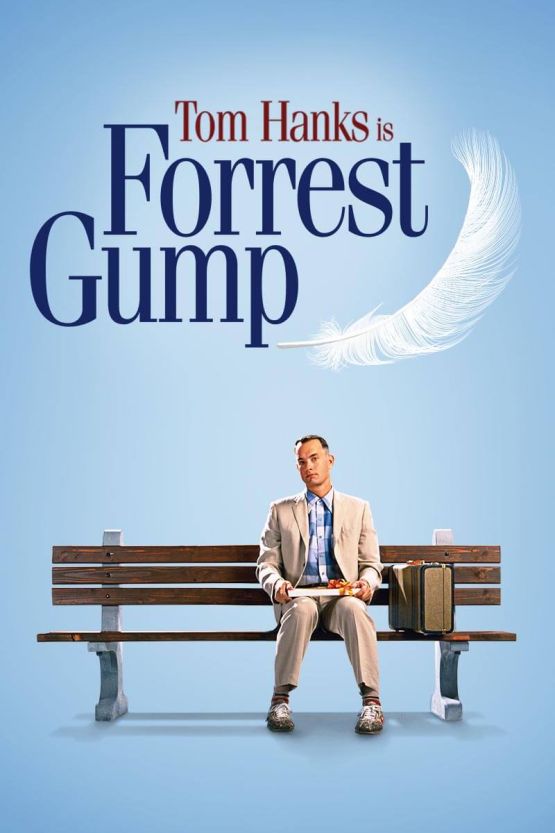
The film tells the story of Forrest Gump (Tom Hanks), a man with an IQ of 75 from Greenbow, Alabama, who inadvertently becomes a witness to and participant in some of the most significant events in American history from the 1950s through the early 1980s . The narrative unfolds as Forrest recounts his life story to strangers at a bus stop in Savannah, Georgia, offering a folksy, bewildered perspective on the tumultuous decades he has lived through.
Forrest’s journey is one of accidental greatness. A childhood bullied for his leg braces and low intelligence, he discovers his remarkable talent for running, which earns him a college football scholarship at the University of Alabama . He serves in the Vietnam War, where he meets his best friend Bubba Blue (Mykelti Williamson) and his commanding officer Lieutenant Dan Taylor (Gary Sinise), both of whom profoundly shape his life. After Bubba’s death and Lieutenant Dan’s injury, Forrest becomes a ping-pong champion, a shrimp boat captain, and an accidental millionaire . He even inspires John Lennon’s “Imagine,” inadvertently reports the Watergate break-in, and becomes a national celebrity by running across the country for three years .
Throughout it all, Forrest’s one constant is his love for Jenny Curran (Robin Wright), his childhood sweetheart who represents everything he is not—restless, self-destructive, and deeply damaged by a traumatic childhood. Their relationship, with its cycles of separation and reunion, provides the film’s emotional core and its most devastating moments .
A Symphony of Performances and Craft
The success of Forrest Gump rests on the extraordinary shoulders of its cast and crew. Tom Hanks delivers a career-defining performance, creating a character of such genuine warmth and decency that he remains one of cinema’s most beloved figures. Hanks’s Forrest is not a caricature; he is a fully realized human being, a man whose simplicity allows him to see the world with a clarity that others lack. As Roger Ebert wrote, his character is “a thoroughly decent man” who survives the turmoil of American history with “only honesty and niceness as his shields” .
The supporting cast is equally brilliant. Robin Wright brings depth and tragedy to Jenny, a woman whose poor choices are rooted in profound trauma . Gary Sinise, in a career-best performance, portrays Lieutenant Dan’s journey from bitter, angry disability to hard-won peace with himself and his circumstances. Mykelti Williamson’s Bubba is a warm, memorable presence whose tragic death haunts the film. And Sally Field brings warmth and wisdom to Forrest’s mother, the source of his most famous aphorisms .
Behind the camera, Robert Zemeckis directs with a sure hand, balancing broad comedy with deep pathos. The film’s visual effects, which won an Academy Award, were groundbreaking for their time. The seamless insertion of Tom Hanks into archival footage with Presidents Kennedy, Johnson, and Nixon was a technical marvel that still impresses, even as digital effects have become commonplace .
Alan Silvestri’s score swells at all the right moments, and the soundtrack, featuring hits from Elvis Presley, The Doors, and Bob Dylan, became a cultural phenomenon in its own right . The film’s quotable lines—”Life is like a box of chocolates,” “Stupid is as stupid does,” and “Run, Forrest, run!”—have seeped into the cultural lexicon .
The American Dream and Its Discontents
At its core, Forrest Gump is a meditation on the American experience. The film presents the turbulent history of the 1960s and 1970s through the eyes of a man who is largely unaware of its significance. This framing device is both the film’s greatest strength and its most contested element .
For many, the film is a celebration of traditional American values. Forrest is a God-fearing, patriotic war hero who achieves fame, fortune, and happiness through his decency and determination, despite his low intelligence. He is the embodiment of the American Dream, a man who succeeds not through cunning or ambition, but through simple, unwavering goodness . His foil is Jenny, who embraces the counterculture, experiments with drugs, and falls into a life of self-destruction. The film’s treatment of Jenny has been criticized as punishing a woman for her choices, while elevating Forrest’s passive, unquestioning acceptance of the world .
Critics have argued that the film presents a conservative, even reactionary, view of history. By showing Forrest—a white Southerner named after the founder of the Ku Klux Klan—as an innocent bystander to history, the film downplays the systemic injustices of the era . It also simplifies complex historical events, presenting them as a series of nostalgic moments rather than the brutal struggles they were . As one critic noted, the film “airbrushes history,” making the past feel safe and comfortable, a far cry from the reality of the Vietnam War, the Civil Rights Movement, and the cultural upheaval of the 1960s .
Others see the film as a more nuanced meditation on fate and chance. The recurring image of the feather—floating on a breeze, landing at Forrest’s feet, and then drifting away again—has been interpreted as a symbol of the randomness of life . Forrest himself wonders at the end of the film whether life is a matter of destiny or “just floating around accidental-like on a breeze” . This ambiguity suggests that the film is less a political statement and more a philosophical exploration of the human condition.
A Polarizing Legacy
Forrest Gump was a massive commercial and critical success. It earned over $678 million worldwide, making it the highest-grossing film of 1994 in the United States . It won six Academy Awards, including Best Picture, Best Director for Zemeckis, and Best Actor for Hanks . Its defeat of Quentin Tarantino’s Pulp Fiction in the Best Picture race has been a source of debate among film enthusiasts ever since, with many arguing that the more daring, innovative film was overlooked in favor of a safer, more traditional choice .
The film’s legacy remains deeply contested. For every viewer who finds it a heartwarming, life-affirming masterpiece, there is another who sees it as a manipulative, conservative piece of nostalgia . Some argue it is an indictment of American naivete, while others believe it is a celebration of it . As one critic noted, “the movie can be read in several different ways” .
This polarization is perhaps the key to the film’s enduring relevance. In an age of deep political and cultural divisions, Forrest Gump remains a Rorschach test, a film that reveals as much about the viewer as it does about its subject matter. Its themes of luck, love, and the search for meaning in a chaotic world continue to resonate, even as its politics are increasingly questioned.
Conclusion: A Box of Chocolates
Forrest Gump is a film of contradictions. It is sentimental and cynical, nostalgic and critical, heartwarming and deeply troubling. It is a film that invites both tears and scorn, and it has earned both in abundance.
Whether you love it or hate it, there is no denying its place in cinematic history. It is a film that defined the 1990s, a box office phenomenon that captured the imagination of millions. It is a film that reminds us of the power of storytelling, even as it challenges us to think critically about the stories we tell ourselves about who we are and where we came from.
Life, as Forrest says, is like a box of chocolates. You never know what you’re going to get. And Forrest Gump is a film that proves the truth of that statement. It is a film that continues to surprise, to provoke, and to move. And that is all we have to say about that.