Reinforced Concrete Foundation Design: A Comprehensive Guide with Code References
Master reinforced concrete foundation design with this comprehensive guide covering footing types, design procedures, code requirements (ACI 318-19, Eurocode 2), and practical references for structural engineers.
Introduction: The Critical Role of Foundations
Every structure—from a single-story residence to a towering skyscraper—is only as strong as its foundation. Reinforced concrete foundations serve as the critical interface between the building above and the soil below, transmitting loads safely while resisting overturning, sliding, and settlement.
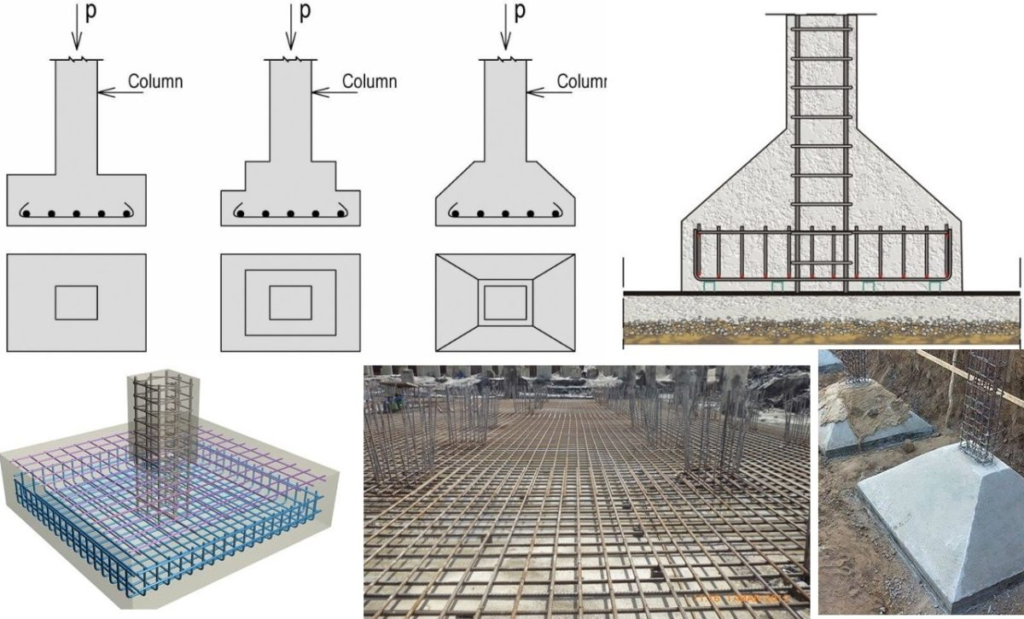
The design of reinforced concrete foundations requires a thorough understanding of soil mechanics, structural analysis, material properties, and applicable building codes. This guide provides a comprehensive overview of foundation design principles, referencing the latest editions of ACI 318-19, Eurocode 2, and authoritative design handbooks.
Key reference texts for this guide include:
- Dasgupta, A.K. (2025). Reinforced Cement Concrete Structures: Practical Design and Standard Details. CRC Press
- Reynolds, C.E., Steedman, J.C., & Threlfall, A.J. Reynolds’s Reinforced Concrete Designer’s Handbook (11th ed.)
- Bond, A.J., et al. How to Design Concrete Structures Using Eurocode 2 (2nd ed.). The Concrete Centre
Part 1: Types of Reinforced Concrete Foundations
1.1 Shallow Foundations
Shallow foundations transmit structural loads to the soil at a relatively shallow depth (typically less than the foundation width). According to ACI 318-19 Chapter 13, shallow foundations include the following types :
| Foundation Type | Description | Typical Applications |
|---|---|---|
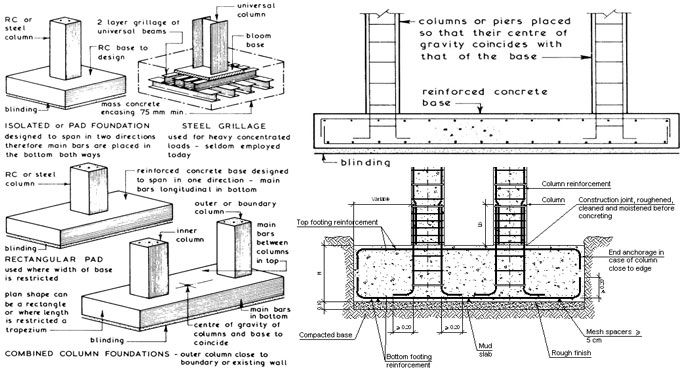
| Isolated (Spread) Footing | Single footing supporting one column | Regular column spacing, good soil conditions |
| Strip Footing | Continuous footing supporting a wall or multiple columns in a line | Load-bearing walls, closely spaced columns |
| Combined Footing | Single footing supporting two or more columns | Columns too close for individual footings, property line constraints |
| Mat (Raft) Foundation | Thick slab supporting multiple columns across entire building footprint | Poor soil conditions, heavy loads, settlement-sensitive structures |
1.2 Deep Foundations
When shallow foundations are inadequate due to poor soil conditions or very heavy loads, deep foundations transfer loads through weak surface soils to competent strata at depth. These include driven piles, drilled shafts (caissons), and auger-cast piles.
For structures assigned to Seismic Design Category C, D, E, or F, ACI 318-19 Section 18.13 provides special requirements for deep foundations, including:
- Continuous longitudinal reinforcement to resist tension loads
- Extended reinforcement over unsupported lengths that could buckle
- Seismic hooks for hoops, spirals, and ties
Part 2: Design Codes and Standards
2.1 ACI 318-19 (USA)
The American Concrete Institute’s Building Code Requirements for Structural Concrete (ACI 318-19) is the primary design standard for reinforced concrete in the United States. Chapter 13 specifically addresses foundation design.
Key provisions for shallow foundations under ACI 318-19 :
- Section 13.3.1.2: Minimum foundation effective depth for bottom reinforcement is 6 inches
- Section 13.3.1.3: Sloped, stepped, or tapered foundations must satisfy design requirements at every section
- Section 13.3.2.1: One-way shallow foundations (strip footings, combined footings, grade beams) shall be designed per Chapter 7 and Chapter 9 provisions
- Section 13.3.3.1: Two-way isolated footings shall be designed per Chapter 7 and Chapter 8 provisions
- Section 13.3.4.1: Combined footings and mat foundations shall be designed per Chapter 8 provisions
2.2 Eurocode 2 (Europe)
Eurocode 2 (EN 1992) governs concrete structure design across European Union member states. For foundation design, Eurocode 2 works in conjunction with Eurocode 7 (geotechnical design). Key resources include:
- How to Design Concrete Structures Using Eurocode 2 (The Concrete Centre) provides practical guidance for foundations, including design examples for strip footings, pad footings, and piled foundations
- Worked Examples for the Design of Concrete Structures to Eurocode 2 (Threlfall, 2013) includes dedicated chapters on foundation design for multi-story buildings
2.3 Indian Standards (IS Code)
For projects following Indian standards, Dasgupta (2025) provides workout examples using both ACI and IS Code methods, covering foundation settlement analysis and strength design calculations .
Part 3: Foundation Design Procedure
3.1 Step-by-Step Design Process
The following sequential procedure is adapted from standard design practice and the example presented by Nanni et al. for isolated footing design :
Step 1: Determine Material Properties
- Concrete compressive strength (f’c) per code requirements
- Steel reinforcement yield strength (fy)
- Soil bearing capacity (from geotechnical investigation)
Step 2: Calculate Service Loads
- Dead loads (DL): Self-weight of structure, permanent fixtures
- Live loads (LL): Occupancy, movable equipment
- Environmental loads: Wind, snow, seismic (where applicable)
- Load combinations per applicable code (ACI 318-19 Chapter 5 or Eurocode 2)
Step 3: Preliminary Sizing
- Determine required footing area based on service loads and allowable soil bearing pressure
- Estimate footing thickness based on shear and flexural requirements (typically L/4 to L/3 for isolated footings)
Step 4: Check Overturning and Sliding
- Verify factor of safety against overturning (typically ≥ 1.5 for service loads)
- Verify factor of safety against sliding (typically ≥ 1.5, considering passive pressure and friction)
Step 5: Design for Flexure
- Calculate factored moments at critical sections (typically at column faces)
- Determine required reinforcement per ACI 318-19 Chapter 7 (one-way) or Chapter 8 (two-way)
- Verify minimum reinforcement requirements (As,min = 0.0018Ag for mat foundations)
Step 6: Design for Shear
- Check one-way (beam) shear at distance “d” from column face
- Check two-way (punching) shear at distance “d/2” from column face
- Provide shear reinforcement or increase thickness if required
Step 7: Check Development Length and Splices
- Verify reinforcement development length per ACI 25.4
- For seismic applications (SDC D, E, F): Extend longitudinal reinforcement into footing with full development length per ACI 18.13.2.2
Step 8: Detailing and Construction Drawings
- Prepare reinforcement placement drawings showing bar sizes, spacing, and details
- Include temperature and shrinkage reinforcement where required
Part 4: Reinforcement Detailing Requirements
4.1 Minimum Reinforcement
According to ACI 318-19 requirements for shallow foundations :
| Foundation Type | Minimum Reinforcement | Distribution |
|---|---|---|
| One-way footings (strip, combined) | Per ACI Chapter 7/9 | Uniformly across entire width |
| Two-way isolated footings | Per ACI Chapter 7/8 | Uniformly across entire width in both directions |
| Rectangular footings (long direction) | As required | Uniform across entire width |
| Rectangular footings (short direction) | γsAs in center band; (1-γs)As outside | Per ACI Eq. 13.3.3.3 |
| Mat foundations | As,min = 0.0018Ag | Per two-way slab requirements |
4.2 Reinforcement Distribution for Rectangular Footings
For rectangular footings, ACI 318-19 Section 13.3.3.3 specifies that reinforcement in the short direction shall be distributed as follows :
- A portion of the total reinforcement = γs × As (total short-direction steel) shall be distributed uniformly over a band equal to the length of the short side of the footing, centered on the column centerline
- The remainder of reinforcement = (1-γs) × As shall be distributed uniformly outside the center bandwidth
The factor γs is calculated as:
γs = 2 / (β + 1)
Where β = ratio of long side to short side of the footing.
Part 5: Seismic Design Considerations
For structures located in regions of high seismicity (Seismic Design Category D, E, or F per ASCE 7), ACI 318-19 Section 18.13 imposes additional requirements :
5.1 Column-to-Footing Connection
- Longitudinal reinforcement of columns resisting earthquake effects must extend into the footing and be fully developed for tension at the interface (ACI 18.13.2.2)
- If column is designed assuming fixed end, longitudinal flexural reinforcement must have 90-degree hooks near the bottom of the foundation, with free ends oriented toward the column center (ACI 18.13.2.3)
5.2 Transverse Reinforcement
- For columns with an edge within one-half the footing depth from the footing edge, transverse reinforcement must comply with ACI 18.7.5.2, 18.7.5.3, and 18.7.5.4
- This transverse reinforcement must extend into the footing the development length (ld) for tension of the column longitudinal reinforcement (ACI 18.13.2.4)
5.3 Foundation Seismic Ties
- Individual pile caps, piers, or caissons must be interconnected by foundation seismic ties in orthogonal directions for SDC C, D, E, or F (ACI 18.13.4.1)
- Individual spread footings on Site Class E or F soil must be interconnected for SDC D, E, or F (ACI 18.13.4.2)
- Required tie strength: 0.1 × SDS × (greater of pile cap or column factored dead + live load)
Part 6: Worked Examples and Practical Resources
6.1 Recommended Design Examples
Several authoritative sources provide practical worked examples for foundation design:
| Source | Examples Provided | Code |
|---|---|---|
| Dasgupta (2025) | Piles, foundations, superstructure elements, water reservoir, two-story office building on soft soil | ACI & IS |
| Threlfall (2013) | Foundations for multi-storey building, free-standing cantilever retaining wall | Eurocode 2 |
| Nanni et al. | Isolated footing design (7-step procedure) | ACI |
| Bentley RAM Elements | Reinforced concrete footings with column loads and moments | ACI |
6.2 Essential Reference Texts
For ACI 318-based design:
- Dasgupta, A.K. (2025). Reinforced Cement Concrete Structures: Practical Design and Standard Details. CRC Press.
- Reynolds, C.E., Steedman, J.C., & Threlfall, A.J. Reynolds’s Reinforced Concrete Designer’s Handbook (11th ed.).
For Eurocode 2-based design:
- Bond, A.J., et al. How to Design Concrete Structures Using Eurocode 2 (2nd ed.). The Concrete Centre.
- Threlfall, T. (2013). Worked Examples for the Design of Concrete Structures to Eurocode 2. CRC Press.
Conclusion: Integrating Theory and Practice
Reinforced concrete foundation design requires the integration of multiple disciplines: soil mechanics, structural analysis, material science, and code compliance. The references and procedures outlined in this guide provide a solid foundation for practicing engineers and students alike.
Key takeaways:
- Always verify applicable building codes for your jurisdiction (ACI 318, Eurocode 2, IS, etc.)
- Obtain geotechnical investigation data before preliminary sizing
- Check both serviceability (settlement) and strength (ultimate) limit states
- Pay special attention to detailing requirements, particularly in seismic regions
- Reference authoritative design handbooks and worked examples for complex cases
The field of reinforced concrete continues to evolve, with the 2025 publication of Dasgupta’s comprehensive text and ongoing updates to design codes. Stay current with the latest editions of your governing code and reference materials.
Frequently Asked Questions (FAQ)
What is the minimum thickness for a reinforced concrete footing?
ACI 318-19 requires a minimum effective depth of 6 inches for bottom reinforcement. Total thickness will be greater depending on cover requirements and bar size.
How do I determine footing size?
Required area = (service load) / (allowable soil bearing pressure). For eccentric loads, account for moment-induced pressure distribution.
What is the difference between one-way and two-way shear in footings?
One-way (beam) shear considers failure along a plane extending across the full footing width. Two-way (punching) shear considers a perimeter around the column.
When are seismic ties required for foundations?
For SDC C, D, E, or F, individual pile caps and spread footings on certain soil types require interconnection with seismic ties per ACI 18.13.4.
Where can I find worked examples for Eurocode 2 foundation design?
Threlfall (2013) and The Concrete Centre’s “How to Design Concrete Structures Using Eurocode 2” both provide practical examples .
Call to Action (CTA)
Are you a structural engineer with foundation design experience? Share your insights or questions in the comments below. For more technical resources, explore the reference texts cited in this guide or consult your local building code authority.