Sovereign AI Clouds: Canada and TELUS Break Ground on Massive AI Data Centers
Canada and TELUS are building massive sovereign AI data centers in British Columbia as part of a 2026 trend treating compute capacity as critical national infrastructure. Discover the $9B project reshaping the AI landscape.
Introduction: The New Critical Infrastructure
For most of history, national power was measured in megawatts—coal plants, hydro dams, nuclear reactors. In 2026, a new metric has emerged: petaflops. Countries are no longer competing only on energy independence. They are competing on compute independence.
The Canadian government and TELUS just made the biggest bet yet in that race. On May 11, 2026, federal Artificial Intelligence Minister Evan Solomon and TELUS announced plans for a massive sovereign AI data center cluster in British Columbia—three facilities designed to keep Canadian data, intellectual property, and AI firepower within national borders .
This is not merely a corporate expansion. It is a declaration that compute capacity is critical infrastructure, on par with power plants and broadband networks. And Canada is not alone. From the United Kingdom to the European Union, nations are racing to build “sovereign clouds” that ensure their AI futures are not dependent on foreign servers.
In this article, we will explore the sovereign AI data centers Canada 2026 project, the technology powering it, the sustainability innovations that make it unique, and the global movement it represents.
Part 1: The Announcement – What Canada Is Building
1.1 The Three-Site B.C. Cluster
The TELUS Sovereign AI Cluster will span three locations across British Columbia :
| Facility | Location | Timeline | Power |
|---|---|---|---|
| Kamloops AI Factory | Kamloops (existing expansion) | Late 2026 | 85MW from BC Hydro |
| M3 Facility | Mount Pleasant, Vancouver | End of 2026 | Part of 150MW cluster |
| 150 West Georgia | Downtown Vancouver | 2029 | Part of 150MW cluster |
The Kamloops facility is an expansion of TELUS’s existing data center, secured with 85 megawatts of clean power from BC Hydro . The Mount Pleasant facility, known as M3, involves converting a former office building (originally built in 1977 and previously occupied by Hootsuite) into a cutting-edge AI data center . The downtown Vancouver facility, developed in partnership with Westbank and Allied Properties REIT, will be a 10-story purpose-built AI data center .
At full scale by 2032, the entire cluster will scale to more than 150 megawatts of capacity and house over 60,000 high-performance GPUs . TELUS estimates the project will cost approximately $9 billion and create about a thousand construction jobs plus hundreds of permanent positions .
1.2 The Federal Role
The project is the first to be supported under the federal government’s Enabling Large-Scale Sovereign AI Data Centres initiative—a program designed to “build the sovereign, high-performance AI compute infrastructure Canada needs to compete in the global AI economy” .
The government received 160 applications in its call for proposals earlier this year . TELUS is the first to move forward, with others under active consideration. While no federal dollars have been committed at this stage, Ottawa has pledged $2 billion over five years starting in 2024-25 under the broader initiative . The government may pursue “off-take agreements or contractual arrangements” in the future .
As Minister Solomon put it: “Canada cannot compete in the AI economy without the infrastructure to back it up. By advancing this project with TELUS, we are taking concrete action to build sovereign AI capacity here in Canada” .
1.3 Why British Columbia?
British Columbia was chosen for two practical reasons :
- Climate: The cooler temperatures reduce cooling costs for high-density AI workloads.
- Clean Energy: BC Hydro’s hydroelectric grid provides abundant renewable power—more than 98% of the cluster’s electricity will come from renewable sources .
Part 2: The Technology – What Powers a Sovereign AI Factory
2.1 GPUs and Computing Power
The B.C. cluster will be powered by NVIDIA’s most advanced accelerated computing platforms, including the Vera Rubin and Grace Blackwell platforms, connected with NVIDIA Quantum InfiniBand and Spectrum-X Ethernet networking . TELUS is the first North American service provider to become an official NVIDIA Cloud Partner .
The numbers are staggering. The cluster will house over 60,000 GPUs. To put that in perspective, TELUS’s first Sovereign AI Factory in Rimouski, Quebec (opened September 2025), is ranked 78th on the Top500 list of most powerful supercomputers and is the most powerful system in Canada, offering 27.44 petaflops of compute capacity . The B.C. cluster will be orders of magnitude larger.
2.2 Liquid Cooling and Heat Recovery
AI data centers are not your father’s server farms. According to a comprehensive 2025 review in Renewable and Sustainable Energy Reviews, next-generation GPU data centers have energy intensities up to 20,000 W/m²—30 times higher than legacy data centers and roughly 200 times higher than residential buildings .
This heat density makes traditional air cooling impossible. The solution is liquid cooling—direct-to-chip or immersion cooling that captures higher-grade thermal energy for reuse .
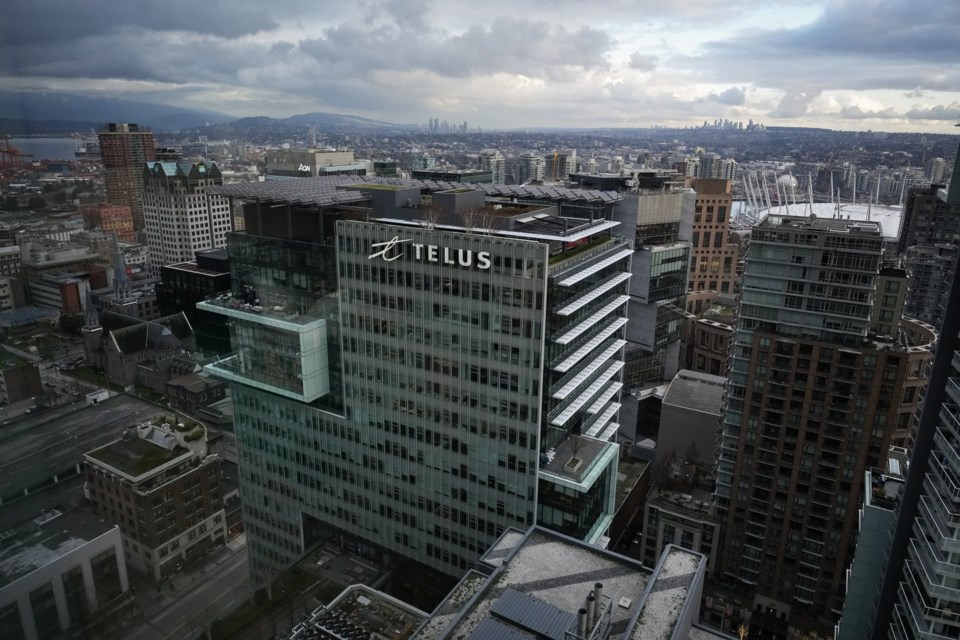
TELUS is embracing this fully. The Vancouver facilities will utilize closed-loop liquid cooling and integrate directly into the City of Vancouver’s Neighbourhood Energy Utility in Mount Pleasant and Creative Energy’s downtown district energy system .
2.3 Waste Heat That Heats Homes
Here is the most remarkable part: the waste heat from AI computing will heat homes.
TELUS estimates that recycled waste heat from these facilities will heat more than 150,000 homes in Metro Vancouver, lowering energy costs for residents while eliminating the overall carbon footprint of the data centers .
As TELUS CEO Darren Entwistle (retiring at the end of June after 26 years) stated: “We harness the waste heat that is the byproduct of AI data centres by recycling this waste heat back into the electrical grid — these urban AI factories will heat more than 150,000 homes just in metro Vancouver” .
This aligns with cutting-edge research showing that GPU data centers, with their higher heat density and liquid cooling requirements, offer greater waste heat recovery potential than traditional CPU data centers .
Part 3: The Global Movement – Sovereign AI Goes Worldwide
Canada is not acting in isolation. The year 2026 is witnessing a wave of sovereign AI infrastructure announcements across the developed world.
3.1 The United Kingdom: BT and Nscale
In April 2026, BT Group and Nscale announced plans to build sovereign AI data centers across the UK . The initiative will deliver up to 14MW of AI data center capacity across three existing BT sites, combining Nscale’s modular deployment approach with BT’s connectivity and infrastructure.
As Jon James, CEO of BT Business, explained: “Digital sovereignty enables UK organisations to adopt the world’s leading technologies, while maintaining resilience and control in a rapidly changing world. Our collaboration with Nscale reflects BT’s unique position as the digital backbone of the UK” .
UK AI Minister Kanishka Narayan added: “To unlock the full benefits of AI, Britain needs more of the infrastructure that powers it. Building more of this on British shores strengthens our position in a highly competitive global market” .
3.2 The Common Thread: Telcos as AI Infrastructure Backbones
Notice a pattern? In both Canada and the UK, telecommunications companies are leading the sovereign AI charge. TELUS and BT are not cloud providers. They are network operators with existing real estate, power connections, and the most critical asset of all: trusted, high-capacity networks.
As NVIDIA’s Anthony Hills noted: “Telecommunications is at the core of sovereign AI, because secure, high-capacity networks are essential to unlocking the UK’s accelerated computing potential” . The same logic applies in Canada.
Part 4: Why This Matters – The Case for Sovereign Compute
4.1 Data Residency and Intellectual Property
The core argument for sovereign AI infrastructure is simple: if your data leaves your borders, you have lost control of it.
Canadian businesses, researchers, and public institutions currently have limited options for running AI workloads without sending their data, intellectual property, and competitive advantage outside Canadian borders . The B.C. cluster solves this. Every computation will happen on Canadian soil, with infrastructure owned and controlled by Canadians .
As Entwistle put it: “The unprecedented demand that completely sold out our first AI Factory in Rimouski proves that Canadian innovators want cutting-edge AI built right here on Canadian soil” .
4.2 Economic Competitiveness
The federal government is explicit about the economic stakes. Minister Solomon acknowledged the financial risks—“Building is a risk” —but argued that inaction is riskier: “Do we want a country that is not taking risks to bet on Canada? Do we want a country that’s not taking a risk to bet our own innovation, our own energy systems, our own cities, our workforce? Absolutely not” .
The opposition Conservatives were less enthusiastic. Shadow AI minister Ben Lobb called the announcement “photo ops” and argued that Canada does not need government involvement—it needs the Liberals to “get out of the way” on regulations and taxes .
4.3 Energy as the Binding Constraint
The single greatest constraint on sovereign AI is not chips. It is power.
A 2026 review in the journal Energies notes that global data centers, AI, and cryptocurrency consumed approximately 460 TWh of electricity in 2022 (about 2% of global demand), and this consumption could exceed 1000 TWh by 2026—roughly equivalent to Japan’s annual electricity consumption .
AI data centers are fundamentally different from traditional facilities. They operate at near 100% utilization for weeks or months at a time (rather than idling overnight) and require rack power densities exceeding 40 kW (compared to 5-10 kW for traditional data centers) .
Canada’s advantage is hydroelectric power. BC Hydro’s clean, abundant, and relatively inexpensive electricity makes British Columbia one of the most attractive locations in the world for energy-intensive AI infrastructure .
Part 5: Challenges and Open Questions
5.1 The Chip Supply Chain Risk
TELUS’s infrastructure relies heavily on NVIDIA GPUs and global supply chains. As one expert noted, there are risks in having one single chip supplier . Geopolitical tensions, export controls, or supply chain disruptions could impact the project’s timeline and capacity.
5.2 Federal Funding Uncertainty
At this stage, no federal dollars have been committed—only a memorandum of understanding . While the government has signaled strong support, the final financial structure (off-take agreements, contracts, or direct investment) remains unclear.
5.3 Grid Integration Challenges
Integrating 150MW of AI data center load into British Columbia’s grid requires careful coordination. Research highlights challenges including grid stability, power quality risks, and the need for demand-response mechanisms to balance AI workloads with renewable energy availability .
5.4 Competitive Response
Canada is not alone in this race. The UK’s BT-Nscale partnership, similar initiatives across the European Union, and massive U.S. investments in domestic AI infrastructure mean that the competition for AI talent, investment, and market share will be fierce.
Conclusion: The New Skyscrapers
Data centers are the new skyscrapers of the 2020s. They are the visible monuments of economic power, the physical infrastructure of the digital age, and the battleground for technological sovereignty.
Canada’s partnership with TELUS on sovereign AI data centers in British Columbia is a bet on that future. It is a recognition that in the AI era, compute capacity is not a commodity to be imported—it is a capability to be built at home.
From the liquid-cooled racks in Mount Pleasant to the waste heat warming Vancouver homes, from the NVIDIA GPUs running Canadian models to the hydroelectric power fueling it all, this project embodies a new kind of industrial policy: clean, digital, and sovereign.
The skyscrapers of the 20th century were made of steel and glass. The skyscrapers of the 21st century are made of silicon and electrons. And Canada is building its own.
Frequently Asked Questions (FAQ)
What is a sovereign AI data center?
A sovereign AI data center is computing infrastructure located within a country’s borders, owned or controlled by domestic entities, ensuring that data, intellectual property, and AI workloads remain subject to national laws and security standards.
How much will the TELUS B.C. project cost?
The three-facility cluster is estimated to cost approximately $9 billion, creating about a thousand construction jobs and hundreds of permanent positions .
When will the facilities open?
The Kamloops expansion and Mount Pleasant facility will open in late 2026. The downtown Vancouver facility will come online in 2029 .
How will these data centers be powered?
More than 98% of the electricity will come from renewable sources, primarily BC Hydro’s hydroelectric grid. Waste heat will be recycled to heat over 150,000 homes in Metro Vancouver .
Is the Canadian government providing funding?
No federal dollars have been committed at this stage. The government has signed a memorandum of understanding with TELUS and may pursue off-take agreements or contractual arrangements in the future .
Call to Action (CTA)
Do you work in AI infrastructure, energy policy, or cloud computing? Share your perspective on the sovereign AI movement in the comments below. And if you found this analysis valuable, share it with a colleague who cares about where—and how—the AI revolution is being built.