Discover 18 traditional Korean Maedeup knot names – from Dorae (double connection) to Janggu and Saengjijok. Learn the meaning, symbolism, and cultural heritage of each knot.
Introduction
Maedeup (매듭) is the traditional Korean art of decorative knotting. Unlike Western or Chinese knots, Korean Maedeup is characterised by symmetry, elegance, and vibrant colours – often using thick silk cords. Each knot carries a specific name and symbolic meaning, often derived from nature, daily objects, or animals.
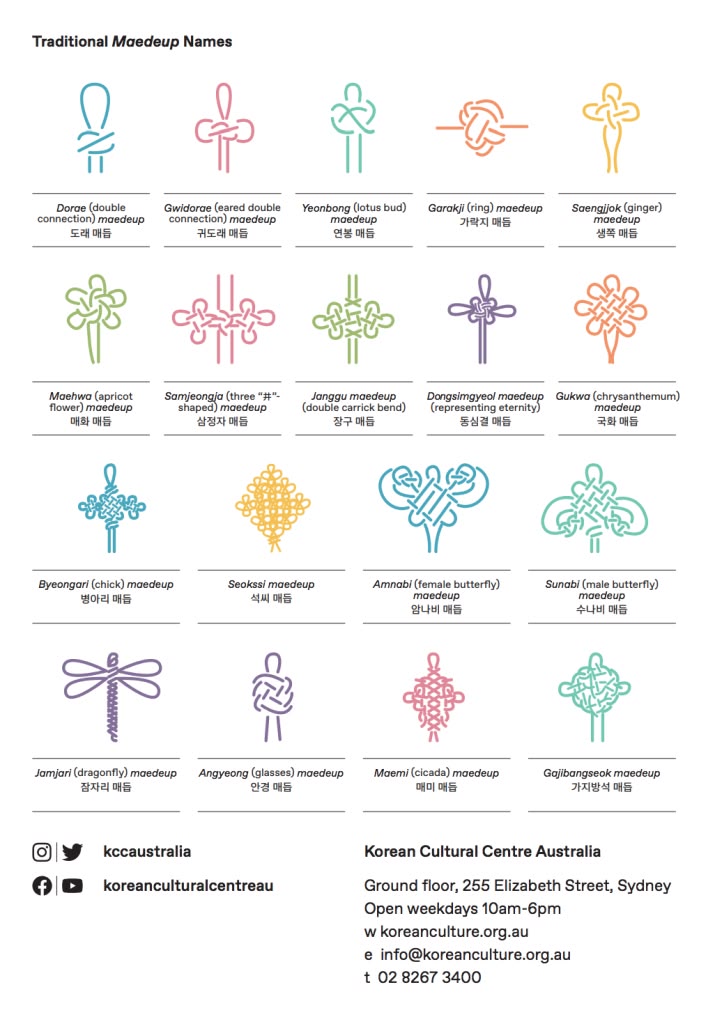
This guide lists 18 authentic Maedeup names as documented by the Korean Cultural Centre Australia (KCC Australia) . Whether you are a textile artist, jewellery maker, or cultural enthusiast, understanding these knots will deepen your appreciation for Korean heritage.
Source: Korean Cultural Centre Australia – Ground floor, 255 Elizabeth Street, Sydney.
What Makes Korean Maedeup Unique?
- Single cord construction – Most Maedeup knots are made from one continuous silk cord.
- Bright natural dyes – Traditional colours include red (passion), blue (protection), yellow (prosperity), green (youth), and purple (nobility).
- Functional & decorative – Used on clothing (norigae pendants), gift wrapping, wedding ceremonies, and Buddhist rituals.
- Named by shape – Many knots are named after flowers, animals, or objects they resemble.
The 18 Traditional Maedeup Knots (Names & Meanings)
Below is the complete list from the image, organised by category.
Connection & Eternity Knots
| Korean Name | Romanisation | English Translation | Symbolism |
|---|---|---|---|
| 도래 매듭 | Dorae maedeup | Double connection | Harmony, reunion, partnership |
| 귀도래 매듭 | Gwidorae maedeup | Eared double connection | Extended family bonds, protection |
| 동심결 매듭 | Dongsimgyeol maedeup | Eternity knot | Infinite love, unbreakable vow |
Flower & Nature Knots
| Korean Name | Romanisation | English Translation | Symbolism |
|---|---|---|---|
| 연봉 매듭 | Yeonbong maedeup | Lotus bud | Purity, enlightenment, rebirth |
| 매화 매듭 | Maehwa maedeup | Apricot flower | Endurance, hope, early spring |
| 국화 매듭 | Gukwa maedeup | Chrysanthemum | Nobility, longevity, autumn beauty |
Animal-Inspired Knots
| Korean Name | Romanisation | English Translation | Symbolism |
|---|---|---|---|
| 병아리 매듭 | Byeongari maedeup | Chick | New beginnings, cuteness, spring |
| 암나비 매듭 | Amnabi maedeup | Female butterfly | Grace, feminine beauty |
| 수나비 매듭 | Sunabi maedeup | Male butterfly | Strength, masculine energy |
| 잠자리 매듭 | Jamjari maedeup | Dragonfly | Victory, agility, summer |
| 매미 매듭 | Maemi maedeup | Cicada | Resurrection, patience, song |
Object & Shape Knots
| Korean Name | Romanisation | English Translation | Symbolism |
|---|---|---|---|
| 가락지 매듭 | Garakji maedeup | Ring | Circle of life, commitment |
| 생쭉 매듭 | Saengjijok maedeup | Ginger | Health, spicy vitality, protection |
| 삼정자 매듭 | Samjeongja maedeup | Three “#”-shaped | Good fortune, threefold blessings |
| 장구 매듭 | Janggu maedeup | Double carrick bend | Hourglass shape, balance, rhythm |
| 안경 매듭 | Angyeong maedeup | Glasses | Wisdom, clarity, scholarly achievement |
| 가지방석 매듭 | Gajibangseok maedeup | Branch cushion | Comfort, family gathering |
Special Name Knots
| Korean Name | Romanisation | English Translation | Notes |
|---|---|---|---|
| 석씨 매듭 | Seokssi maedeup | Seok’s knot | Named after a person (likely a master knotter) |
Detailed Descriptions of Key Maedeup Knots
1. Dorae Maedeup (도래 매듭) – Double Connection
The most fundamental Maedeup knot. It consists of two interlocking loops that mirror each other. Used as a base for many larger knots and often appears at the end of norigae pendants.
Uses: Traditional clothing accessories, bracelet closures, gift cords.
2. Gwidorae Maedeup (귀도래 매듭) – Eared Double Connection
A variation of Dorae with two small “ears” (extra loops) on each side. The ears represent children or extended family members – hence its association with protection and lineage.
Uses: Wedding decorations, baby clothing, amulets.
3. Yeonbong Maedeup (연봉 매듭) – Lotus Bud
Resembles a closed lotus flower before blooming. The lotus is sacred in Korean Buddhism – this knot symbolises the potential for enlightenment within every person.
Uses: Temple offerings, meditation accessories, bridal headpieces.
4. Maehwa Maedeup (매화 매듭) – Apricot Flower
The five petals of the apricot blossom represent the five virtues: benevolence, righteousness, propriety, wisdom, and trust. This knot is popular in spring-themed crafts.
Uses: Norigae (pendants), hairpins, spring festival decorations.
5. Janggu Maedeup (장구 매듭) – Double Carrick Bend
Named after the Korean hourglass drum (janggu). This knot is flat, wide, and symmetrical – often used as a central decorative element on pouches or belts.
Uses: Musical instrument accessories, belt knots, purse decorations.
6. Dongsimgyeol Maedeup (동심결 매듭) – Eternity Knot
Also called the “endless knot” in other Asian cultures. It has no beginning or end – symbolising the Buddha’s infinite wisdom and the cycle of rebirth.
Uses: Buddhist prayer beads (yeonjuk), wedding gifts, protective charms.
7. Byeongari Maedeup (병아리 매듭) – Chick
A small, cute knot with two “wings” and a “beak.” Often made in bright yellow to mimic a baby chick. It is a modern favourite for children’s accessories.
Uses: Baby shoes, children’s hair ties, keychains.
8. Jamjari Maedeup (잠자리 매듭) – Dragonfly
A long, thin knot with four small “wings” and a tail. The dragonfly represents summer, courage, and happiness in Korean folklore.
Uses: Summer fans, mobile phone charms, norigae for young women.
9. Maemi Maedeup (매미 매듭) – Cicada
The cicada knot has a rounded body and folded “wings.” In Korean tradition, the cicada symbolises resurrection and patience because it emerges from the ground after years underground.
Uses: Scholarly pendants (students wear them for focus), funeral accessories.
10. Saengjijok Maedeup (생쭉 매듭) – Ginger
This knot looks like a knobby ginger root. Ginger is believed to ward off evil spirits and improve health. The knot is often used in shamanistic rituals and medicinal pouches.
Uses: Medicine bags, shamanic tools, protective amulets.
11. Angyeong Maedeup (안경 매듭) – Glasses
A rare knot that forms two connected circles resembling a pair of eyeglasses. It represents learning, clarity, and scholarly achievement.
Uses: Bookmarks, graduation gifts, calligraphy tool decorations.
12. Seokssi Maedeup (석씨 매듭) – Seok’s Knot
This knot is named after a person – likely Master Seok, a famous knotter from the Joseon dynasty. It is a complex, proprietary knot passed down through generations.
Uses: Heirloom pieces, master-level examinations, museum reproductions.
How Maedeup Differs from Japanese Kumihimo & Chinese Knotting
| Feature | Korean Maedeup | Japanese Kumihimo | Chinese Knotting |
|---|---|---|---|
| Cord material | Thick silk, often multi-colour | Thin cotton or silk cords | Satin or nylon cords |
| Primary structure | Symmetrical, single cord | Braided (multiple cords) | Interwoven loops |
| Typical colours | Obangsaek (five cardinal colours) | Pastels & earth tones | Bright red & gold |
| Common use | Norigae, clothing decoration | Obi cords, jewellery | Wall hangings, gifts |
Learning Maedeup: Tips for Beginners
- Start with Dorae – It is the foundation for almost all other knots.
- Use practice cord – Paracord or thick satin cord works before investing in silk.
- Work on a cork board – Pins help hold loops in place.
- Learn the tassel – Many Maedeup designs end with a silk tassel (sul).
- Study symmetry – Korean knots are perfectly mirrored left-to-right.
Where to See Authentic Maedeup in Australia
The Korean Cultural Centre Australia offers:
- Exhibitions of traditional norigae and maedeup art
- Workshops for beginners (check website for dates)
- Reference library with knotting diagrams
Contact:
- Location: Ground floor, 255 Elizabeth Street, Sydney
- Hours: Weekdays 10am – 6pm
- Website: koreanculture.org.au
- Email: info@koreanculture.org.au
- Phone: 02 8267 3400
Follow them on social media: @kccaustralia
Frequently Asked Questions
Q: What is the hardest Maedeup knot?
A: Seokssi maedeup and Samjeongja are considered master-level knots, requiring years of practice.
Q: Can I use Maedeup for modern jewellery?
A: Absolutely. Dorae and Gwidorae knots are popular for bracelets and earrings. Smaller knots like Byeongari fit well on delicate chains.
Q: What is norigae?
A: A traditional Korean pendant worn by women, usually composed of a maedeup knot, a tassel, and a decorative ornament (often jade or gold).
Q: How do I pronounce “Maedeup”?
A: “Mae” as in “may” – “deup” rhymes with “cup” → MAY-duhp.
Q: Where can I buy Maedeup supplies in Australia?
A: The Korean Cultural Centre can recommend local suppliers. Online, search for “Korean silk knotting cord” or “maedeup thread.”
Conclusion
The 18 traditional Maedeup knots documented by the Korean Cultural Centre Australia represent centuries of Korean artistry, spirituality, and daily life. From the simple Dorae (double connection) to the sacred Dongsimgyeol (eternity knot) , each name tells a story.
Whether you are a crafter, a historian, or a jewellery designer, learning Maedeup connects you to a living heritage. Start with one knot – perhaps the Yeonbong (lotus bud) or Maehwa (apricot flower) – and let the symmetry and colour guide your hands.
Explore further: Visit the Korean Cultural Centre in Sydney, attend a workshop, or download a Maedeup diagram online. Share your creations with:
#KoreanMaedeup #DoraeKnot #KCCAustralia #TraditionalKoreanKnots


