Learn to make a beautiful macrame plant hanger with wrap knots, crown knots, and alternating square knots. Includes bead placement and hanger ring attachment. Perfect for beginners.
Introduction
Macrame is enjoying a major revival – and for good reason. A handcrafted macrame plant hanger adds boho charm to any room while showing off your favourite trailing plants. This tutorial uses a complete kit containing:
- 8 six-yard cords
- 2 one-yard cords
- 1 metal or wooden ring
- 4 decorative beads
You will learn five essential macrame knots: the wrap knot, crown knot, half square knot, square knot, and alternating square knot. By the end, you will have a finished hanger ready to hold a potted plant.
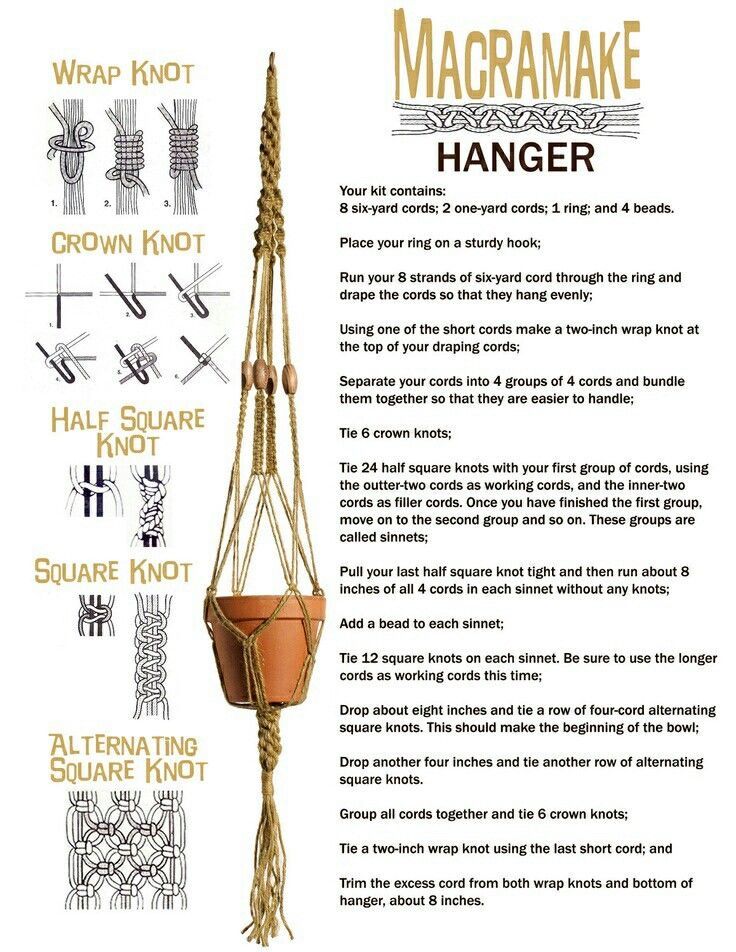
Note: This project creates one standard-sized plant hanger suitable for a 6–8 inch pot.
Difficulty & Time
- Level: Beginner (no prior macrame experience needed)
- Time: 2–3 hours
- Techniques: Wrap knot, crown knot, half square knot, square knot, alternating square knot
Materials & Tools
| Category | Item |
|---|---|
| Main cords | 8 strands × 6 yards each |
| Short cords | 2 strands × 1 yard each |
| Hardware | 1 ring (metal or wood, approx. 1.5–2 inches diameter) |
| Beads | 4 beads (hole large enough for 2–3 cords to pass through) |
| Tools | Scissors, measuring tape, sturdy hook (for hanging work) |
| Optional | Comb or brush (for fringe), glue (to seal knots) |
Understanding the Knots Used
| Knot Name | Purpose |
|---|---|
| Wrap Knot | Binds multiple cords together neatly at the top and bottom |
| Crown Knot | Decorative start; holds cords in a circular pattern |
| Half Square Knot | Creates a spiral effect (twisted sinnet) |
| Square Knot | Flat, alternating pattern; main structural knot |
| Alternating Square Knot | Creates net-like or bowl-shaped sections |
Step-by-Step Instructions
Step 1: Set Up Your Ring & Cords
- Place your ring on a sturdy hook (door knob, wall hook, or macrame stand).
- Take the 8 six-yard cords – fold each in half.
- Run the folded ends through the ring, then pull the tails through the loop (lark’s head knot).
- Drape the cords so they hang evenly – all 16 strands (8 folded cords = 16 hanging ends) should be the same length.
- Adjust as needed before proceeding.
Step 2: Tie a 2-Inch Wrap Knot (Top)
Using one of the 1-yard cords:
- Place the short cord horizontally against the draped cords, about 2 inches below the ring.
- Wrap the short cord tightly around all main cords.
- Continue wrapping until you have a neat 2-inch long wrapped section.
- Tuck the end of the wrapping cord under the wraps to secure.
- Trim excess.
This wrap knot prevents the cords from sliding and creates a clean transition from the ring.
Step 3: Separate into 4 Groups of 4 Cords
- Count your 16 hanging strands.
- Divide them into 4 groups – each group has 4 cords.
- Bundle or clip each group separately to keep them organised.
Step 4: Tie 6 Crown Knots
Crown knot instructions (on one group of 4 cords):
- Hold the 4 cords vertically.
- Take cord 1 (leftmost) and lay it over cords 2 & 3.
- Take cord 4 (rightmost) and lay it over cord 1.
- Pass cord 4 under cords 2 & 3 and up through the loop created by cord 1.
- Pull all ends evenly to tighten.
- Repeat 5 more times – total of 6 crown knots on this group.
Repeat crown knots for all 4 groups. You will have 4 separate chains of 6 crown knots each.
Step 5: Tie 24 Half Square Knots (Spiral Sinnet)
On the first group of 4 cords:
- Identify the outer two cords as your working cords.
- The inner two cords are filler cords (stay straight).
- Tie a half square knot: bring left working cord over fillers, right working cord over left, under fillers, and up through the left loop. Pull tight.
- Repeat, always starting from the same side (e.g., always left over right).
- After 24 half square knots, the chain will naturally spiral.
Repeat 24 half square knots on the remaining 3 groups.
This creates a twisted sinnet – a classic macrame design element.
Step 6: Run 8 Inches Without Knots
- After finishing the half square knots on each group, let all 4 cords hang straight down for about 8 inches.
- Do not tie any knots in this section.
- This creates an open, airy gap before the beads.
Step 7: Add a Bead to Each Sinnet
- Take one bead and thread it onto all 4 cords of the first group.
- Push the bead up until it sits at the end of the 8-inch blank section.
- Repeat for each of the 4 groups – you will use all 4 beads.
The bead adds weight and decoration. It also marks the transition to the next knotting section.
Step 8: Tie 12 Square Knots on Each Sinnet
This time, the longer cords become the working cords.
On each group (below the bead):
- Use the two longer cords as working cords (left and right).
- The two shorter cords become fillers (centre).
- Tie a square knot:
- Left working cord over fillers.
- Right working cord over left, under fillers, up through left loop.
- Right working cord over fillers.
- Left working cord over right, under fillers, up through right loop.
- That is one full square knot.
- Tie 12 square knots in a row on each of the 4 groups.
Step 9: Drop 8 Inches & Tie Alternating Square Knots (First Bowl Row)
- After the 12 square knots, let all cords hang straight for another 8 inches (no knots).
- Now, take cords from adjacent groups to form alternating square knots.
- How to alternate: Take 2 cords from Group A and 2 cords from Group B. Tie one square knot using these 4 cords.
- Work across all groups until you have tied a full row of alternating square knots.
- This creates the beginning of the bowl (the part that will hold the plant pot).
Step 10: Drop 4 Inches & Tie Another Alternating Square Knot Row
- Drop down another 4 inches (no knots).
- Tie a second row of alternating square knots, again using adjacent cords from different groups.
- This second row should sit directly below the first, completing the bowl structure.
Step 11: Gather All Cords & Tie 6 Crown Knots
- Bring all 16 cords together as one bundle.
- Tie 6 crown knots using the same technique as Step 4, but now with all cords together.
- This gathers the hanger into a single tail below the bowl.
Step 12: Tie a 2-Inch Wrap Knot (Bottom)
- Use the remaining 1-yard cord.
- Wrap it tightly around all cords for 2 inches, just like Step 2.
- Tuck the end under the wraps and trim.
Step 13: Trim the Excess
- Below the bottom wrap knot, cut the remaining cords to your desired length (approximately 8 inches is standard).
- For a fringe effect, leave them long. For a cleaner look, cut evenly and comb out the strands.
Pro Tips for a Professional Finish
- Even tension – Pull each knot with the same force. Uneven tension makes the hanger crooked.
- Measure as you go – Check that all 4 sinnets are the same length before adding beads.
- Use a tape measure – The 8-inch and 4-inch drops should be exact for a balanced bowl.
- Burn or glue ends – If using synthetic cord, carefully melt the cut ends to prevent fraying.
- Test with your pot – Before cutting the bottom fringe, place a pot inside the bowl to check the fit.
Troubleshooting Common Problems
| Problem | Cause | Solution |
|---|---|---|
| Hanger is crooked | Different knot counts per group | Count every knot – all 4 groups must have exactly 24 half square knots and 12 square knots |
| Bowl is too small | Alternating knots tied too tightly | Loosen tension on alternating rows |
| Beads won’t fit | Cord ends are frayed | Burn or tape the ends before threading |
| Wrap knot slides | Not tightened enough | Pull each wrap very firmly; tuck the end securely |
| Crown knots look messy | Cords twisted | Straighten cords before pulling each crown knot tight |
Variations to Try
| Variation | How To |
|---|---|
| Coloured cords | Use ombre or multicoloured 6-yard cords for a gradient effect |
| More beads | Add 4–8 additional beads on the fringe tails |
| Larger pot | Increase the number of alternating square knot rows |
| Tassel bottom | Instead of trimming at 8 inches, comb out the fringe and hang beads on individual cords |
| Wooden ring | Replace the metal ring with a wooden dowel or branch for a rustic look |
Frequently Asked Questions
Q: What does “six-yard cord” mean?
A: Each cord is 6 yards (18 feet / 5.5 metres) long. When folded in half, you get working lengths of 3 yards each.
Q: Can I use cotton instead of synthetic cord?
A: Yes – cotton macrame cord works beautifully. However, you cannot burn the ends (use glue or fray check instead).
Q: How much weight can this hanger hold?
A: With proper knots and a sturdy ring, it can hold a medium ceramic pot (up to 5–7 lbs / 2.5–3 kg). For heavier pots, use thicker cord.
Q: What is a sinnet?
A: A sinnet is a chain of repeated knots (e.g., 24 half square knots in a row).
Q: I don’t have a sturdy hook – what can I use?
A: A closet rod, a ladder back, a curtain rod, or even a door handle. You can also work on a table with a clamp holding the ring.
Finished Look & Dimensions
When completed, your macrame plant hanger will have:
- Total length: Approximately 40–50 inches (1–1.3 metres)
- Top section: Ring + 2-inch wrap + 6 crown knots
- Twisted sinnets: 24 half square knots each
- Open drop: 8 inches (before beads)
- Bead section: 4 beads
- Square knot sinnets: 12 knots each
- Bowl: Two rows of alternating square knots
- Bottom finish: 6 crown knots + 2-inch wrap + 8-inch fringe
It fits a standard 6–8 inch (15–20 cm) diameter plant pot.
Conclusion
Making a macrame plant hanger is a rewarding weekend project. By following this tutorial – from the initial ring set-up to the final fringe trim – you have learned five essential knots: wrap knot, crown knot, half square knot, square knot, and alternating square knot.
Your kit contained everything you needed: 8 six-yard cords, 2 one-yard cords, 1 ring, and 4 beads. Now you have a beautiful, functional piece of boho decor.


