AI Emergency Braking Construction Safety e Stop
HD Construction Machinery’s AI emergency braking construction safety E-STOP system just won a top European innovation award. Discover how deep learning on heavy equipment is revolutionizing jobsite safety in 2026.
Introduction: The Muddy Front Lines Get Smarter
For years, headlines about artificial intelligence in construction have focused on the same few applications: drones surveying sites, software optimizing schedules, BIM models catching clashes before they reach the field. Important work, all of it. But it happens in offices, in trailers, in the cloud.
The real danger on a construction site is not in the office. It is in the mud, the dust, the blind spots, the reversing trucks, and the exhausted equipment operators who have been running heavy machinery for ten hours in the summer heat.
That is where AI emergency braking construction safety technology is finally arriving.
In May 2026, HD Construction Machinery’s E-STOP system won the prestigious SaMoTer Innovation Award at Italy’s premier construction equipment exhibition . The technology is not a prototype. It is not a PowerPoint slide. It is a deep-learning-powered, camera-and-radar-based automatic braking system already being demonstrated on real European jobsites .
This article examines how E-STOP works, why it matters for the future of construction safety, and how it fits into a rapidly expanding ecosystem of AI-powered protection systems rolling out across the global industry.
Part 1: The Award-Winning Tech – HD’s E-STOP System
1.1 What Is E-STOP?
E-STOP stands for Emergency Automated Equipment Stop. Developed by HD Construction Machinery (a subsidiary of the larger HD Hyundai group), the system uses onboard cameras and radar sensors to continuously monitor the area within a machine’s operating radius .
When the system detects a person or object in a hazardous zone, it automatically activates the brakes. The operator does not need to react. The machine stops itself.
This is fundamentally different from backup cameras or proximity alarms, which rely on a human operator to see a warning and take action. E-STOP removes the human reaction time from the safety chain entirely.
1.2 How Deep Learning Changes the Game
The critical innovation is AI deep learning. Traditional object detection systems struggle to distinguish between a human worker and, say, a pile of lumber or a parked wheelbarrow. They generate false positives, which lead to operator frustration and, eventually, the system being disabled.
E-STOP’s AI model is trained to accurately distinguish human workers from other objects on the jobsite . When it sees a person entering the danger zone, it brakes. When it sees an inanimate object, it allows the machine to continue operating.
This balance between safety and operational efficiency is the system’s core design principle. A system that stops the machine for every piece of debris is not safer—it is unusable. Workers will turn it off. E-STOP aims to stop only when stopping is truly necessary.
1.3 Two-Stage Response: Deceleration and Full Stop
The system does not simply slam on the brakes the moment anything enters the detection field. Instead, it uses a distance-based graduated response :
| Distance from Hazard | System Response |
|---|---|
| Outer warning zone | Audible/visual alert to operator |
| Intermediate zone | Automatic deceleration |
| Critical zone | Full emergency stop |
This graduated approach preserves productivity while ensuring safety. A worker passing near a machine does not trigger a full stop—but if they continue approaching, the machine will slow and then halt entirely.
1.4 Real-World Validation
E-STOP is not laboratory technology. In September 2025, HD Construction Machinery demonstrated the system on the Seine canal project in France, organized by the French Labor Ministry’s construction safety agency, OPPBTP .
The demonstration received positive feedback from European contractors, who operate under some of the world’s most stringent workplace safety regulations. Europe’s tight regulatory environment makes it an ideal proving ground for technologies that will eventually spread globally.
1.5 A Note on Terminology: E-STOP vs. E-Stop
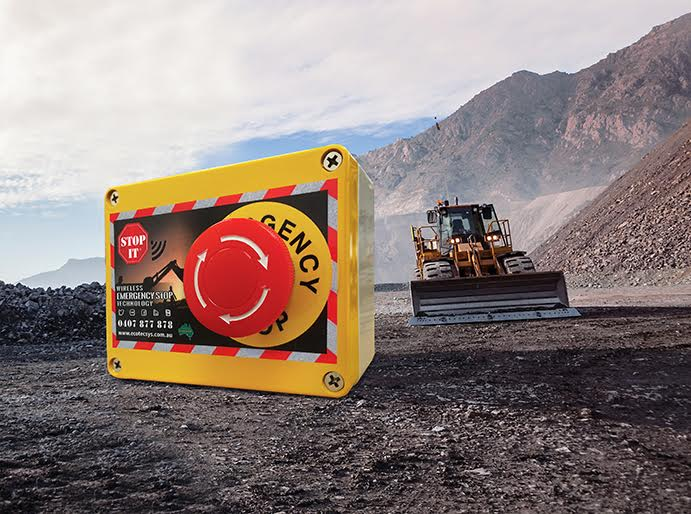
Safety professionals should note that HD’s “E-STOP” naming overlaps with a long-standing industrial safety category. Traditional E-stops (emergency stop buttons) have been a fixture on industrial machinery for decades, using hardware relays (like the NPFSR-K series safety relay) to cut power in emergencies .
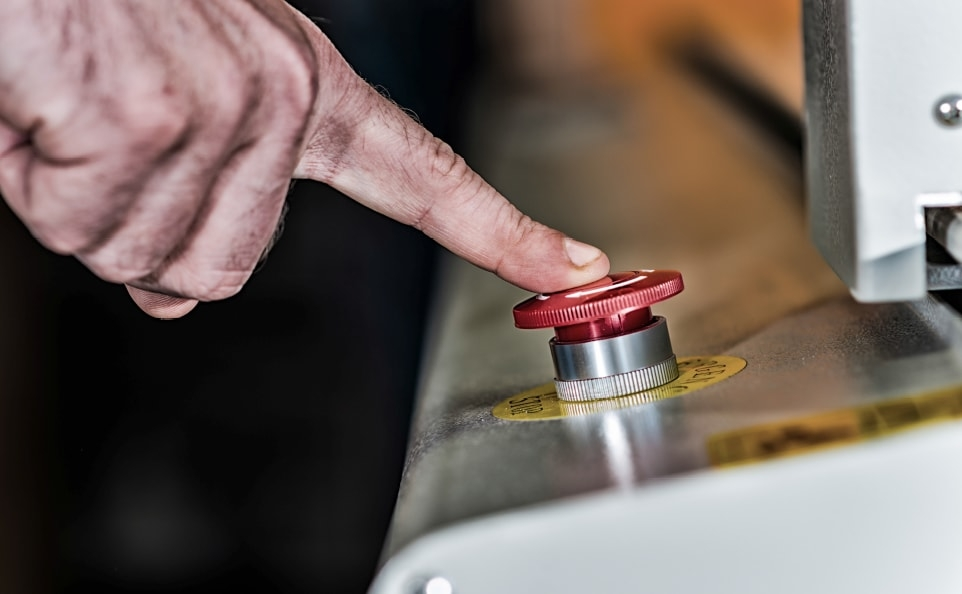
HD’s E-STOP is not a button. It is an AI-driven automation of what a human would otherwise do in response to an emergency. This distinction matters for both safety certification and industry adoption.
Part 2: The Broader Ecosystem – AI Safety Goes Mainstream
E-STOP is not operating in a vacuum. The year 2025 and 2026 have seen a remarkable acceleration in AI-powered construction safety systems across the globe.
2.1 Leica’s Xsight360: 360-Degree Visual Detection
Leica Geosystems, in partnership with AI company Presien, launched Xsight360 in mid-2025 . The system uses up to six ruggedized cameras and an onboard edge AI processor to provide complete situational awareness around any construction machine.
The AI model powering Xsight360 was trained on over 700,000 hours of real-world jobsite operations . It delivers low-latency alerts to operators with minimal false alarms. Video and alert data are uploaded to the cloud, where safety managers can analyze incident patterns, generate heatmaps of dangerous zones, and identify policy violations.
As Neil Williams, President of Leica Geosystems’ Machine Control division, stated: “Ensuring the safety of construction professionals is a top priority, especially as the industry advances towards automation” .
2.2 Caterpillar’s Cat Detect: Alarms for the Ground and Cab
Equipment giant Caterpillar has integrated its Cat Detect system across its machinery line. Using intelligent cameras, the system tracks personnel who approach heavy equipment. As workers enter preset danger zones, escalating alarms activate—both inside the cab to alert the operator and on the exterior to warn workers on the ground .
Balfour Beatty, a London-based infrastructure builder, has deployed Cat Detect on roadside jobsites, where traffic noise can drown out a single audio warning. Multiple alarm points ensure that the message is received.
Jason Sikora, construction manager for Balfour Beatty’s Southeast infrastructure work, emphasized that the human operator remains the final decision-maker: “We want to give the person in that seat all the information we can, and they’re going to make the right choice” .
2.3 Global Innovation: From Geneva to Hong Kong
The 51st International Exhibition of Inventions in Geneva (April 2026) showcased a wave of Chinese and Hong Kong innovations in construction AI safety :
- Hong Kong’s Civil Engineering and Development Department won multiple awards, including a “Judges’ Commendation Gold” for an AI-based landslide warning system with accuracy exceeding 90% (up from 70% for conventional systems).
- Auxface Technology demonstrated a confined space monitoring system integrating AI video recognition, multi-sensor fusion, and edge computing—already deployed in over 100 projects in China’s Greater Bay Area.
- China Construction Third Engineering Bureau won a gold award for its tower crane intelligent centralized control system, enabling ground-based remote operation.
These developments signal that AI safety technology is becoming a global, not regional, phenomenon.
Part 3: Why This Matters – The Shift from Office AI to Frontline AI
3.1 The Productivity-Safety Trade-Off No Longer Exists
Traditional construction safety has often been framed as a trade-off: more safety means slower work, more downtime, and lower productivity. Hoardings, guardrails, spotters, and exclusion zones all cost time and money.
AI-powered active safety systems invert this logic. E-STOP does not require a spotter. Xsight360 does not require an exclusion zone. The machine protects workers while continuing to operate. Safety and productivity are no longer opposites—they are aligned.
3.2 The Operator’s Burden Is Lightened
Heavy equipment operators face an immense cognitive load. They must monitor GPS guidance, watch for ground personnel, track other machinery, maintain awareness of traffic, and execute precise movements—all simultaneously .
AI safety systems act as a second set of eyes that never blink, never get distracted, and never experience fatigue. The operator remains in control and responsible, but the AI provides a safety net that was previously impossible.
3.3 Europe Leads, the World Follows
Europe’s safety regulations are the world’s strictest. Winning an award at SaMoTer and demonstrating technology to the French OPPBTP are significant milestones for any construction technology company .
As HD’s Lim Jung-woo noted: “This award underscores our technological competitiveness in Europe, a key hub for next-generation construction equipment innovation” . Technologies proven in Europe’s demanding environment will inevitably spread to North America, Asia, and beyond.
Part 4: The Road Ahead – What to Expect by 2027-2028
The trajectory is clear. By 2028, AI-powered active safety systems will be standard equipment on most new heavy machinery sold in regulated markets.
Near-term developments include:
- Integration with telematics: E-STOP and similar systems will feed data into fleet management platforms, allowing safety managers to track near-misses and identify high-risk zones across entire job sites.
- Reduced false positives: As training datasets grow (Xsight360’s 700,000 hours is already substantial), AI models will become even more accurate at distinguishing genuine hazards from benign objects.
- Lower costs: As the technology scales, retrofitting existing machines will become affordable for smaller contractors, not just large firms.
The human element remains central. No AI system replaces the judgment of an experienced operator or the vigilance of a safety manager. But these systems provide tools that were unimaginable a decade ago.
Conclusion: The Brakes That Think
The AI emergency braking construction safety E-STOP system is not the first AI safety device, and it will not be the last. But its recognition at a major European exhibition marks a turning point.
Artificial intelligence has left the trailer. It has left the BIM model. It has left the drone control station.
It is now operating in the mud, the dust, and the blind spots—watching, learning, and stopping when necessary.
The machines on tomorrow’s job sites will not just be powerful. They will be thoughtful. And that is a change worth celebrating.
Frequently Asked Questions (FAQ)
What is E-STOP in construction?
E-STOP (Emergency Automated Equipment Stop) is an AI-powered automatic braking system developed by HD Construction Machinery. It uses cameras, radar sensors, and deep learning to detect people in a machine’s operating radius and automatically apply brakes.
How does E-STOP differ from a traditional emergency stop button?
A traditional E-stop button requires a human to press it. E-STOP automates that decision—the machine stops itself when it detects a person in a danger zone, without operator input.
Is E-STOP available for purchase?
HD Construction Machinery has demonstrated the technology on European projects and is actively marketing it following its SaMoTer Innovation Award in May 2026.
What other AI safety systems are on the market?
Leica’s Xsight360 offers 360-degree visual detection with cloud analytics. Caterpillar’s Cat Detect provides zone-based alarms. Numerous Chinese and Hong Kong firms have also developed confined space monitoring and remote operation systems.
Will AI replace construction equipment operators?
No. AI safety systems assist operators by providing a second set of eyes and automatic emergency braking. The operator remains responsible for the machine’s safe operation.
Call to Action (CTA)
Are you a safety manager or equipment operator who has used AI-powered proximity detection? Share your experiences in the comments below. And if you found this article valuable, share it with a colleague who spends their days in the operator’s seat.