Beyond the Boho: The 2026 Rise of “Structural Macramé” in High Fashion
Structural macramé 2026 fashion trend is transforming fiber art from boho wall hangings into architectural clutches, molten textures, and wearable sculpture. Discover why this craft is going luxe.
Introduction: The Knot Evolves
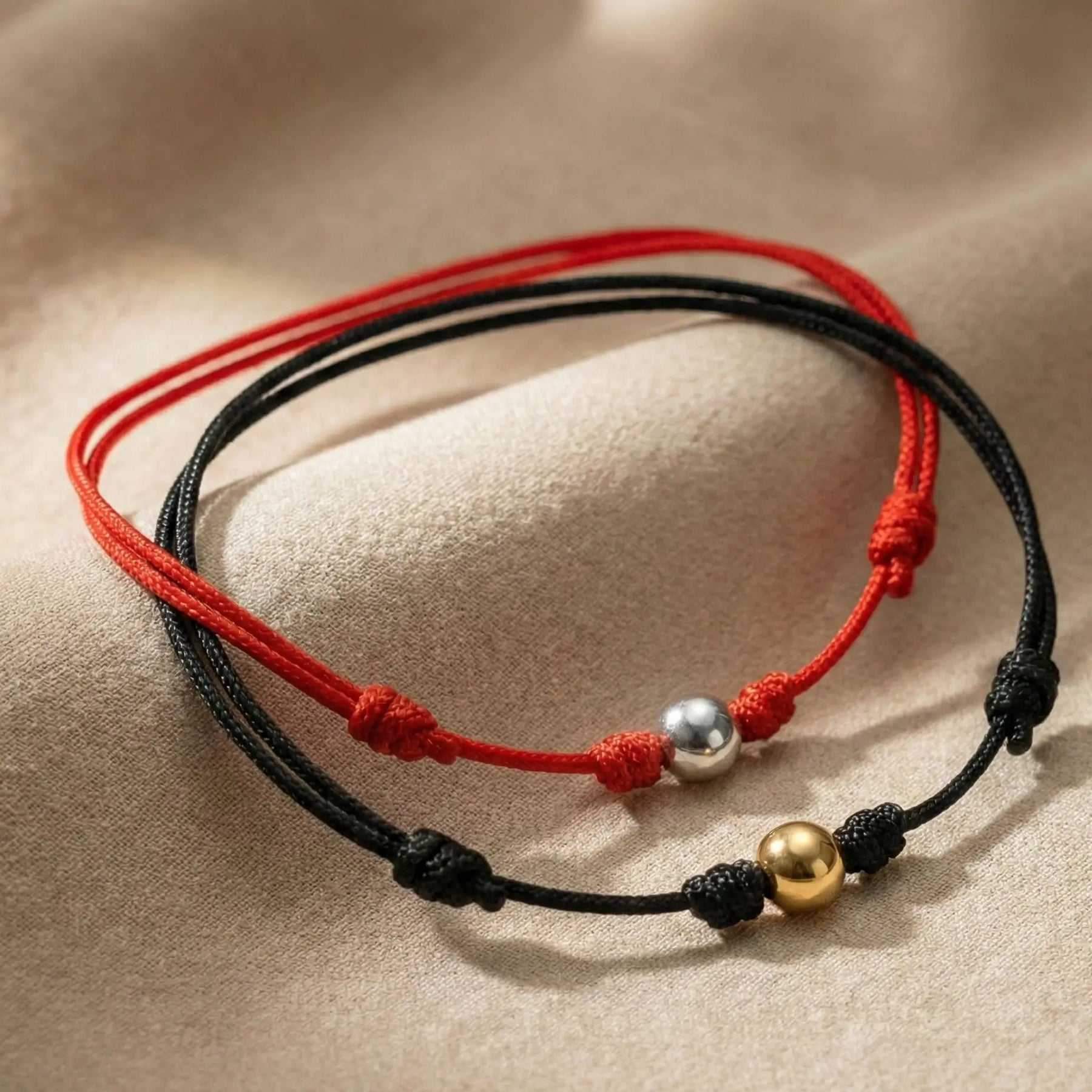
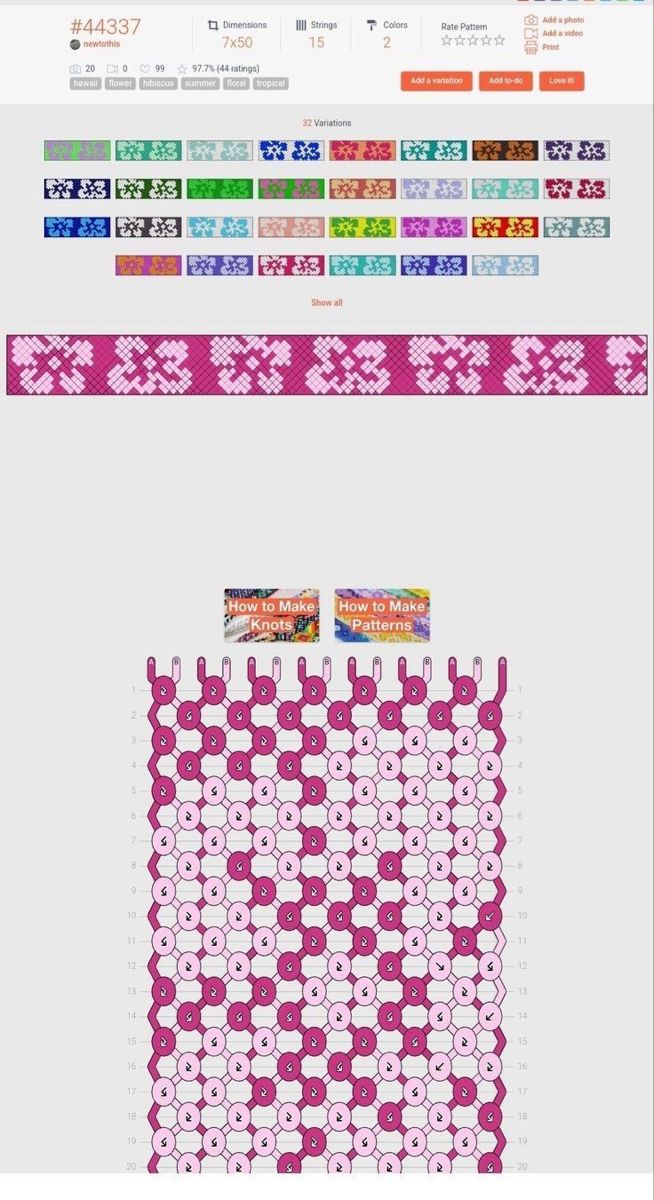
For decades, the word “macramé” conjured specific images: a dusty plant hanger in a 1970s sunroom, a fringed wall hanging at a beachside boho boutique, or perhaps a friendship bracelet made at summer camp. It was craft. It was humble. It was, to be blunt, a bit kitschy.
Not anymore.
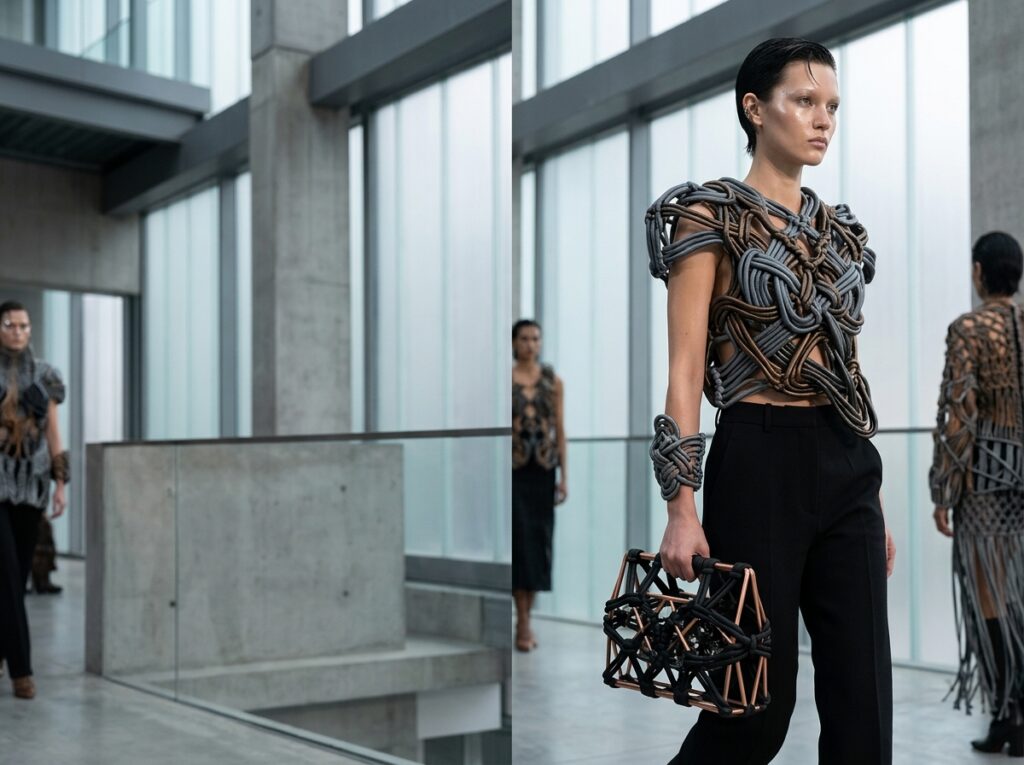
Something extraordinary is happening in the fiber arts world in 2026. Designers are abandoning the flat, decorative “dust-catcher” aesthetic and pushing the ancient craft of knotting into entirely new territory. The result is structural macramé: three-dimensional, architectural, almost molten in texture. Think wearable art that hugs the body like liquid rope. Think handbags that look more like woven sculptures than accessories. Think fiber art that belongs in a gallery, not a dorm room.
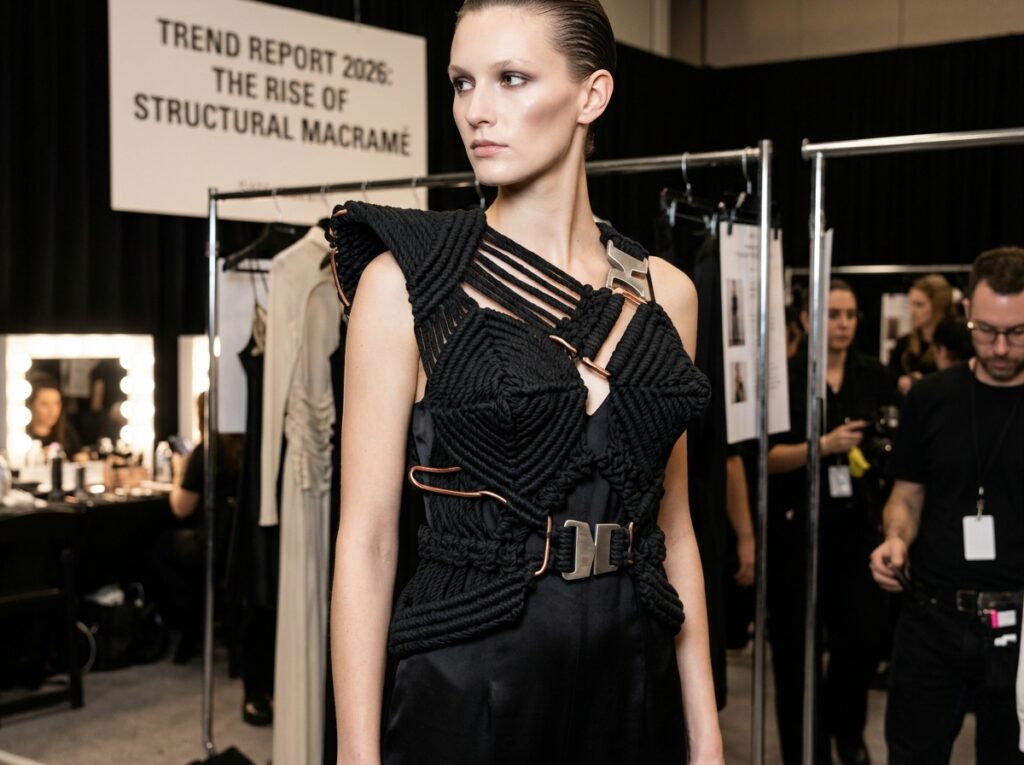
This article explores the structural macramé 2026 fashion trend, the designers driving it, the techniques that make it possible, and why this ancient craft is finally being recognized as a legitimate luxury medium.
Part 1: From Bohemian to Brutalist
1.1 The Old Macramé
Traditional macramé is a textile craft created by knotting cordage rather than weaving or knitting. Its origins are ancient—some scholars trace it back to 13th-century Arab weavers who used decorative knots to finish the edges of woven textiles. The word itself derives from the Turkish makrama (napkin or towel), which came from the Arabic migramah (striped cloth).
Macramé experienced its first major Western revival in the 1970s, when it became synonymous with bohemian, hippie-era decor. Plant hangers. Wall hangings with wooden dowels. Fringed vests. These pieces were charming, handmade, and deeply of their time. But they were also flat, two-dimensional, and often viewed as “craft” rather than “art.”
The problem was not the technique. It was the ambition. Traditional macramé used soft, untreated cotton cords and simple knots (square knots, half hitches, lark’s heads) to create decorative but structurally limited pieces.
1.2 The Structural Revolution
Structural macramé changes everything. Instead of soft cotton, contemporary fiber artists are using waxed linen, dyed hemp, recycled polyester, and even metallic threads. Instead of flat wall hangings, they are building three-dimensional forms that stand upright, drape in curves, and hold their shape without internal armatures.
The difference is like comparing a paper airplane to a fighter jet. Both involve folding. One is a toy. The other is engineered.
Three-dimensional structural macramé involves creating volume through tension, knots, and cord selection rather than relying on internal supports. The result is light, flexible, and surprisingly strong. A structural macramé clutch can hold its shape like leather. A structural macramé top drapes like nothing else in a wardrobe.
Part 2: The Designers Leading the Movement
2.1 Sally England: The Pioneer
If structural macramé has a godmother, it is Sally England. Her oversized, large-scale fiber installations have been exhibited in galleries and public spaces across the United States for years. England’s work is not “craft.” It is monumental.
England’s signature style involves creating massive, textured wall hangings that appear almost geological—like frozen lava or rippled sand dunes. She achieves this through dense clusters of knots, varied cord thicknesses, and a technique she has developed over a decade of experimentation.
Her influence on the 2026 fashion trend is indirect but profound. England proved that macramé could be sculptural, not merely decorative. She opened the door for fashion designers to think of knotted fiber as a structural medium rather than a flat textile.
2.2 Zsofia Kollar: The Material Scientist
For those seeking to push macramé into the realm of speculative design, Zsofia Kollar represents a fascinating parallel. Kollar’s work explores the intersection of biology, material science, and craft.
While Kollar is best known for growing fungal mycelium into mushroom-based leather, her approach to material innovation influences structural macramé designers who are experimenting with unconventional fibers. Her research at the Royal College of Art has inspired a generation of fiber artists to ask: What can we knot with?
2.3 Emerging Fashion Designers
The most exciting developments are happening on runways and in small-batch fashion studios in 2026. New York, London, and Copenhagen have all seen collections featuring:
- Architectural clutches: Handbags made entirely of dense, waxed-linen macramé that hold their shape like a shell. No lining. No internal structure. Just knots.
- Wearable sculpture: Tops and dresses that use macramé to create “molten” textures—rippling, organic forms that seem to flow over the body like liquid.
- Statement jewelry: Oversized necklaces and earrings built from micro-macramé techniques, often incorporating metallic threads and semi-precious beads.
These pieces are not “boho.” They are not “hippie.” They are minimal, architectural, and undeniably luxurious. Price points reflect this shift: a structural macramé clutch from a boutique designer can easily command $500 to $1,500.
Part 3: The Techniques – How Structural Macramé Works
3.1 From 2D to 3D
The transition from flat macramé to three-dimensional forms requires a different approach to knotting. Traditional macramé is worked in rows, similar to weaving. The knots sit in a single plane.
Structural macramé uses:
- Varied cord thicknesses: Thicker cords create volume and shadow. Thinner cords allow for fine detail.
- Directional knotting: Knots are tied at angles to push the piece outward, creating curves and bulges.
- Internal tension: Strategic placement of tight and loose knots creates internal tension that holds three-dimensional shapes.
- Wet-finishing: Some designers dampen finished pieces and mold them around forms to set specific curves, similar to wet-felting.
3.2 The “Molten” Texture
One of the most distinctive aesthetics in 2026 structural macramé is what designers call “molten” texture—rippling, uneven surfaces that resemble cooling lava or melting wax.
This effect is achieved by varying knot density across the piece. Dense clusters of tight knots create raised ridges. Sparse, loose knots create valleys. The contrast between the two produces an organic, almost geological surface that changes dramatically as light moves across it.
3.3 Micro-Macramé for Jewelry
At the smaller end of the spectrum, micro-macramé is fueling a resurgence of knotted jewelry. Using fine threads (waxed linen or polyester) and minuscule knots, designers create intricate, lace-like patterns that are far more delicate than traditional macramé.
Micro-macramé jewelry has the advantage of being lightweight, flexible, and nearly unbreakable. A well-made micro-macramé necklace can be knotted so tightly that it feels almost like woven metal.
Part 4: Why Now – The Cultural Shift
4.1 Rejection of Fast Fashion
The rise of structural macramé aligns with broader consumer trends in 2026. Shoppers are increasingly rejecting disposable fast fashion in favor of handmade, durable, and meaningful pieces. Macramé, by its nature, is slow. A single structural clutch might require 20 to 40 hours of knotting. That is not mass production. That is craft.
4.2 The Texture Imperative
After years of minimalist, clean-lined fashion, consumers are craving texture. Structural macramé delivers texture in abundance. The play of light on knotted surfaces, the shadows cast by three-dimensional forms, the tactile pleasure of running a hand over a “molten” surface—these are experiences that flat textiles cannot provide.
4.3 Sustainability and Natural Fibers
Structural macramé designers are increasingly using natural, biodegradable fibers such as undyed hemp, organic cotton, and linen. As the fashion industry confronts its plastic pollution problem (synthetic textiles shed microplastics with every wash), knotted natural fibers offer a genuinely sustainable alternative.
A structural macramé bag contains no plastic. No synthetic lining. No metal zippers (designers use knot-and-loop closures). At the end of its life, it can be composted or untwisted and the fibers reused.
4.4 Social Media and the “Satisfying” Aesthetic
The knotting process itself is deeply satisfying to watch—and social media platforms have taken notice. Time-lapse videos of complex macramé pieces taking shape generate millions of views. The rhythm of the knots, the gradual emergence of form, the final reveal of a three-dimensional object—it is visual ASMR.
This online visibility has introduced structural macramé to a new generation of makers and buyers who might never have encountered the craft otherwise.
Part 5: How to Wear Structural Macramé in 2026
5.1 As a Statement Piece
Structural macramé is not subtle. A “molten” texture top or an architectural clutch is a conversation starter. The key to wearing it is to keep everything else minimal.
- Pair a structural macramé top with: Simple trousers (linen or cotton), minimal jewelry, flat sandals or clean sneakers.
- Pair a structural macramé clutch with: A solid-colored dress or jumpsuit. Let the bag be the focal point.
5.2 Layering
Because structural macramé has texture and volume, it layers beautifully over simpler pieces. A loose-knit macramé vest over a silk slip dress. A structural open-weave shawl over a turtleneck and jeans.
5.3 Dressing Up
Waxed linen and metallic-thread macramé can absolutely be formal. An architectural clutch in black waxed linen is evening-appropriate. A micro-macramé necklace with gold threads elevates a simple black dress.
Part 6: The Future – What Comes Next
6.1 Digital Design and CNC Knotting
The next frontier for structural macramé is computer-assisted design. Researchers and designers are exploring CNC (computer numerical control) knotting machines that can execute complex knot patterns with precision. While handmade pieces will always have a market, digital fabrication could make structural macramé more accessible and consistent.
6.2 Smart Textiles
Could knotted fibers carry electrical signals? Researchers are experimenting with conductive threads in macramé structures, opening possibilities for wearable technology embedded in knotted forms. A structural macramé bracelet that monitors heart rate. A clutch that wirelessly charges your phone.
6.3 Large-Scale Architectural Applications
If structural macramé works for handbags and tops, why not for furniture and architecture? Designers are already experimenting with knotted room dividers, lamp shades, and seating that use the same three-dimensional techniques. The lightweight strength of knotted structures makes them ideal for tension-based architectural elements.
Conclusion: The Knot That Refuses to Stay Humble
The structural macramé 2026 fashion trend represents something more than a seasonal style shift. It is a rebrand of an ancient craft. It is a rejection of the false divide between “art” and “craft.” It is a celebration of handmade objects in an increasingly automated world.
The plant hangers and wall hangings are not going away. But they have company now—company that is architectural, sculptural, and unapologetically luxurious.
Macramé has left the sunroom. It is walking the runway.
Frequently Asked Questions (FAQ)
What is structural macramé?
Structural macramé is a three-dimensional approach to the ancient craft of knotting cordage. Unlike traditional flat macramé (wall hangings, plant hangers), structural macramé creates volume, curves, and self-supporting forms using varied cord thicknesses, directional knotting, and internal tension.
How is structural macramé different from traditional macramé?
Traditional macramé uses soft cotton cords and simple knots to create flat, decorative pieces. Structural macramé uses stiffer fibers (waxed linen, metallic threads), advanced knotting techniques, and intentional tension to create three-dimensional, architectural forms.
Is structural macramé durable?
Yes. High-quality structural macramé, especially pieces made with waxed linen or polyester cords, is extremely durable, flexible, and resistant to stretching. Some designers claim their clutches and bags are stronger than comparable leather pieces.
How do I care for structural macramé?
Most structural macramé should be spot-cleaned with a damp cloth. Do not machine wash. Avoid soaking, as wet fibers can stretch or lose their shape. Some designers offer re-tensioning services for high-end pieces.
Where can I buy structural macramé accessories?
Look for independent fiber artists on platforms like Etsy, specialized craft fairs, and boutique fashion websites. Major luxury brands are beginning to take notice, but the most innovative work is still coming from small-scale makers.
Call to Action (CTA)
Have you seen structural macramé on a runway or in a boutique? Are you a fiber artist experimenting with 3D knotting? Share your thoughts and creations in the comments below. And if you found this article valuable, share it with someone who still thinks macramé is just for plant hangers.