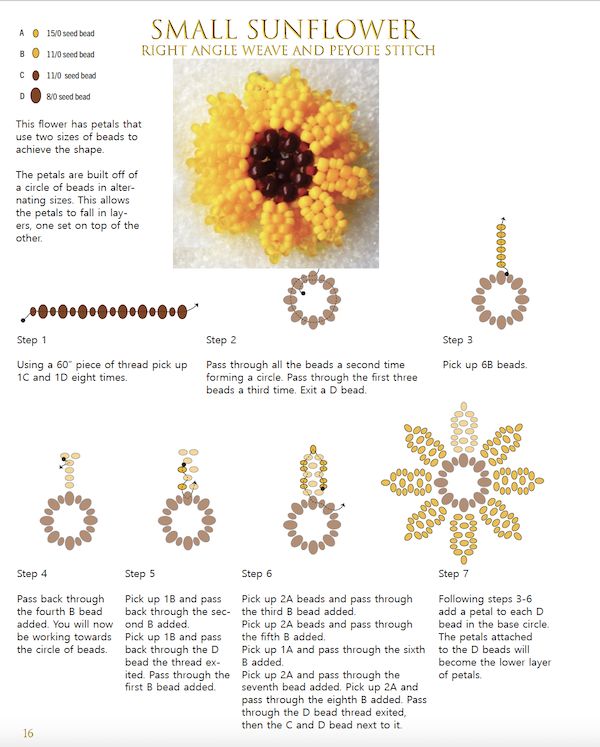
Small Sunflower Beaded Flower: Right Angle Weave & Peyote Stitch Tutorial

This beautiful Small Sunflower design combines two fundamental bead-weaving techniques: Right Angle Weave (RAW) for the structured base circle, and Peyote Stitch for the layered petals. By using three different bead sizes (15/0, 11/0, and 8/0), the petals naturally fall into two layers — one set on top of the other — creating a dimensional, lifelike flower.

Small Sunflower Beaded Flower: Right Angle Weave & Peyote Stitch Tutorial

In this guide, you will learn:

  • The full meaning of each step in the process
  • Step-by-step instructions for the base circle and petals
  • How to use three bead sizes (A, B, C, D) to achieve the layered effect
  • Right Angle Weave and Peyote Stitch techniques

Why Make a Beaded Sunflower?

BenefitExplanation
DimensionalTwo layers of petals create depth and realism
Uses multiple bead sizes15/0, 11/0, and 8/0 beads work together
Combines two stitchesLearn RAW and Peyote in one project
VersatileUse as a pendant, earring component, brooch, or embellishment
Stunning resultA miniature sunflower that sparkles

Part 1: Materials & Bead Sizes

Bead Key

Bead CodeSizeColor (Example)Role
A15/0SmallestPetal tips / upper layer
B11/0MediumPetal bodies
C11/0Medium (contrast)Base circle filler
D8/0LargestBase circle anchors / petal attachment points

Note: In your diagram, A and B are both 11/0? Let me clarify based on the text:

CodeSize from TextRole
A15/0Smallest bead (petal tips)
B11/0Medium bead (petal bodies)
C11/0Medium bead (base circle filler)
D8/0Largest bead (base circle anchors)

Complete Materials List

MaterialSpecificationQuantity
Seed beads A15/0Approximately 50–60
Seed beads B11/0Approximately 50–60
Seed beads C11/0 (contrasting color)8 beads
Seed beads D8/08 beads
Beading threadNylon (Nymo, FireLine, or Wildfire)60 inches (152 cm)
Beading needleSize 12 or 13Very fine for 15/0 beads
ScissorsSharpFor cutting thread

Color Suggestions for Sunflower

Bead CodeTraditional SunflowerPurple Artisanal Version
A (15/0)Dark brown (center)Deep purple
B (11/0)Yellow / goldLavender
C (11/0)Yellow / gold (contrast)Light purple
D (8/0)Dark brown (base)Eggplant

Part 2: Understanding the Structure

The Base Circle

The base circle uses alternating sizes of beads: C (11/0) and D (8/0) repeated 8 times.

| Pattern | 1C + 1D repeated 8 times = 16 beads total |
| Order | C, D, C, D, C, D, C, D, C, D, C, D, C, D, C, D |

The Petals

Each petal attaches to a D bead (the larger 8/0 beads) in the base circle. The petals use B (11/0) and A (15/0) beads.

  • Lower layer of petals: Attached to D beads
  • Upper layer of petals: Created by the staggered arrangement

Why Alternating Sizes?

EffectExplanation
Creates anchor pointsLarger D beads give the thread a place to exit and enter
Allows layeringPetals attached to D beads sit at different heights
Provides structureThe alternating sizes lock the base circle in place

Part 3: Step-by-Step Instructions

Step 1: Create the Base Circle

ActionDetail
Using a 60-inch piece of threadCut approximately 152 cm
Pick up 1C and 1D eight timesAlternate: C, D, C, D, C, D, C, D, C, D, C, D, C, D, C, D
Total beads16 beads on the needle

Result: A line of 16 alternating beads.

Step 2: Form the Circle (First Pass)

ActionDetail
Pass through all the beads a second timeGo through the entire circle again
This reinforces the baseCreates a stable ring

Step 3: Reinforce and Exit at a D Bead

ActionDetail
Pass through the first three beads a third timeThis locks the circle
Exit a D beadYour needle should be coming out of a large (8/0) bead

Result: A tight circle of alternating C and D beads, with thread exiting a D bead, ready to begin the first petal.

Step 4: Begin the First Petal

ActionDetail
Pick up 6 B beads (11/0)These form the main body of the petal
Pass back through the fourth B bead addedCount: 1, 2, 3, 4 → go back through the 4th bead

Result: The B beads form a loop that will become the petal shape.

Step 5: Add the Petal Point

ActionDetail
Pick up 2 A beads (15/0)These are the smallest beads — the petal tip
Pass through the third B bead added (the one right next to where you just exited)Connect the tip to the petal body

Result: The petal now has a pointed tip made of 2 tiny A beads.

Step 6: Continue Building the Petal

ActionDetail
Pick up 2 A beads (15/0)Another pair for the other side
Pass through the fifth B bead addedThe other side of the petal

Result: The petal is now symmetrical, with A bead tips on both sides.

Step 7: Complete the Petal and Move to Next D Bead

ActionDetail
Pick up 1 A bead (15/0)Center tip of the petal
Pass through the sixth B bead addedComplete the top of the petal
Pass through the D bead the thread exitedReturn to the base circle
Then pass through the C and D bead next to itMove to the next D bead for the next petal

Result: One complete petal attached to a D bead, and your thread is now positioned at the next D bead.


Part 4: The Repeat Pattern

Steps 3–6 Repeated for Each D Bead

StepAction
3Exit a D bead
4Pick up 6 B, pass back through 4th B
5Pick up 2 A, pass through 3rd B
6Pick up 2 A, pass through 5th B
7Pick up 1 A, pass through 6th B, then through D, C, D to next D

How Many Petals?

| Base circle has | 8 D beads |
| Each D bead gets | 1 petal |
| Total petals | 8 petals |

The petals attached to the D beads become the lower layer of petals. The alternating arrangement creates the upper layer naturally.


Part 5: Understanding Right Angle Weave (RAW) in This Project

Right Angle Weave is used in Steps 1–3 to create the base circle.

RAW PrincipleHow It Applies Here
Beads form right anglesEach C and D bead sits at 90° to its neighbors
Thread passes through beads multiple timesYou go through the circle 2–3 times to lock it
Creates a flexible, structured basePerfect for attaching petals

Part 6: Understanding Peyote Stitch in This Project

Peyote stitch is used in Steps 4–7 to create the petals.

Peyote PrincipleHow It Applies Here
Beads are staggeredEach row of beads sits in the gaps of the previous row
Creates a flat, even surfaceThe petal lies flat and symmetrical
Perfect for petal shapesYou can add decreases (fewer beads) at the tip

In this petal:

  • Base of petal: wider (6 B beads)
  • Middle: tapers with A beads
  • Tip: pointed (single A bead)

Part 7: Visual Summary of the Petal

Petal Bead Structure

                    ● (1 A bead - tip)
                   / \
                  ●   ● (2 A beads)
                 /     \
                ●       ● (2 A beads)
               /         \
              ●           ●
              ●           ● (B beads)
              ●           ●
               \         /
                ●       ●
                 \     /
                  ●   ●
                   \ /
                    ● (attachment to D bead)

Bead Count per Petal

Bead CodeQuantity per PetalTotal for 8 Petals
B (11/0)648
A (15/0)2+2+1 = 540

Part 8: Finishing the Flower

Step 8 — Secure the Thread

ActionDetail
After the 8th petalWeave the thread back through several beads
Pass through the base circleIn both directions
Tie a surgeon’s knotBetween beads (invisible)
Weave through 5–6 more beadsTo hide the tail
Trim close to the beadBe careful not to cut the thread holding the flower together

Step 9 — Attach Findings (Optional)

UseAttachment
PendantAdd a bail to the back of the flower
EarringAttach an earwire to one petal or the center
BroochGlue or sew a pin back to the reverse side
Bracelet embellishmentSew the flower onto a beaded or leather bracelet base

Part 9: Common Mistakes & Fixes

MistakeCauseFix
Base circle is wobblyDid not pass through beads enough timesGo through the circle 2–3 times before adding petals
Petals point in wrong directionExited the wrong side of the D beadAlways exit the D bead from the same side for consistent petal direction
Petals are unevenInconsistent tensionPull each petal with the same firmness
15/0 beads are hard to seeTiny size!Use good lighting and magnification (reading glasses or beading loupe)
Thread breaksTension too tight or old threadUse fresh thread; loosen tension slightly
Needle won’t pass through 15/0 beadsNeedle too largeUse a size 12 or 13 beading needle
Petals don’t layerD beads not sitting correctlyCheck that your base circle alternates C/D correctly

Part 10: Design Variations

VariationChangeEffect
Larger flowerAdd more C/D pairs (e.g., 10 instead of 8)More petals, larger flower
Different colorsChange B and A bead colorsDaisy, rose, or fantasy flower
Center beadAdd a focal bead in the middleEmbellished center
Smaller petalsUse fewer B beads (e.g., 4 instead of 6)Delicate, smaller petals
Longer petalsUse more B beads (e.g., 8 instead of 6)Elongated sunflower petals

SEO Blog Post Optimization

Meta TagSuggested Content
TitleSmall Sunflower Beaded Flower: Right Angle Weave & Peyote Stitch Tutorial
Meta DescriptionLearn to make a small sunflower with 15/0, 11/0, and 8/0 seed beads using Right Angle Weave and Peyote stitch. Step-by-step instructions.
URL slug/small-sunflower-beaded-flower-tutorial
Keywordsbeaded sunflower, right angle weave, peyote stitch flower, 15/0 seed beads, 11/0 seed beads, 8/0 seed beads, beaded flower tutorial
Alt text for imageSmall sunflower beaded flower tutorial showing Right Angle Weave base circle with alternating C (11/0) and D (8/0) beads, and Peyote stitch petals using B (11/0) and A (15/0) beads

Final Pro Tip: Work with a Thread Conditioner

15/0 beads have very small holes, and thread can fray or snag. Use a thread conditioner (like Thread Heaven or beeswax) to strengthen and lubricate your thread. This will make passing through tiny beads much easier and prevent breakage.


Summary: You Can Now Make a Beaded Sunflower

StepTechniqueSkill Learned
1–3Right Angle Weave (RAW)Create an alternating C/D base circle
4–5Peyote stitchBuild the petal body with B beads
6Peyote stitch (decrease)Add the petal tip with A beads
7WeavingMove between D beads to attach all 8 petals

This beautiful sunflower can be used as a pendant, earring, brooch, or embellishment. Once you master the pattern, experiment with different colors and bead sizes to create a whole garden of beaded flowers.